SpaceComputer 2026 - The Road Ahead
2025 was a remarkable year for aerospace.
- SpaceX valuation at the beginning of the year was rumoured to be an already impressive figure of $400B, by the end of the same year estimates of close to $800B were circulating with a widely anticipated >$1T IPO in 2026.
- Space Data Centres emerged as a technology discussed in mainstream media with StarCloud’s launch of the Nvidia H100.
- Many smaller and bigger tech players are now either actively taking steps to start exploring space computing or following it closely with anticipation for the space sector to become a critical part of the modern internet and AI compute stack.
At SpaceComputer, we’re a team building secure space computing technologies. From the inside, the current atmosphere among space builders resembles a lot the exhilarating feeling I witnessed from peers building in AI in the year 2015: This tech will imminently become widely adopted.
So where does the aerospace renaissance place SpaceComputer?
The two defining characteristics of SpaceComputer are:
- Secure Compute Platform
- Space Native Decentralized Application Platform
What are the value propositions in these two pillars?
- Secure Space Computing: While there is growing interest in Space-Based Data Centres and space technologies in general, much of the focus is on harvesting free solar energy, communicating with remote regions, or processing strategically valuable visual data. These unique benefits of space all merit the excitement, at the same time, space cybersecurity is somewhat overlooked in the heat of the enthusiasm.
At SpaceComputer, we design hardware and software that addresses the need to handle sensitive applications with a high degree of security.
- Hardware - Physical Security - In space, it is physically impossible to tamper with a satellite without being noticed. This makes the Space Fabric, with the TEE hardware we’re integrating a first of its kind Trusted Execution Environment integrated chipset.
- Software Isolation and Cryptographic Security - Compute execution on SpaceComputer’s satellites will be cryptographically secured. This is achieved by forming state consensus among satellites that together form a constellation of nodes. These are the very same principles that provide security to Bitcoin, Ethereum and other public blockchain networks.
- Attestation - Beyond executing the logic with SpaceComputer’s unique integrated hardware and software stack, it must be verifiable. For this, we have designed our own protocol, which can provide guarantees that our infrastructure truly runs in space without needing to rely on SpaceComputer completely.
Imagine this as the infrastructure that provides the “https for space compute.” With more and more applications getting deployed on space-based compute platforms in AI, communication, imaging and more, security is paramount.
- Space Native Application Platform
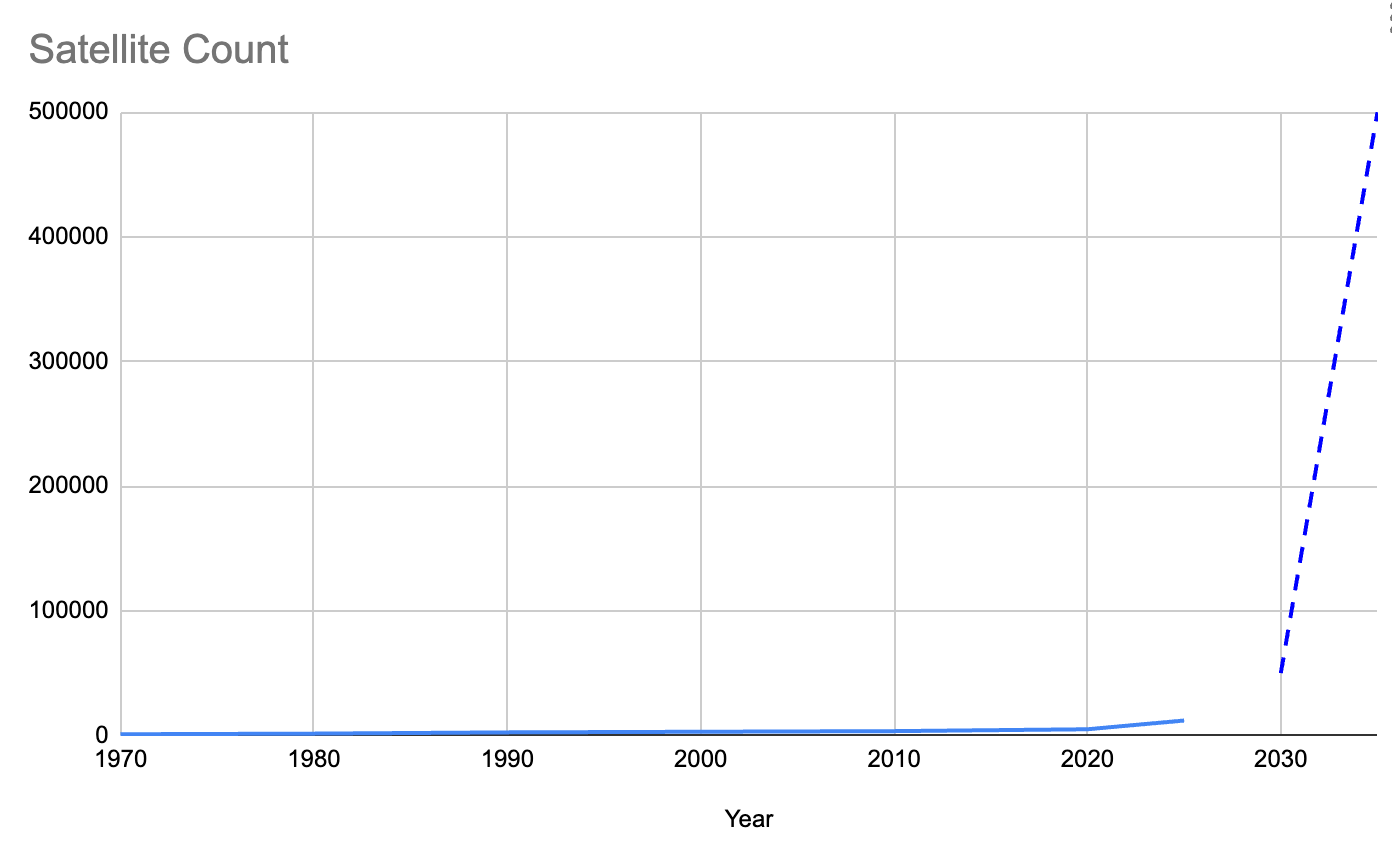
As of today, the majority of the active satellites in orbit are part of SpaceX’s Starlink constellation. The user count of Starlink doubled from 4.5 to 9 million in 2025 alone and there are currently more than 20 constellation projects either in planning or in early deployment stages. Based on these figures alone, the projected satellite count is expected to increase from 10k to 500k!
The space sector is evidently in its early incubation phase of the exponential growth curve.
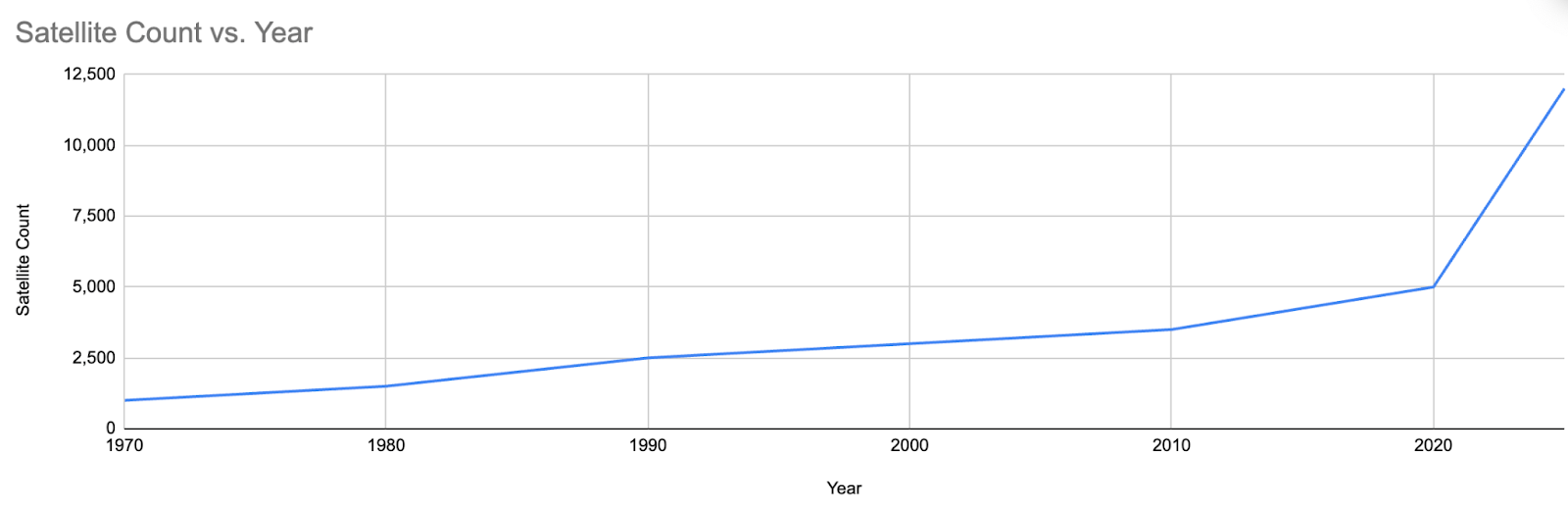
Looking at the projected satellite count, the space sector is anticipating a 15x growth in satellite count within a decade. Space computing is quickly becoming bedrock for modern digital economies. The early use cases that have demonstrated market appetites are communication and imaging; the notable examples are Starlink’s YoY growth at 2x and Planet Labs track record of serving gov and private sector critical data for supply chains or geopolitical strategy. However, the AI boom indicates space computing will be serving this sector sooner or later and more domains will emerge to be services as the industry develops.
SpaceComputer Vision - Layer 1 Blockchain Constellation
The rise of the internet pushed the world’s commerce into the interconnected digital realm. In recent years, archaic, fragmented and laggy financial systems of decades past is disrupted with tokenization technologies; DeFi and Stablecoins are prime use cases. The space sector is humanity’s literal frontier and we anticipate that the economy on the internet as we know it will become fully embedded into space based systems.
As cryptography and security for the financial systems evolve, as do their unique needs and architectures. Part of this evolution is the migration of critical infrastructure to space, where they will enable accessibility by all people on earth and by space native systems.
With more critical infrastructure anticipated migration to space, settlement and smart contracts are going to become increasingly important for the space native economy. Whether it is for space based data centres running AI, satellites dedicated to imaging, communication or other satellite services. SpaceComputer is aiming to build a space native free market tokenization platform for satellite services and high security guarantees for Earth-based tokenization services through direct-to-satellite (D2S) connectivity.
Space Connectivity
Much like mobile internet connectivity, most modern electronic systems will incorporate space connectivity terminals. This will remove the dependency on localized network and compute providers such as telcos and ISPs, this will all inevitably turn into relics of the past like localized media did.
The space native economy is the international economy.
A quick recap of what SpaceComputer achieved in 2025:
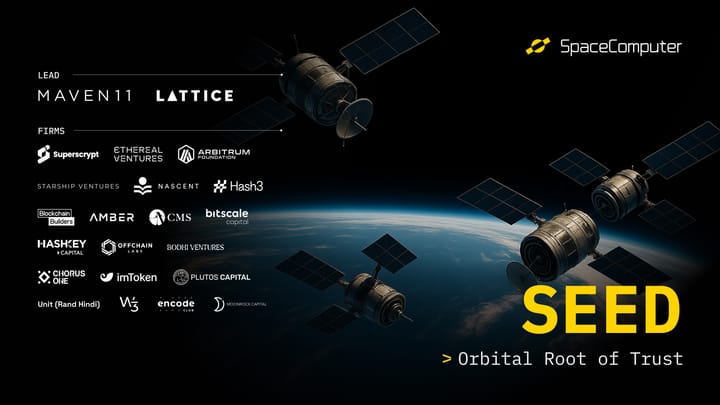
- Raised seed funding, bringing our total funds raised to $10m.
- Built a strong engineering team
- Ramped up R&D across both the hardware and software stacks
- Satellite-based consensus research
- TEE research and integration with the satellite architecture and software stack - Space Fabric
- Satellite mission planning and hardware integration
- Unique technical features of security services e.g., KMS, cTRNG, and others enabled by Orbitport.
- Formed partnerships across hardware and software
- EigenDA for L2 stack
- Aptos Orbital
- UCSB Center of Distributed Systems
- Started deploying core infrastructure and initial applications
- Orbitport as a gateway to space computing
- cTRNG as first application
SpaceComputer 2026 Forecast
Satellite hardware
The first SpaceComputer-specific secure compute hardware called Space Fabric is currently under final stages of integration and testing before proceeding to aerospace tests in prep for rocket launch, mission control, and operation.
→ More updates in Q1/Q2 2026.
Orbitport: trust-minimized space compute gateway
Over the past year, we’ve developed Orbitport to serve as a trust-minimized interface to connect Earth-based applications to space-based compute resources.
Orbitport serves as the interface for users on Earth to interact with available security services e.g., cosmic true random generator or KMS, and will be extended in the future for deployments by other parties.
Current supporting solutions focus on randomness, where we provide random beacons for consumption and are integrating them with an oracle partner for smart contract usage. The next step is to extend the capabilities to private beacons.
Overall, the design fits production use cases like secure keys generation, nonces, simulations, and blockchain oracles, with client-side verification.
In 2026, we will actively work on growing Orbitport’s capabilities, starting with running Orbitport in a TEE in early Q1. This will make it trust-minimized and enable new use cases, such as private beacons, which we aim to offer by the end of Q1. For the production usage, users can expend consumption of space randomness on-chain, too. Testnet of on-chain randomness will be available in Q1 and production ready plan is for Q2 once we go through required audits.
An important aspect for us is to ensure the user can verify the randomness source and randomness quality itself. For both, we are working on detailed documentation highlighting our approaches. In the future, Orbitport should be operated without exclusivity to us by other partners. Currently we are in contact with several partners who are good fit to run Orbitport in a permissioned setting and interact with the space infrastructure by the end of the year.
Security Services: Space Grade Security Guarantees
There are unique primitives built using secure hardware in space. These primitives together will form the building blocks with which applications are built using the SpaceComputer.
- Cosmic True Random Number Generator (cTRNG)
Using secure hardware to harvest cosmic radiation as a source of entropy for a randomness beacon available on IPFS. - Confidential computing
Key Management Systems (KMS) is an important part of financial stack and data security critical applications, separation of sensitive compute instances from much of what is classified as standard operations (e.g. secure key storage and recovery vs data indexing to serve front ends). For the KMS, we will initially target single node deployment with a TEE, while expecting to expand from single node capabilities by multi-party computation protocols for mitigation of a single point of failure and solution centralization. - As we operate in space we observe communication constraints, for which we will focus on deployments of ZK proofs for succinctness features.
These fundamental security services will be offered as solutions to our partners and will be available already at the single satellite level. Moving forward and ideally already this year, we plan to run them between a number of satellites and in a hybrid setting of on-Earth and space deployments. Importantly, even though they serve as external facing solutions, we plan to dogfood them for SpaceComputer’s L1/L2 architecture stack, customized for the needs of space native deployments.
This brings us to SpaceComputer’s blockchain architecture.
Two-tier architecture
Following the Blue Paper outline, through 2025, the team has been grinding R&D of the Blockchain stack components:
Orbital L1
The orbital layer serves as the orbital root of trust. It runs as a protocol client aboard our satellite Space Fabric nodes. This protection from the physical access threat model is unique to SpaceComputer: Physically isolated environment in space provides the highest security guarantees as required for finality, tamper-resistance primitives (e.g. security services), and external networks state checkpointing. All of this should be programmable using smart contract capabilities.
As we’re approaching the Lunar Slingshot phase of development, the SpaceTEE testbed will be ready using HW components corresponding to actual satellites. Hands-on experience targeted for Q2 for private groups (reach out if you’re interested to enlist for access!). The hardware will be used in the future for Space Fabric, which details we plan to publish in Q1 along with initial devkit. Space Fabric components will be available in broader testing after October 2026, once our launch and orbital commissioning is completed.
Uncelestial L2
SpaceComputer’s Uncelestial L2 is the high-performance execution layer for throughput-heavy tasks, bridged to the Celestial L1 for security,verifiability, and finality. The Uncelestial L2 is built to satisfy the performance required by modern blockchain applications on Earth. This provides similar utility as L2 on top of Ethereum or other networks: Greater performance on top of the Orbital L1 enabled by ZK/Optimistic rollup technology and DA offloading using our partnership with Eigen. The initial integration of consensus and execution should be available in Q2 for on-Earth devnet.
In summary, 2025 was the year space turned from a distant backdrop into a part of the fabric of the internet and the global economy. SpaceComputer is building a secure, space-native infrastructure for everyone. As hundreds of thousands of satellites come online over the next decade, our mission is to turn space into a trustworthy commons where humanity can build the next generation of open, resilient systems that are not bound by borders!
Keep your antenna up for signals soon!
Join the public Telegram chat and get involved today!
- LinkedIn: linkedin.com/company/spacecomputer
- X: @SpaceComputerIO
- YouTube: youtube.com/@SpaceComputerIO