Dahlia's Network Effect
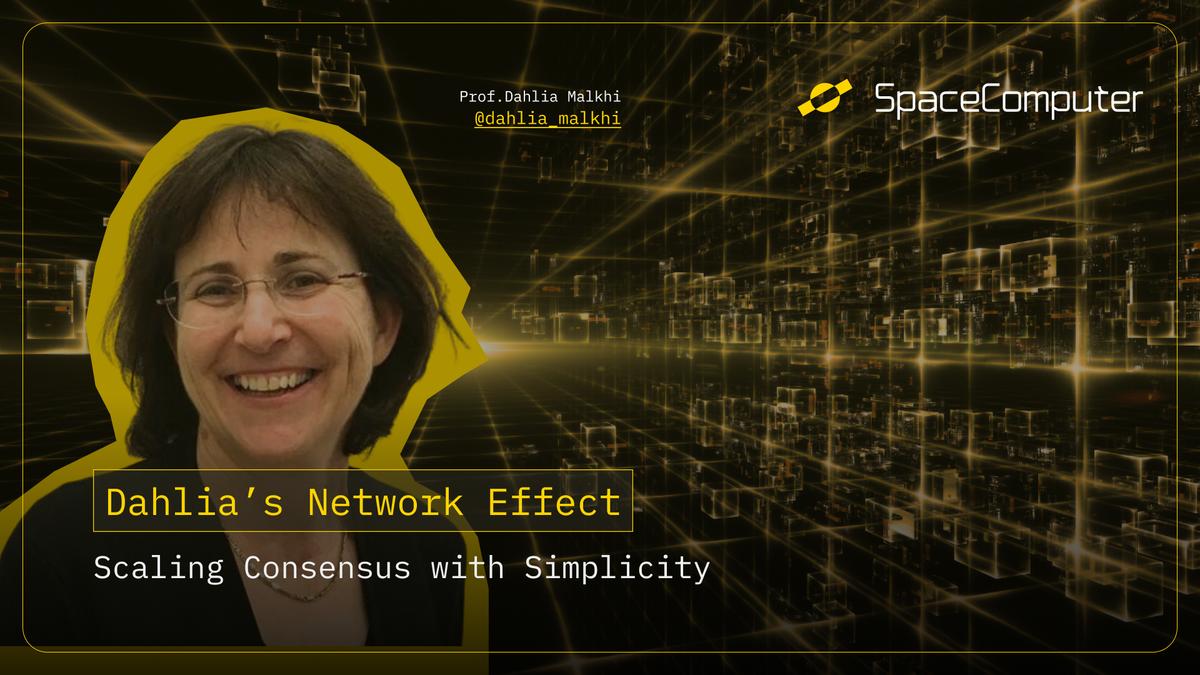
Building consensus protocols that global decentralized systems depend on is no easy feat. From her PhD in Computer Science to HotStuff to Facebook’s Libra (Diem), SpaceComputer Research Coordinator Dr. Dahlia Malkhi’s career demonstrates that breakthroughs are forged by teamwork - not on solo geniuses - and why that matters as consensus moves beyond the cloud into orbit.
The Beginning: Academia and Distributed Systems
Consensus is the foundation of every distributed system. It’s how computers, separated by geography and trust, agree on what’s true. For decades, it has been the collaborative effort of computer scientists to continue evolving and improving state-of-the-art distributed systems.
Malkhi was interested in the field of distributed systems from the beginning of her career, long before blockchain or Web3 existed as concepts. After her PhD at the Hebrew University of Jerusalem, Malkhi’s interest spurred her to work with some of the greatest scientists of all time.
Of note, at the Hebrew University, an unexpected cross-disciplinary collaboration was forged. Working jointly with Noam Nisan, a pioneer in complexity theory and inventor of algorithmic game theory, Benny Pinkas, a renowned cryptography expert, and Yaron Sella, Malkhi’s then PhD student, they developed the Fairplay system. It combined practical research with theory in advancing the state-of-art Secure Multi-Party Computation (SMPC).
SMPC is a foundational cryptographic protocol that allows multiple parties to collaboratively compute a function without revealing their inputs to one another.
Fairplay was the first ever usable SMPC system, and led to generations of real-life circuit-based applied cryptography, including zero-knowledge proofs (ZKPs), and fully homomorphic encryption (FHE).
Fairplay is but one example, along with many other pioneering works in distributed systems and security, that constitute the foundation of how the cryptocurrencies we use today function.
So how did cryptocurrency enter the distributed systems picture?
Malkhi’s short answer:
“Distributed systems experts did not get into cryptocurrencies, cryptocurrencies got into our space.”
Marc Andreessen Gets It Wrong.
The next chapter in Malkhi's career was as a Principal Researcher at Microsoft. Towards the end of her time there, Malkhi and her colleagues noticed cryptocurrency - particularly Bitcoin - was rising popularity after the Whitepaper publication in 2008.
Malkhi can still remember the day when she and all the researchers at Microsoft read the article Why Bitcoin Matters by Marc Andreessen in the New York Times (2014) that stated Bitcoin solves the Byzantine Generals Problem.
“And we were like… no… it didn't.”
To Malkhi and other experts in the field, Bitcoin didn’t so much ‘solve’ the Byzantine Generals Problem, but instead brought up new questions: What does the Bitcoin core algorithm known as Nakamoto Consensus guarantee? Under what assumptions? And how could those guarantees be made stronger, simpler, and more efficient?
To put these questions in context, we need to return to the pioneering works of the field. Over the course of the previous decade at Microsoft, Malkhi had collaborated with Leslie Lamport, the Turing Award winner behind Paxos and the author of Specifying Systems. His research focus was Byzantine Fault Tolerance (BFT), the idea that distributed systems can still reach agreement even if some components act maliciously or fail. This challenge was famously modelled in the Byzantine Generals Problem (Lamport, 1982).
Bitcoin's Nakamoto Consensus didn't solve the Byzantine Generals Problem. What Bitcoin did solve was the ability to globally scale distributed systems and overcome the double spend problem by creating an economic incentive to collectively maintain a global ledger of who owns the value of that digital currency (e.g., DigiCash and Mondex). Securing this behaviour requires increasingly large investment of work (e.g., compute, power), and creates a large imbalance.
In contrast, in the classical settings, a Byzantine Quorum (a super majority) of parties is authorized to drive consensus by having authority or stake in a collective. This concept was first introduced by Malkhi and Michael Reiter in 1996 in the famous paper Byzantine Quorum Systems. Being able to scale quorum-based consensus drove years of research, which culminated with HotStuff.
Casper the Friendly Ghost Faces Hotstuff the Little Devil
HotStuff started taking shape when the VMware Research Group (VRG), was co-founded by Malkhi and her colleagues in 2014. Together the VRG researchers wrote a number of papers laying the groundwork for HotStuff, with focus on bridging Bitcoin and academic approaches to consensus.
The breakthrough of HotStuff really took off after a blockchain workshop at Shenzhen Tisnghua-Cornell summer school in 2017, where Malkhi and fellow researchers met Vitalik Buterin, fresh off the publication of Casper, the Friendly Finality Gadget for Ethereum. Casper was the concept of building a partial consensus mechanism that combines Proof of Stake (PoS) algorithm research with Byzantine fault tolerant (BFT) consensus theory.
Over four days of discussion, Malkhi and her former PhD student Ittai Abraham mapped Casper into an academic protocol format to figure out how to streamline and linearize consensus.
The ultimate breakthrough came on a 16-hour flight home from Hong Kong to San Francisco. Disconnected from the internet but wired from days of debate, Malkhi drafted what became HotStuff: A consensus protocol that transformed years of theory into a protocol that addresses the challenges of the Byzantine Generals problem with both simplicity and linearity.
HotStuff is a BFT consensus protocol for partially-synchronous systems. It uses linear communication; instead of complex protocols with multiple states and message types and incur quadratic message overhead as previous academic works did, nodes confirm blocks in HotStuff with a uniform, linear pattern.
Over the following year, Malkhi, Maofan (Ted) Yin, Michael K. Reiter, Ittai Abraham, and Guy Golan Gueta, refined the HotStuff protocol. In particular, Yin (co-founder of Ava Labs & the Avalanche protocol) wrote the first open-source implementation of HotStuff, and Reiter developed the model-checking correctness tester.
Through their collective effort, the first paper, HotStuff: BFT Consensus with Linearity and Responsiveness was published in 2019. It is now one of the most cited papers in blockchain research.
HotStuff’s simplicity was highly influential on the development of distributed systems, as now developers could implement it without needing to be an expert in distributed computing.
HotStuff’s adoption spread quickly, from academic labs to Silicon Valley giants. Nowhere was this more visible than at Facebook’s multi-billion-dollar venture known as Libra (later rebranded Diem).
Diem: Blueprints for a Global Currency
Diem was one of the biggest undertakings of Malkhi’s career. As CTO, Makhi led engineers to create a unified digital currency that would allow for the easy transfer of funds and payments between billions of people. It would have been a USD-pegged stablecoin network that would allow users to send the new currency Diem over any interconnected device.
A big component of Diem was determining the consensus protocol to be used. After A/B testing several, they landed on HotStuff. It was determined to be the easy-to-implement solution, it met all the requirements, and fit well into the prototype. HotStuff's theoretical guarantees were vital for assuring banks of system safety.
Heartbreakingly, due to challenges with government regulators, the project came to a close in February 2022.
Nonetheless, Diem's heritage permeated throughout the industry, and HotStuff’s simplicity and intuitiveness led to the algorithm’s widespread adoption not only by Diem. For reference, the HotStuff-based core logic for the DiemBFT system is less than 100 lines of code.
“When you have a good algorithm, developers recognize it.”
Malkhi was unaware how many people had picked it up until she started getting messages about HotStuff usage and its success.
Over time, there have been many enhancements and adaptations to HotStuff by Malkhi and others in the community. Notably, Espresso Systems, a decentralized sequencing platform for rollups where Malkhi acts as an advisor, driving the productionization of HotShot, Espresso’s HotStuff‐based consensus engine. During the HotShot development cycle, working together with Kartik Nayak, Malkhi introduced HotStuff‐2, an optimization that cuts latency by roughly one‐third, significantly improving throughput in a high‐stakes production environment.
As HotStuff continued to evolve the way we use distributed systems, Malkhi’s focus shifted to new frontiers: consensus in orbit.
On the Precipice of a New Frontier
Distributed systems have been an integral part of space technology since the 1970s, expanding significantly with the rise of satellites through the 1990s and 2000s. In fact, the foundational research by Lamport on the Byzantine Generals Problem was funded by NASA. Systems in space experience the challenges of high latency, similar to Bitcoin.
So why is sending consensus into orbit the next step for blockchain-based infrastructure?
While Byzantine fault tolerance revolves around minimizing trust, deploying tasks on satellites takes trust-minimization to the next level. Once a compute-platform is securely deployed on a satellite it becomes tamper-resistant, secrets are essentially leak-proof, and communication with it becomes virtually jam-proof. There are other features relevant to satellites that transcend what can be currently achieved on Earth, like the ability to prove the location of a tamper-resistant computation and Sybil resistance.
In the past year, there has been a significant increase in satellite deployments, naturally motivating exploration of orbital systems as a new class of runtime environments. SpaceComputer represents an early and influential effort in this direction, establishing a trusted execution platform whose security and operational guarantees differ fundamentally from those of earth-based TEEs.
But the ambition goes well beyond building a trusted execution platform. The goal is to create a decentralized network that powers the financial and coordination backbone of a new generation of orbit-native applications.
Taking Consensus to Orbit
The stars aligned across several chapters in Malkhi’s career that led to her involvement in SpaceComputer.
Malkhi’s advisory at SpaceComputer first took form when she connected with Yan Michalevsky in hopes to recruit him to join VRG. When he instead chose to co-found Cryptosat to build small, cost-efficient satellites for powering Web3 infrastructure, Malkhi was intrigued.
Rewind to two years ago, Malkhi met with Daniel Bar (Co-Founder of SpaceComputer) and Yan Michalevsky. They told her they had decided to build a space blockchain as a separate project to Cryptosat.
Malkhi said:
“If you're going to have a constellation of satellites in space and they're securely launched and they're running software and you can communicate with them and you can do all the cryptography needed on it, building consensus among them will NOT be your biggest problem. I (we) will solve that problem.”
Malkhi began working with the pioneering team at SpaceComputer to outline a preliminary design for the platform, which they published in the Blue Paper in November 2024. To combat challenges of deploying computation in orbit such as limited bandwidth, intermittent communication and high latency, a key component of the design is a two-tier architecture. The Layer 1 will be a Celestial tier serving as a ground-source of truth, and an Uncelestial Layer 2 to scale performance.
Tying back to HotStuff, the team saw the protocol’s linearity and simplicity as crucial in celestial settings, and is actively exploring enhancements in HotStuff protocols with cutting-edge related techniques.
Malkhi and the SpaceComputer team see three key areas where HotStuff enhancements will be useful:
- Opportunistic parallel proposing
- Reducing latency
- Network topology
Parallel proposing is important for satellites to communicate with a within-range ground station, or with each other. To parallel propose is to transmit data to be included in the next block opportunistically, without having to wait for another opportunity or rotation, which reduces latency.
“Additionally, a significant challenge the SpaceComputer team is collaboratively addressing with scientific researchers is building this system over a dynamic communication network topology without constant, all-to-all connectivity.”
Yet, with these areas where HotStuff will help tackle challenges to consensus in orbit such as limited latency and bandwidth, consensus is not the biggest barrier at SpaceComputer.
Following the same thread as Malkhi’s talk at the Science of Blockchain Conference (SBC '25) in July, the real hurdle is physics. Satellites have limitations on computational power and heat dissipation, and often come with a bigger price tag.
Despite these constraints, space creates a unique environment for security properties that cannot be replicated on Earth. Once securely launched, the satellite becomes tamper-resistant. When satellites are in direct line-of-sight with secure ground stations, confidential transfers can happen with no malicious interception or jamming.
Orbital paths also unlock geolocation attestation. Because satellite paths are predictable, users can prove they’re speaking to the right node overhead. This property offers Sybil resistance that Earth-based systems struggle to provide.
When building a product founded on security, the only path to deployment is to build carefully and collaboratively, with the goal that every step is pioneering towards a new frontier.
Optimism
If there is a constant in Malkhi’s work, it is the people, from colleagues like Leslie Lamport to students like Ted Yin who became co-authors and founders. Each chapter of her work is a network effect in motion. That is why SpaceComputer’s push beyond the clouds is more than a technical bet. It is a bet on communities that build things together, to build the self-sovereign infrastructure that the rest of us will one day take for granted.
Malkhi expressed her pride to be part of the SpaceComputer team, leading the charge towards the frontier.
She described Daniel Bar as the visionary cypherpunk CEO and semiconductor veteran leading the team, and Filip Rezabek as the technical powerhouse and rising star in the trusted computing space. She highlighted Amir Yahalom’s deep and broad software expertise, who will guide the software development to the highest standards in security products.
The team is growing in various capacities and strengths, all invested in the mission: accessible public space infrastructure for the space economy.
They carry the passion and ambition to build strong foundations in a new market, and do the heavy lifting to make the mission of secure distributed satellite systems a reality.
Getting to space is not something that is done alone. Part of SpaceComputer’s success will come from the community and partnerships built across the crypto and space industries.
Pioneering on the frontier is both risky and exciting. As Malkhi said:
“It is a moonshot, but if you don't make it to the moon and crash on the way, you still burn bright in the sky–people remember that.”
Malkhi's career is an inspiration to distributed systems engineers and entrepreneurs alike as we continue to evolve computation systems. Whether you're a builder, a researcher, or a long-term observer, this is your invitation to join us. To be optimistic, to create systems that will still be running long after Earth’s infrastructure has failed.
The future of sovereign, trust-minimized compute starts at SpaceComputer.
→ Join the public Telegram chat
→ Follow Dahlia Malkhi on Twitter (X)