Decentralized Small Satellites and why they matter for SpaceComputer
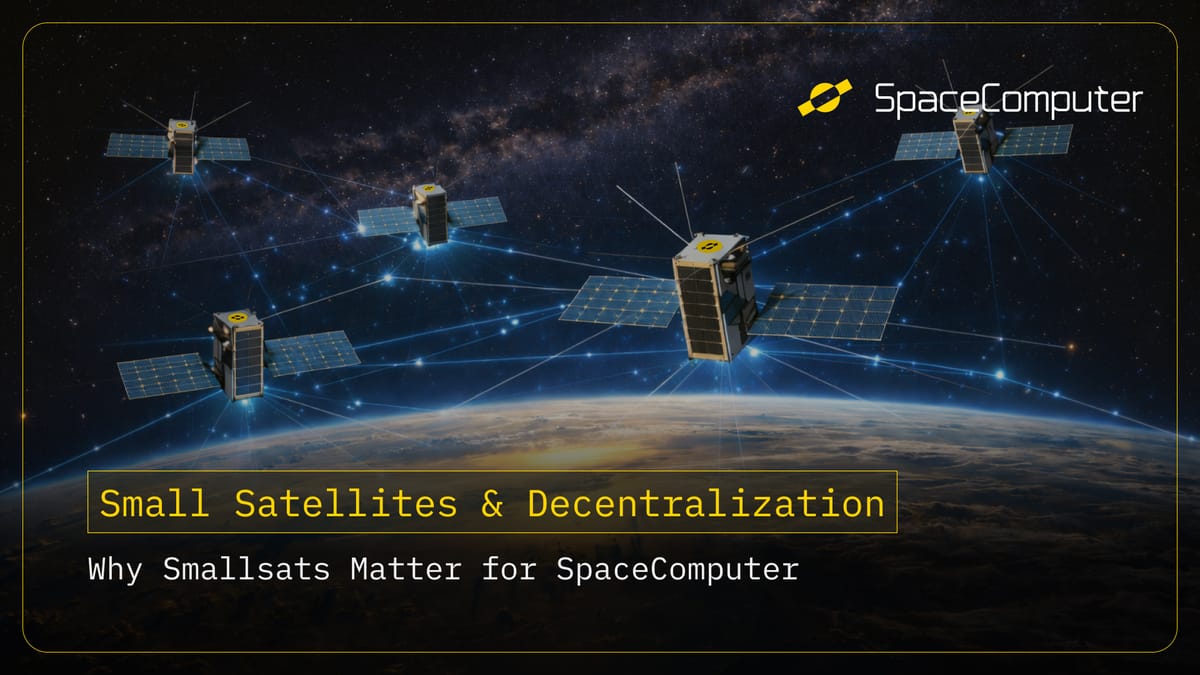
A constellation of smallsats can do what a single large satellite did, and no single entity or government holds the keys. The network is permissionless infrastructure
For most of the Space Age, orbit was reserved for those who could write billion-dollar checks. Satellites were limited in functionality, clunky, and launched on rockets controlled by a handful of governments. Even GPS started as a U.S. military project. Early communications satellites like those operated by the legacy company Intelsat were built to serve sovereign and corporate interests.
That era is ending.
Over the past decade, the cost of reaching orbit has collapsed. SpaceX's reusable Falcon 9 drove launch prices down by an order of magnitude. CubeSat standards turned satellite design from a nation-state endeavour into something a university lab or a startup can pull off. Today, thousands of small satellites (Smallsats) circle the Earth in low earth orbit (LEO), and the pace is only accelerating.
BREAKING: SpaceX wants to turn Space into the World’s Biggest AI Data Center.
— DogeDesigner (@cb_doge) January 31, 2026
• SpaceX is seeking approval to launch and operate up to one million satellites designed to function as orbital data centers.
• These satellites would provide massive computing power to support… pic.twitter.com/ez4yBVKXhH
What makes this significant is more than just the cost. As launch prices fall, space is becoming more composable. Instead of one monolithic satellite for everything, teams can now deploy dozens of small, specialized nodes in orbit. That shift from monolithic to distributed is more than an engineering choice, it’s an architectural choice similar to the evolvement of blockchain networks.
This is the world SpaceComputer is building for. Space as a platform for permissionless, verifiable computation, with smallsats as the hardware foundation that makes it all possible.
Thesis for Decentralization in Orbit
If you've spent any time in crypto, you already understand why a distributed networks beats a centralized one. More nodes = more resilience, no single point of failure, and no single entity with absolute control.
Now apply that logic to space.
Today's orbital infrastructure is very similar to Earth’s: overwhelmingly centralized.
Starlink is the most visible example: over 7,000 satellites in orbit, all owned and operated by a single company. SpaceX decides who gets access, what the terms are, and can shut off service to entire regions if it sees fit. Legacy operators like Intelsat and SES run the same playbook from geostationary orbit, serving governments and telcos through tightly controlled networks. Even GPS, the system the entire world relies on for positioning and timing, is ultimately run by the U.S. Space Force.
Centralization concerns aside, current dominating LEO constellations are truly impressive systems. They're also single points of trust in a world that's learning to be skeptical of exactly that.
That's where smallsats have the capability to flip the model. They're cheap to build and launch, and you can deploy many of them.
Because you can deploy many smallsats, you can distribute ownership, operation, and validation across independent nodes.
The parallels to blockchain architecture in smallsats are hard to miss: many small, resilient nodes working in coordination beats a few massive central servers every time.
This is where the decentralization 'vision' enters orbit. A constellation of smallsats can do what a single large satellite does, with the added benefit that no single operator, government, or corporate entity holds the keys. The network becomes the infrastructure, and the infrastructure becomes permissionless.
What to do with SmallSats?
So if smallsats are the hardware that makes decentralized space infrastructure possible, what do you actually do with them?
The most compelling answer is to turn them into compute nodes. Satellites in low Earth orbit are physically isolated from every government, corporation, and bad actor on Earth. No one can walk up and tamper with them. That physical isolation creates something incredibly valuable: a tamper-proof execution environment that doesn't depend on trusting any single party on the ground.
Now picture a whole constellation of these nodes running cryptographic services. Verifiable randomness sourced from cosmic entropy, secure key management, threshold signing, and confidential computation. Consensus that is anchored in orbit rather than in a data center somewhere, or worse: someone's garage. A trust layer that exists beyond the reach of terrestrial jurisdictions, available to anyone.
Secure Compute Smallsats in Orbit
The project's satellites run as SpaceTEEs (Space Trusted Execution Environments), and the first service already live is cTRNG, a cosmic True Random Number Generator. Randomness sounds niche until you realize it is the secure cryptographic force behind key generation, consensus mechanisms, fair NFT mints, governance systems, and beyond.
The SpaceComputer Blue Paper lays out the full architecture: a Celestial blockchain acting as a compute platform across the satellite constellation, while Earth-based Layer 2s handle throughput and data availability. The most critical trust layer lives in the most tamper-proof environment imaginable, and everything else anchors to it.
The constellation is the network, the smallsats are the validators, and the whole system is designed to be permissionless from the core. .
Building in the Expanse of Space
For decades, space was a domain of empires. Expensive, centralized, and gatekept by the few who could afford it. Smallsats are rewriting that story. Orbit is becoming accessible, composable, and for the first time, compatible with the principles that decentralized networks were built on. Permissionless computation, verifiable trust, cryptographic services beyond the control of any single entity. The building blocks are already up there.
Sign up for email updates to be first to hear about SpaceComputer's upcoming hardware and software architecture paper. This one is going to be big.
Dive Even Deeper on SpaceComputer's mission and vision:
📄 Read the Blue Paper for the full technical vision: Blue Paper
📜 Read the Manifesto for the philosophy behind the mission: Manifesto
💬 Join the conversation on Telegram: t.me/SpaceComputerOfficial