

Orbital Data Centers: Cooling vs. Power Debate
Key Takeaways
- The orbital data center cooling debate has split into two camps that are, for the most part, analyzing different machines at different scales.
- The skeptics are right that radiative heat rejection gets brutal at gigawatt scale, and the optimists are right that it behaves like a manageable engineering trade at 100 kW.
- Flight data from 2025-2026 suggests power delivery, not cooling, is what throttles the compute hardware currently in orbit.
- At small satellite scale, thermal management in space is a solved problem with decades of low Earth orbit (LEO) heritage.
- This debate will be settled by a handful of falsifiable milestones in 2027, not by better arguments.
The Biggest Discourse in Orbital Computing
In February, science YouTuber Kyle Hill published a video flatly titled Space Data Centers Are Dumb. The same month, Voyager Technologies CEO Dylan Taylor called cooling the fundamental unsolved challenge of the category. A week after that, NVIDIA's Jensen Huang told investors the economics are poor today but the category is worth pursuing, and by spring, SpaceX's IPO filing was promising AI compute satellites by 2028. Everyone, it seems, is arguing about orbital data center cooling.
Scroll through the comment sections and you'll find the popular version of the skeptic case stated in absolutes: the concept is "inherently flawed" because cooling an orbital data center "would be impossible." On Hacker News, engineers trade back-of-envelope calculations, with one estimating roughly 250 square meters of radiator to cool a single liquid-cooled rack's worth of GPUs. Meanwhile the companies raising money for orbital compute publish analyses concluding the cooling problem is overstated to the point of myth.
Both camps cite physics, and are selective about which machine they run the physics on. So let's hear both sides: the strongest version of each argument, and try to reach a verdict.
The Cooling Argument
The thermal camp starts from a fact nobody disputes: in vacuum, radiation is the only way to reject heat. The Stefan-Boltzmann law caps how much a radiator can emit per square meter, and SemiEngineering's rule of thumb is that rejecting 1 kW of heat takes roughly 2.5 m² of radiator.
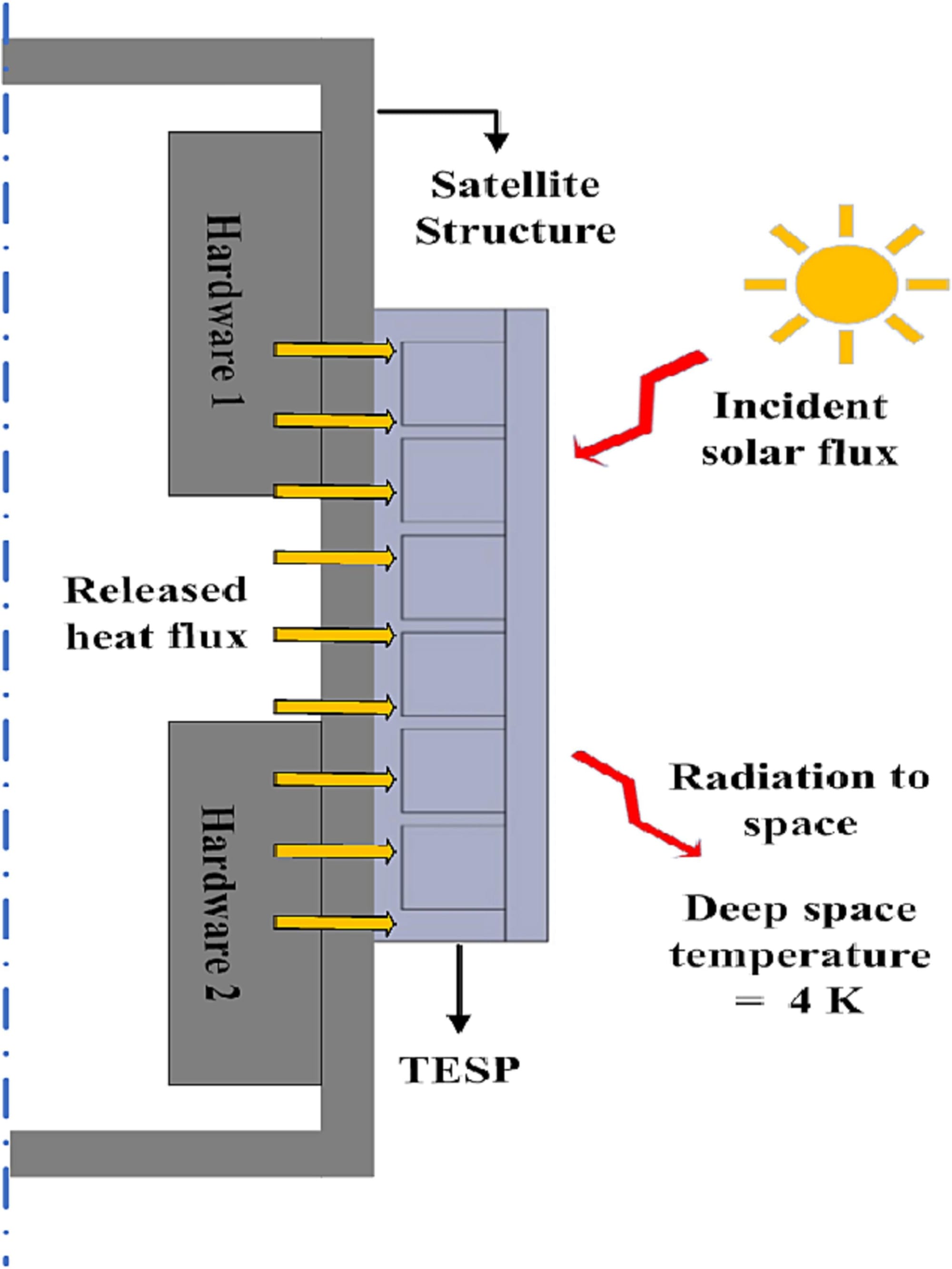
Theory is the generous version. The International Space Station's thermal control system rejects up to 70 kW across 422 m² of ammonia-loop radiators, which works out to about 166 W/m² in practice, well below theoretical maximums once solar exposure, Earth's infrared, and system losses take their cut. Space engineering has a long record of radiators underdelivering on paper numbers, and the gap between theory and telemetry is where the skeptic case earns its keep.
Scale that to AI ambitions and the numbers turn hostile. The World Economic Forum's analysis describes the design spiral as death by a thousand cuts: pack GPUs densely and heat concentrates faster than you can move it to radiators; spread them out and interconnects and shielding mass balloon. Add thermal cycling every 90 minutes as satellites pass between sunlight and shadow, and reliability erodes on top of everything else.
Even Huang, whose company sells the GPUs this industry wants to fly, names heat rejection as the bottleneck while calling orbital energy abundant.
That's the thermal argument: not that cooling in space is impossible, but that at data center scale the radiator becomes the machine.
The Power Argument
This is the topic orbital data center cooling discourse doesn't usually discuss. the compute hardware actually flown so far has never had the chance to overheat, because it couldn't be fed.
The average satellite (excluding Starlink) generates about 1 kW of power for everything onboard, while a single H100 with its supporting systems wants about 1 kW by itself. When Starcloud-1 made history in late 2025 by flying the first H100 in orbit, Star Catcher's modelling of the event suggests that the bus generated around 100 W at peak, meaning the GPU probably ran below a 10% duty cycle. That means the most advanced computer ever launched spent most of its time waiting for electricity.
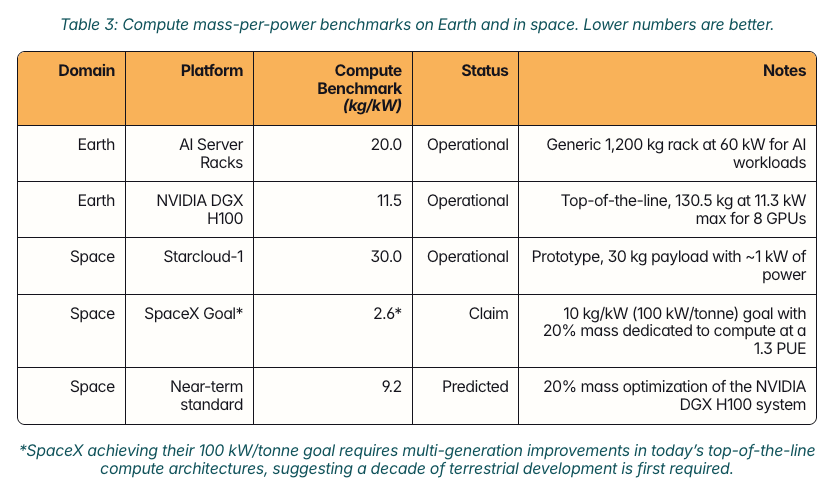
The power camp argues this is the real binding budget: mass per kilowatt of generation. Mach33's analysis modelled scaling a Starlink-class platform from 20 kW to a compute-optimized 100 kW and found radiators claimed only 10 to 20% of total mass and about 7% of planform area. Solar arrays dominated the spacecraft. Their conclusion: if a platform can accommodate the solar area needed to generate the power, the additional radiator area is comparatively modest.
In this telling, space data center cooling is real engineering but tractable engineering, and the harder question is generating, storing, and delivering continuous power through eclipse cycles at a mass the launch manifest can afford. Even Starcloud's own white paper frames the opportunity around energy: a solar array in orbit generates over 5 times what the same array produces on Earth. Energy is the pitch. Converting it into delivered compute is the biggest hurdle.
Small Satellites Don't Follow the Same Constraints
While the giants argue about hypothetical gigawatts, there's a scale where both constraints were solved years ago and the debate simply doesn't exist.
Below roughly 500 watts per node, thermal management in space runs on flight-proven hardware with decades of LEO heritage. For payloads under about 100 W, the spacecraft's own structure is the radiator: a 3U CubeSat has around 0.17 m² of external surface, enough to passively reject roughly 70 W with the right thermal coatings, a baseline capability in NASA's state-of-the-art smallsat assessments.
Push into the 50 to 500 W range and heat pipes move heat from processors to the best-positioned radiating surface through phase change, so no pumps are needed. Phase change materials act as thermal batteries, absorbing heat during compute bursts and releasing it during idle periods.
This is how edge compute payloads running AI inference or cryptographic workloads operate in orbit today: passively cooled, structurally radiating, and thermally boring in the best possible way. Power at this scale is equally routine, met by conventional solar arrays sized within normal smallsat budgets. Adding nodes to a distributed constellation scales compute capacity without proportionally scaling thermal infrastructure, which is one reason the distributed path keeps attracting architectures while the monolithic path keeps attracting arguments.
The Comparison
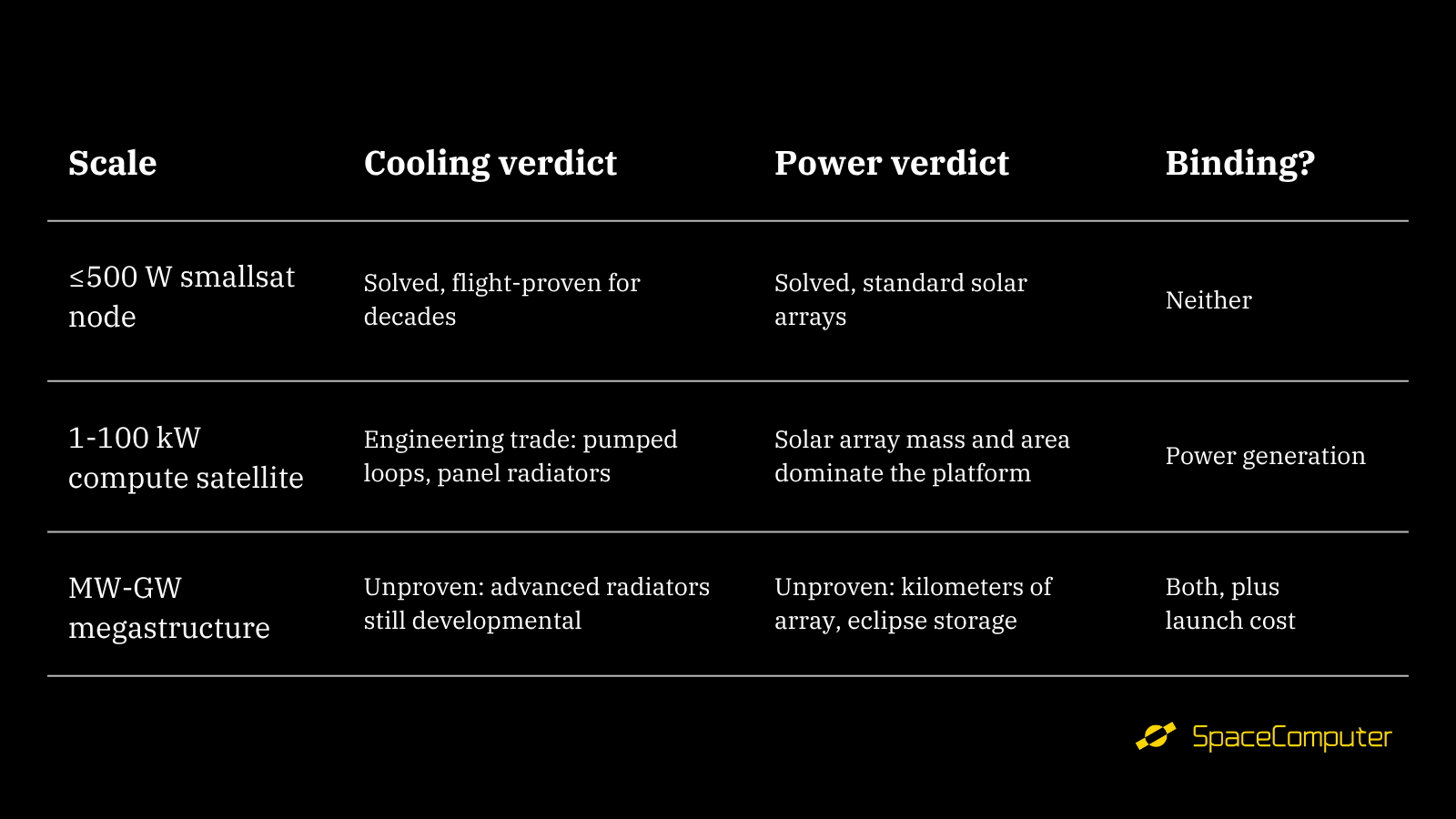
The loudest participants in this debate are defending verdicts from different arguments. The viral physics videos are largely correct about the bottom row, the venture models mostly describe the middle row, and the top row is where the industry actually operates today, drawing no argument because there's nothing left to settle there.
The Shrinking Radiator
The "unproven" verdict on that bottom row comes with an active R&D pipeline behind it, attacking radiator mass from several directions at once.
Radiative output scales with the fourth power of temperature, so doubling radiator temperature yields 16x the cooling capacity, and NASA's MARVL program is chasing exactly that with megawatt-class modular radiators running liquid metal coolant, designed for robotic assembly in orbit so radiator area stops being capped by what fits in a rocket fairing. Hotter radiators imply chip temperatures today's GPUs can't survive, which is why the industry is expected to adopt space-rated heat pumps that push heat uphill to hotter radiators by 2027.
Liquid droplet radiators replace the solid panel with a recollected mist of coolant that radiates in transit, a concept NASA found up to seven times lighter than conventional radiators and one that returned to active research after three decades of dormancy, though nothing has flown yet. Nearer term, origami-inspired composite radiators in the lineage that folded the James Webb telescope unfurl from a fairing into lightweight thermal wings, and Starcloud's Hypercluster plans to lean on deployables to manage 100 times its predecessor's power. Sophia Space's modular tile treats the whole spacecraft surface as a heat exchanger, with solar cells on one face and radiators on the other, and Axiom's first data center nodes are already flying thermal-tile testbeds developed with Spacebilt.
None of these programs settles the bottom row yet, but each one is dated and testable, which is more than most comment sections can say.
3 Ways This Debate Ends
1. Duty cycles.
When Starcloud-2 and its successors fly serious GPU payloads, the number to watch is the percentage of time the chips run at full power. Sustained high duty cycles would gut the power-starvation argument; thermal throttling in flight telemetry would gut the cooling optimists.
2. Achieved watts per square meter
The ISS manages 166 W/m² in practice. Any orbital compute platform claiming better should publish flight numbers, not renders.
3. Launch cost per kilogram
Every megawatt-scale concept implicitly assumes Starship-class pricing. If that arrives, the top row of the card gets contested for real. If it doesn't, the debate stays academic and the bottom row keeps quietly compounding.
Until those numbers can truly be calculated, every confident verdict on orbital data center cooling should be met with a question: at what wattage? The physics doesn't change. The answer does.
This piece follows our landscape analysis of cooling for orbital compute. For a broader look at the category, see our breakdown of space-based data centers.
SpaceComputer is the open, credibly neutral infrastructure layer that connects the space economy, providing the hardware and software standard for verifiable compute across operators, jurisdictions, and satellites, with high security guarantees and verifiability.
Visit our website for more information.
Check out SpaceComputer on X (Twitter) and LinkedIn.
Read more about our trust architecture in our research paper Space Fabric here.