Orbitport: The Gateway to Space
Hello Earthlings!
Space computing today feels like a strange split reality: on one hand, we are building a future filled with paradoxes—laser communications beaming data across orbit, moon based hotels, and ambitious timelines for human travel to Mars. On the other hand, much of our actual interaction with space infrastructure still resembles something far more primitive, closer to mailbox-based communication—slow, indirect, and constrained. Space computing is currently where the internet was in the 1970s: expensive, exclusive, and siloed, accessible mainly to specialized institutions and the ultra-wealthy.
Despite surging demand for space-based infrastructure, users face steep technical barriers, and even when access is achieved, existing systems often lack the security primitives and usability expected in modern computing. The result is a jarring juxtaposition between the futuristic vision advertised and the limited, almost antiquated experience currently available.
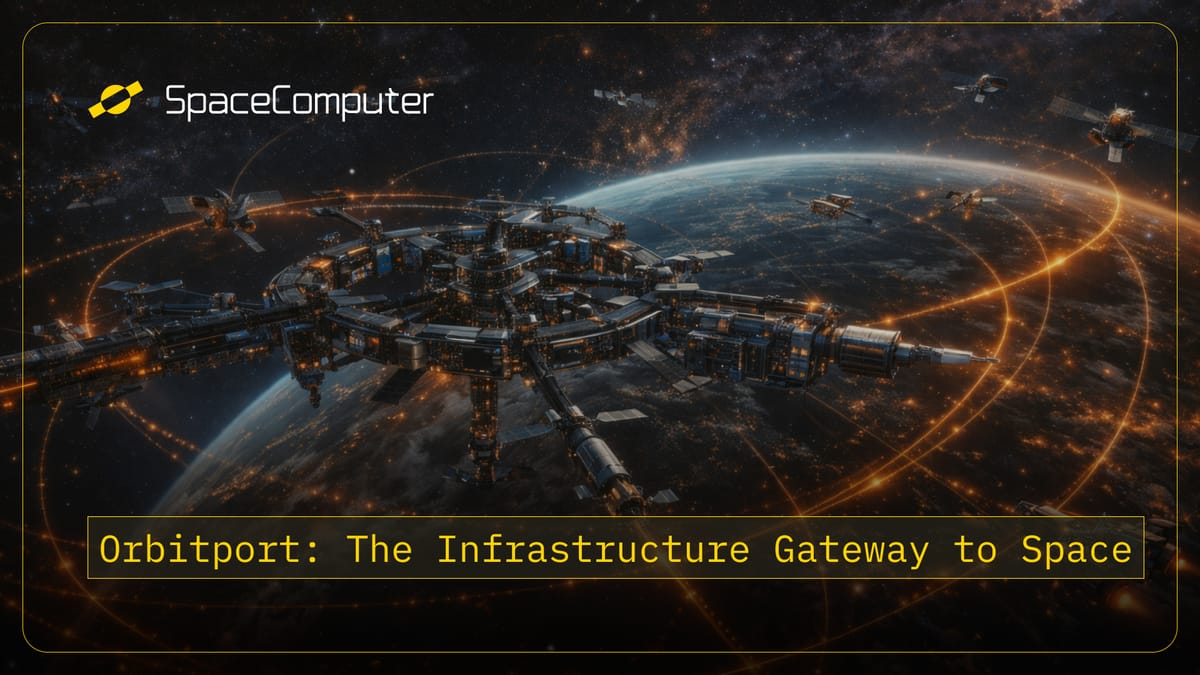
Enter SpaceComputer’s Orbitport: the universal portal between Earth and in-space infrastructure, bridging the gap between current systems and the future. While serving as the primary gateway for SpaceComputer’s own orbital services - including Cosmic True Random Number Generation (cTRNG) and Orbital Key Management Systems (KMS) - Orbitport is built to scale. It provides a secure, vendor-neutral bridge for third-party operators to manage communications with orbital assets, supported by a growing network of integrated ground station providers. By abstracting the non-trivial complexities of satellite interaction into a developer-friendly platform, Orbitport makes integrating with space-based assets as seamless as any terrestrial cloud service.
The “Secure Rails” and Automation of Space Communication
Interacting with a satellite is far more complex than a standard API call. Given their 90-to-180-minute orbits, these nodes only cross the communication horizon intermittently, creating a highly dynamic connectivity environment.
Establishing a link requires a precisely orchestrated 5-to-15 minute window at a terrestrial ground station - a physical process where high-gain antennas must be oriented in real time to track and synchronize with the passing asset. To complicate matters further, communication is subject to the satellite’s strict onboard energy budget; even during a clear line-of-sight window, the satellite must balance its power budget across multiple subsystems, meaning compute availability is never a given. Orbitport is planned to abstract these orbital logistics entirely, securing the link, managing the scheduling, streamlining connectivity, and optimizing packet delivery consistency.
Orbitport automates these “secure rails” for developers by establishing and maintaining communication between ground stations and orbital infrastructure across diverse communication bands:
- S-Band: enabling the utilization of resilient S-band links from ground stations to satellites, in order to traffic relatively large quantities of data, for mission-critical applications and command execution.
- High Data-Rates: By leveraging modern Low Earth Orbit (LEO) constellations such as Iridium and future integrations with additional constellations such as Starlink, Orbitport facilitates seamless data transmission, enabling the efficient delivery of cryptographically secured payloads.
- End-to-End Automation: Our gateway handles the heavy lifting - scheduling, packaging, and transmitting data, such that developers can focus on building as opposed to orbital physics and managing signal processing systems.
Here is a deep dive into the architecture we’ve deployed, the progress we’ve achieved, and our trajectory toward a fully decentralized orbital network.
The Vision: Making Space Accessible
Orbitport serves as the production-ready translation layer between terrestrial applications and global satellite constellations. Our architecture abstracts the immense complexity of orbital mechanisms and intermittent connectivity, providing a stable, high-availability bridge. By orchestrating communication across a diverse array of providers, we allow developers to leverage space computing as a standard extension of their existing tech stack.
Key Objectives
To deliver a seamless experience, we have built Orbitport around three core engineering pillars:
- Unified Protocol: We have moved beyond the fragmented nature of aerospace hardware. Orbitport provides a common, standardized API that allows developers to access orbital services across multiple satellite networks and provider constellations without delving into cumbersome provider proprietary integrations.
- Engineered Resilience: Space communication is inherently dynamic. Orbitport ensures enterprise-grade reliability by utilizing intelligent routing across Ground Stations and LEO communication networks. Our system maintains high availability through a redundant array of providers, backed by automated failover strategies that handle orbital handovers invisibly.
- Verifiable Cryptographic Integrity: In the current state of space communications, transmissions are predominantly unencrypted and easily intercepted, lacking both privacy and crucial security. Every data packet retrieved and sent via Orbitport is backed by cryptographic proofs of origin. We establish secure, hardware-level handshakes and authentication with orbital platforms, ensuring that the data you receive and send is mathematically proven to be authentic and untampered.
Under the Hood: Engineered for Security, Resiliency, and Speed
High Level Architecture Overview
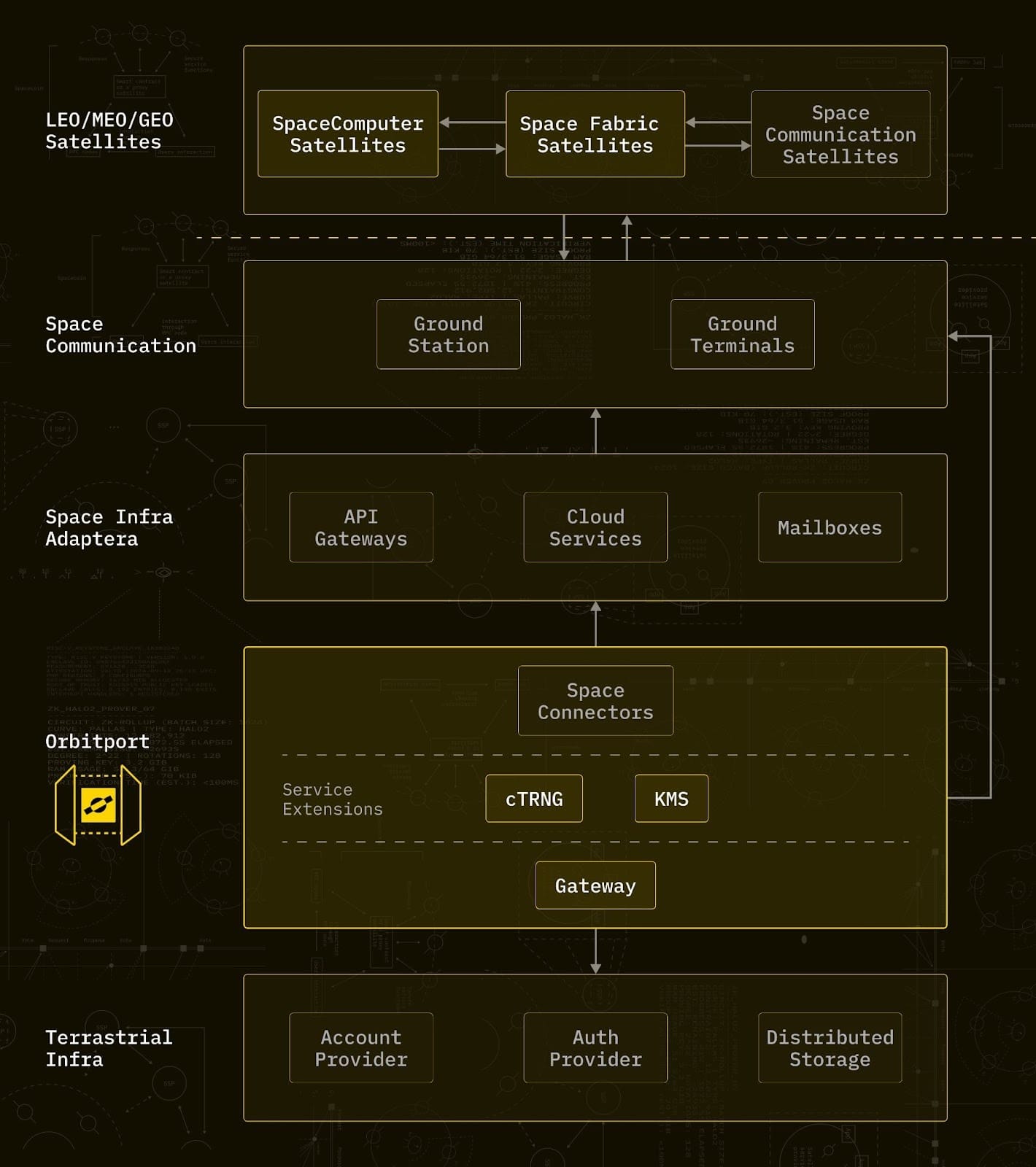
Orbitport’s core components include an external facing Gateway, wrapped with a plugin system that extends Orbitport easily and independently:
- Application Plugins that interface with orbital services.
- Celestial Integration Plugins that are responsible for interfacing with space infrastructure.
- Terrestrial Integration Plugins for capabilities such as authentication, account management, or public storage.
Space Infrastructure is usually exposed via an Adapter, such as an API Gateway, Cloud Services, or human-managed Mailboxes.
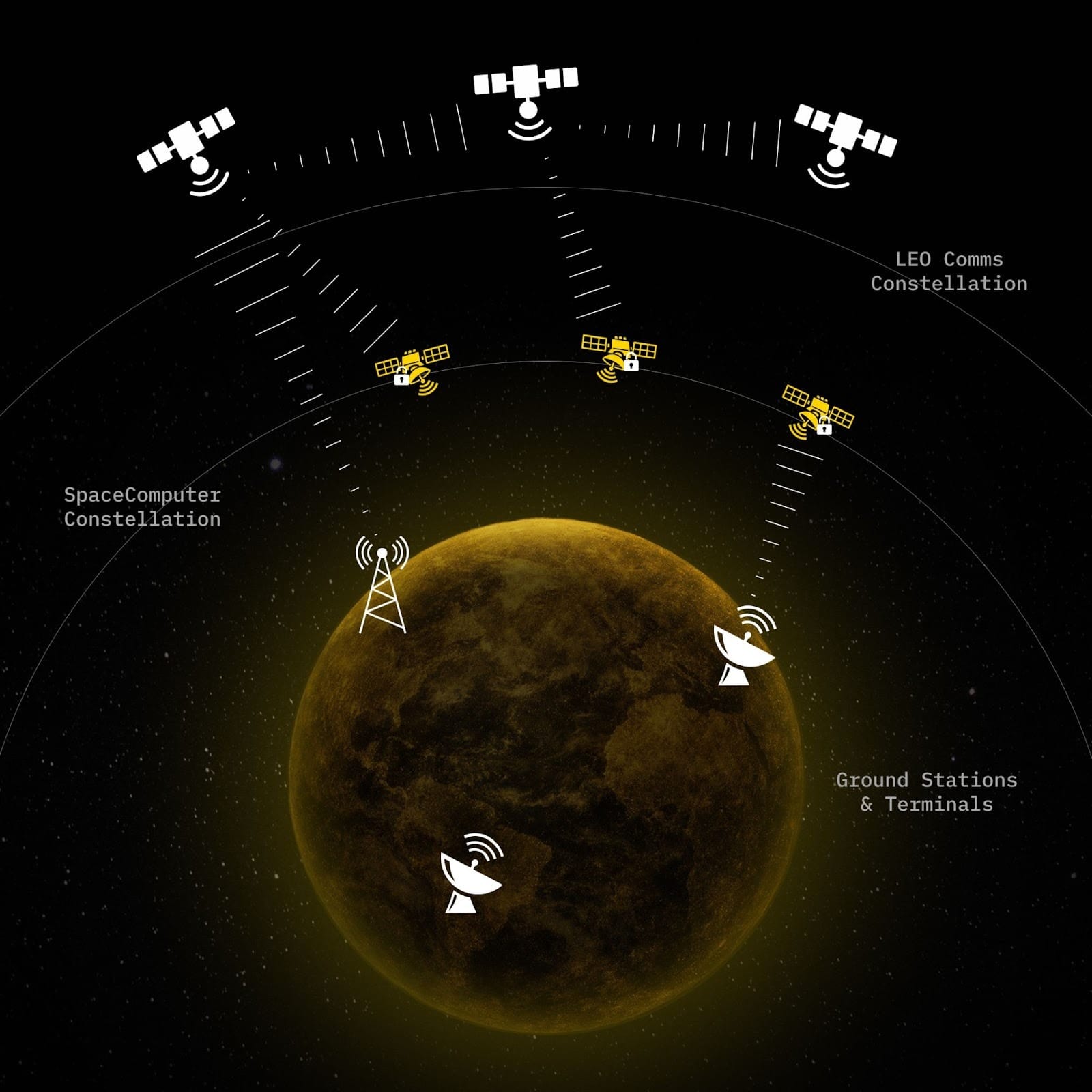
Adapters either route data packets directly to Ground stations for direct uplink with satellites or alternatively through intermediary proprietary ground terminals of third-party low-earth-orbit communication networks that in turn facilitate transmission of data packets from earth to orbit.
These LEO communication networks also facilitate inter-satellite links.
The Inherent Challenges of Space Communication
Orbitport supports various communication types, each with its own nuances and limitations.
Ground Stations
Inherent orbital dynamics and terrestrial infrastructure bottlenecks often result in communication latencies ranging from minutes to several hours. Data transmission is restricted to specific operational windows - brief periods when a satellite is in view of a ground station. Within these windows, ground stations must balance high-demand scheduling; while peak demand leads to data packet congestion, the gaps between available transmission slots introduce significant delivery delays.
To overcome these orbital bottlenecks, Orbitport implements several sophisticated mitigation strategies designed to maximize throughput and minimize wait times:
- Strategic Capacity Provisioning: We utilize pre-allocated ground station windows to enable predictive transmission scheduling, ensuring that data paths are cleared well before each satellite pass.
- Redundant Resource Buffering: By over-allocating bandwidth across our provider network, we insulate our users from the volatility of orbital demand, maintaining consistent availability even during peak network congestion.
- Payload Aggregation & Batching: Our gateway optimizes every transmission slot by intelligently aggregating packets. By batching data into high-density payloads, we significantly reduce the total number of required orbital handshakes and maximize the utility of every second of connectivity.
LEO Communication Networks
In Low Earth Orbit (LEO) environments, communication is characterized by high-variability constraints: latency is often measured in minutes, and while uplinks remain relatively consistent, data packet sizes are significantly smaller than those used in S-Band ground-station communications.
Maximizing delivery consistency typically requires complex orchestration, such as concurrent repeated transmissions across multiple channels - a strategy that often leads to ballooning operating costs.
Managing these trade-offs - balancing packet reliability against cost and orbital timing, streamlining data transmission, standardizing interfaces and removing friction from client-side deployments - dismantles the “walled garden” of legacy space operations, opens the space development sector to a broader market and decouples orbital utility from traditional aerospace complexity - enabling organizations to leverage space-based infrastructure without the burden of proprietary systems or the need for nation-state-level resources, making orbital integration as accessible as any modern workflows.
The Roadmap: From Earth to Orbit
In developing Orbitport, our first priority was to establish a stable connection between Earth and space. By aggregating disparate providers into a single interface, we have successfully removed the operational dependency on individual Ground Station partners and their varying availability windows.
While this provides a high-reliability solution tailored for sensitive data communications, it currently requires clients to place their trust in SpaceComputer as the central orchestrator.
Our long-term vision for Orbitport is to move beyond the “managed trust” model to become a fully trust-minimized, decentralized gateway for secure, verifiable communication with space assets. We have a trust-minimized architecture that does not require SpaceComputer to act as a centralized intermediary.
Orbitport Phase-1 (Current): Centralized Gateway (MVP)
Orbitport is currently operational as an earth bound gateway bridging terrestrial requests with space bound infrastructure offered by several providers.
- Live Service (cTRNG): We are actively supporting the Cosmic True Random Number Generation (cTRNG) service. This service harvests entropy directly from already available satellite hardware.
- Cryptographic Authenticity: To ensure zero-trust integrity, satellites cryptographically sign all generated data. This provides mathematical proof that the data originated in orbit and remained untampered during transit.
- Current State: Fully functional API for developers requiring verifiable cosmic randomness.
Orbitport Phase-2: Trust-Minimized Gateway
We are currently hardening our gateway security by transitioning Orbitport deployments to Trusted Execution Environments (TEEs) to minimize trust needed in the node operator:
- Confidential Computing: purposefully utilizing Confidential Virtual Machines (CVMs) and Confidential Containers as the secure runtime.
- Hardware-Level Privacy: This update enables secure end-to-end communication with satellites, ensuring that even the gateway operator cannot inspect or alter data packets in memory.
- Foundational Attestation: Establishing a system for end-to-end, remote attestation as the foundation of ensuring the verifiability, soundness, and confidentiality of terrestrial and celestial execution.
Orbitport Phase-3: Modular Gateway & Ecosystem Scaling
As we mature the platform, our focus shifts to developer UX and architectural flexibility.
- Modular Account Management: Introduction of a comprehensive system for granular permissioning and asset management.
- On-Earth Testnet: To accelerate the development cycle, we are building Earth-based Orbital Simulators. This would facilitate developers in testing integrations, simulating latency, and debugging orbital logic on-Earth prior to space deployment.
- Scaling Extensibility: Enabling users to embed their own logic into Orbitport via the introduction of dedicated plugins.
Orbitport Phase-4: Distributed Permissioned Gateway
This milestone consists of expanding our operational footprint through a distributed trust model. This phase scales the gateway from a single-operator environment into a permissioned network of strategic partners.
- Diversification of Node Infrastructure: maximizes the network’s collective security and ensures the long-term sustainability of decentralized orbital communications.
- Orbitport operated by a Consortium of trusted partners: it both scales the infrastructure and ensures a superior degree of decentralization, performance, and reliability.
Start Building
The space economy is no longer a closed loop. The frontier is expanding, and we are welcoming engineers to begin building with space infrastructure. Orbitport is your entry point to the next chapter of technoeconomical evolution.
Ready to integrate cosmic randomness into your application?
Check out our Official Documentation to start hitting our live endpoints today.
Sign up for early access keys to the Orbitport platform.
If you are interested in using Orbitport’s enterprise services, please reach out to us at services@spacecomputer.io.
Follow along with our walkthrough demos on YouTube: