

The Frontier Podcast Episode 4: Rand Hindi
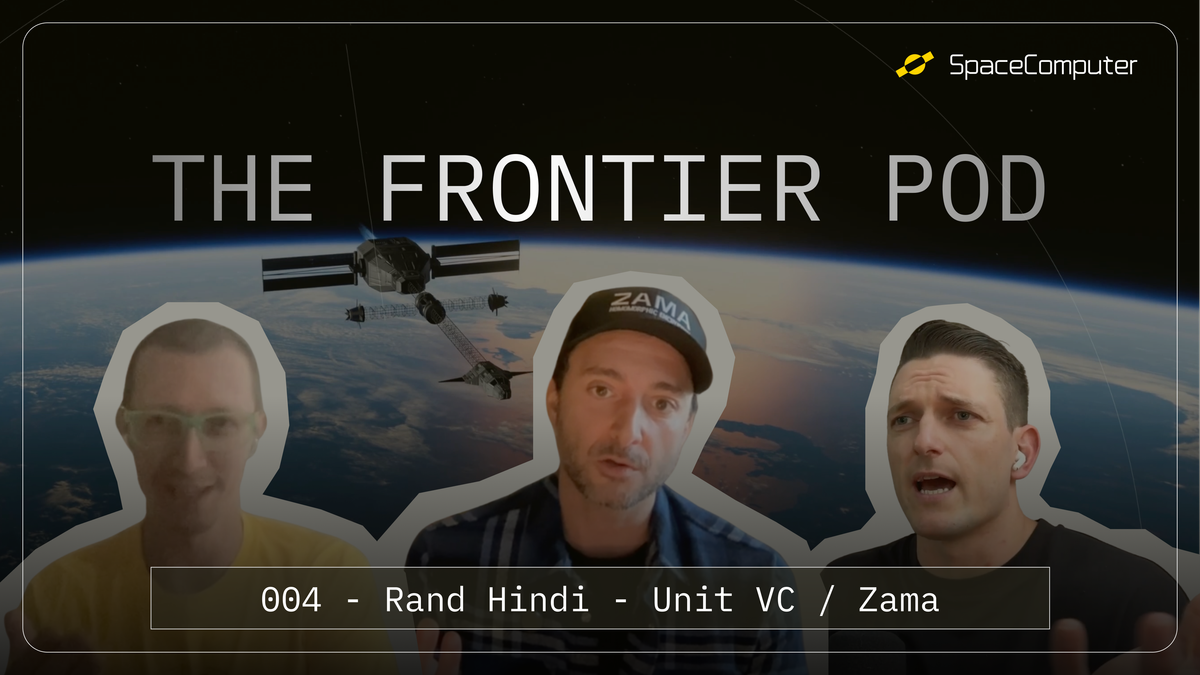
This is the transcript for the third episode of The Frontier Podcast with Rand Hindi, Founder of Zama and Unit VC, hosted by Tom Mitchelhill and SpaceComputer CoFounder Daniel Bar.
Welcome back to the Frontier Podcast, the show where we interview the pioneers pushing technology and humankind into the future and going deep on the original cypherpunk values of cryptography, digital sovereignty, and the limits of human ingenuity. I'm your host Tom Mitchell-Hill, and today I'll be joined by my co-host Daniel Barr, the co-founder of Space Computer. Thanks for joining me, Daniel.
Greetings, lovely to be here again. Oh, you can actually do that. I've always struggled.
Today we're speaking with Rand Hindi. Rand is an entrepreneur and deep tech investor. He is the CEO of Zama, a leading crypto privacy protocol and a general partner at UnitVC, where he's invested in over 70 companies across the cryptography, AI, blockchain, and biotech sectors.
Rand has been coding from an extremely early age. He founded a social network at 14, a web agency at 15, before getting into machine learning at the age of 18, starting a PhD at 21. He went on to found Snips, an AI startup that was acquired by Sonos, and is now powering a voice assistant in over 20 million devices.
Now he leads Zama. Rand, thanks so much for joining us on the Frontier Podcast. Thanks for having me, guys.
Awesome. I'd love to start off with your background and journey as a hacker and entrepreneur. This is a multi-part question, but can you share some details on the different perspectives of being an academic researcher background versus being an entrepreneur, and the benefits of having that technical depth as a founder? You know, when I was actually studying, maybe a little bit of a backstory here.
Because I've been coding since such a young age, when I was graduating from high school and deciding what should I actually study, I kind of got lazy and decided to do computer science. I thought, well, how hard can it be if I'm already basically a developer? And unsurprisingly, I was kind of bored my first year in college, and so I decided to take some master's classes, including one in artificial intelligence. And I remember at the time thinking, oh my God, this is actually going to change everything.
We're going to go from programming computers to teaching computers to do things. And so my first year in college, I knew that AI was going to be my thing. And so right after my bachelor's, I went straight from bachelor's to PhD, skipping master's, well, because I had done a master effectively during my bachelor's.
And that's when I actually started thinking that maybe there is something more than just pure AI. Maybe there is something interesting around using artificial intelligence for biology, for healthcare. And my PhD was actually in something called protein folding.
So applying machine learning to learn how molecules are structured in space. Twenty years ago, to be clear, at the time, we could barely make any AI stuff work. But it was interesting because Demis Hassab, who is the founder of DeepMind, actually got the Nobel Prize a couple of years ago specifically for solving protein folding with AI.
I guess it just took 20 years and $20 billion to get there. But I guess the idea was not so bad at that time. That's just a long story short to say that I've usually always found interest in working in topics that were not yet very mainstream.
And so for me, academia was not so much about becoming a researcher as it was about an opportunity to work on something that wasn't necessarily a business. And then I figured eventually as a founder that, well, everything can be turned into a business if you actually try to figure out what the product can be. And so I'm still kind of trying to do the same thing, trying to work on very frontier stuff, but now actually trying to turn that into a company instead of just a few papers.
It's interesting in academia that oftentimes the specific topic of a PhD student is like the niche of a niche, but the skill set is something that brings so much, right? Yeah, 100%. I mean, look, I think doing a PhD taught me two things. The first thing is it taught me how to actually research without any prior art in a way, right? So you're basically given a topic which is super big, super hard, and you're like, look, figure out something related to that topic.
And when you're a founder, it's a little bit like that too. You're looking at blockchain. Blockchain is a huge space.
You could be building 1,000 different products within the space. So how do you actually decide what to build? How do you conduct experiments to figure out that what you're building is actually meaningful? That's research. It's just instead of publishing a paper, you're basically making money.
That's how you know that this is actually useful. Can you walk me through how you went from kind of like AI machine learning side into cryptography? What did that path look like? When you work in AI, you basically spend your time looking at data, right? And when you work specifically on biology, DNA-related stuff, you look at a lot of very personal data. So for me, it was very clear that the more we use AI, the more data we need to trust to those AI, and therefore, the more privacy becomes an issue.
So when I started my company, Snips, we set out to actually build one of the first AI assistants that actually had privacy built in. The way we did that at the time was that we ran everything on device. So there was no data being sent to the cloud.
But it was very limited because you couldn't really compute that much on a Raspberry Pi, right? I mean, it's okay for basic stuff, but clearly, things like LLMs today would never fit on a Raspberry Pi. So I started looking for other things. How could we potentially have privacy server-side? And that's where I came across FHE, fully homomorphic encryption.
And I remember it was back in 2015. I looked at that, and I was like, oh my god, this is clearly the future, not just of AI, but of potentially any kind of computation where sensitive data is involved. So it's been a decade getting to this point.
And arguably, blockchain became the real product market fit for FHE, not AI. But I mean, from that point onwards, I just couldn't go back. It was just impossible for me to imagine that you could have a world where all your data is piped to companies and then not have any privacy around it.
You were kind of building privacy tech before it was cool. What was the journey of Snips? And how did the kind of privacy by design influence your decisions? We could even talk about Zama directly, because to be fair, privacy got cool, what, three months ago? Zcash popped up and everyone's like, oh my goodness. Got mainstream, yeah.
Privacy, yay. Talk about good timing and being lucky. You can't really make this up.
People realizing suddenly that privacy is important. It's not that nobody cared about it. It's just that up until now, if you look at Web2 specifically, there was really no reason to force companies to adopt those privacy technologies.
Because look, people trust OpenAI, they trust Google. And so far, at least Google has not messed up as bad as other companies have in terms of privacy. So the incentive for Google to put massive amount of efforts into doing everything private is just not there.
In blockchain, however, it's completely different. Because on a blockchain, everything is public. If you want any level of privacy on a public blockchain like Ethereum, you have to use confidential computing technologies, FHR-wise, to do that.
There is no choice. You cannot just trust a company not to leak your data and keep it private. So I think that's a reason why people care about privacy suddenly in blockchain.
It's not that they care about privacy. It's that they realize that without confidentiality, we're never going to build all those use cases where data has to be kept confidential. There is another industry that is obviously related to the financial industry.
Also, privacy is super important. Is there any appetite or place where it's linked? It's linked. Because they're moving to blockchain.
So when we talk about blockchain going private, what's really driving that is finance moving on-chain. So the opportunity today in confidential compute on-chain is really just finance. I don't think it's necessary to go after financial use cases for not going to be on-chain because within a decade, all the finance will be blockchain-related anyways.
So might as well just kind of catch that wave going. There are other industries long-term that I see outside of blockchain where this could be useful. For example, healthcare.
This is always going to be an issue. And it's unlikely that that would benefit from blockchain in the same sense, because you typically have gigantic data sets with very few people that need to collaborate on it, as opposed to finance, which is very tiny data with 8 billion people involved. So it's kind of like a shared ledger.
It's interesting, maybe, just like to your comment there, you're saying in a decade from now, blockchain will eat finance. Kind of like what Andreessen was calling software eats everything. So blockchain will eat finance rather than looking at TriFi becoming something that is auxiliary.
It's going to be contained in on-chain finance, basically. And it won't even be TriFi versus DeFi. It'll just be finance.
Yeah. Kind of like online, right? Online became the default, so on-chain becomes the default. Yeah.
Nobody today builds a website. You build a service. The fact that you're on the internet with a web presence is just part of what you're building.
And I think all of fintech, all of finance is going to eventually use blockchain rails as opposed to TriFi rails, because it's just more effective. That's it. And it needs confidentiality, obviously.
Yeah. And it needs confidentiality. Actually, I did that.
I went to the street the other day. I walked up to random people asking them to show me their bank account. Nobody said yes.
Like, there you go. People don't want other people to see how much money they have, period. You can brag with a nice car, but you're never going to show your real bank account to everybody else.
For those who haven't heard about it yet, can you explain what Zama is and how it all works? Sure. So Zama is a confidentiality layer for public blockchains. So we add a layer of privacy on top of Ethereum, Solana, Base, so that any asset you have there can be converted to a confidential token, where balances and transfer amounts are encrypted.
And now that they're encrypted, you can start staking them confidentially, you can swap them confidentially, you can trade them confidentially. So anything you can do with a token on a public chain today, you can now do confidentially with the same token on the same chain with Zama. How does that work with the regulation side in terms of confidentiality and privacy on that front? The same way as TradFi works, when you have a bank account, you see your bank account, but your bank also sees your bank account, so they can comply with whatever regulation they have.
The model we're proposing for compliance in the Zama protocol is the same. So the token issuer or the DeFi app basically can give themselves the right to see all the transactions going through their own contracts, which means that they can comply off-chain with any regulation they need. So the kind of privacy we think that you need to build if you want compliance is not as much as I would like to, but it's not end-to-end encryption.
It's actually more of a a privacy with regards to your neighbor type of encryption. So I see my data, the service provider sees my data, but anybody else on chain in my neighbor doesn't. And I don't think there is a shortcut though, because if you really want blockchain to be used for a hundred trillion dollars of assets, you can't expect finance to change the rule of how it works.
And so we want to make sure that whatever people want to do compliance-wise, they can do directly in the protocol. Okay. Before we mentioned the term FHE a fair bit, and I do want to get into a slight semi-non-technical breakdown of those terms in a sec, but FHE itself was considered kind of like borderline sci-fi, the frontier of privacy.
I'd like to hear your thoughts on like the early efforts of taking the academic concept of FHE and actually demonstrating confidential transactions and what that process looked like. So FHE as a technology is not new. It's been around since the seventies.
The problem is that it didn't work that well. You could barely do anything. So you could add numbers, you could multiply numbers, but you couldn't do machine learning.
You couldn't do smart contracts for things like that. So the first thing that Zama solved is making FHE applicable to any kind of use case. So now you can use it for anything that you want.
The second problem is that it was very, very hard to use for developers. You needed to learn a new language. You needed to learn cryptography.
If you wanted to compute privately on something, you needed to be a cryptographer. So we've also solved that by integrating FHE into existing developer workflows. So for example, if you want to build a confidential smart contract or DeFi app, you just write a solidity contract that you deploy to Ethereum that people interact with MetaMask.
So we've removed all of kind of the complexity of integration. And finally, the third thing that was missing was performance. When we started a company, doing something like a confidential stablecoin transfer would take about one minute.
It's not bad. It's better than Bitcoin, but it's hardly what people expect from blockchains today. So yeah, sure.
Okay. Five years ago, we could have done encrypted Bitcoin, but you would not have been able to do encrypted Solana or global payments. So since then, we've actually improved the performance by 400,000x actually on some use cases.
So we can now do about a thousand confidential transfers per second on GPUs. And we're working on building an ASIC, which will get us to 100,000 TPS in the next four years. So yeah, you have to at some point.
So FHE is a done deal. It's no longer a math problem. It's just a compute problem, which fortunately is just a money problem.
So the more money we invest in making it faster, the bigger the addressable market for this technology. For the non-technical listeners, and I'll kind of put my hand up and include myself in that crew. Can you break down what's meant by FHE and how it differs from stuff like ZK, TEE, MPC, all the acronyms? Okay.
So sorry, Daniel and my trash tease a little bit, but you're solving the reason I'm trashing them. So it's okay, right? You can talk about space computer. So there are typically four types of technologies when it comes to confidentiality for blockchain.
So I'm going to talk about the blockchain use case specifically. So FHE, which means fully homomorphic encryption, which is a way for you to compute on encrypted data without decrypting it. So for example, imagine that you have a token, right? Your balance is on chain encrypted.
The amount you're sending is encrypted. The way that you've encrypted it still allows you to compute on the encrypted data itself. So you can have a smart contract that's manipulating this encrypted state on chain and transforming it into whatever you actually want.
So the nice thing about FHE is that you can manipulate an encrypted state. And that's really the power of it is that you're not changing the way blockchains work. You're just basically doing it over encrypted data instead of public data.
FHE is also post-quantum. So the data you're encrypting and putting on chain cannot be broken by quantum computers, which arguably I think is an important thing to keep in mind. Now, if you compare that to other technologies, let's take, for example, MPC.
Multiparty computation, you take the secret key and you split it with a bunch of people who need to basically collaborate to do a computation. MPC is the best tool that exists for managing keys and for managing decryption. So we use it in the Zama protocol for decrypting, for example, the balance when a user wants to see how much tokens they have.
But when you want to use it for computation, it's very hard to scale because the scalability depends on how many people are basically participating. And importantly, it's hard to make it verifiable. You basically have to trust that people doing the computation have done it correctly.
FHE is publicly verifiable. Anybody can recompute and see that the state is correct. ZK, great technology for scalability.
However, when you're using ZK for privacy, it doesn't give you composability. I can send you Zcash privately, but I cannot stake my shielded Zcash. I cannot swap my shielded Zcash.
I cannot do any of those things. FHE is composable. So your FHE tokens, you can stake them, swap them, lend them, anything you can do with a token, you can do with FHE.
So you see, it gives you security, composability, and verifiability, which is really important. Now, TEEs, in theory, give you similar properties. The problem with TEEs is that there has been multiple papers published recently that show that if you have physical access to the machine running the trusted enclave, the hardware, you can basically break it.
We can go into the detail how that works, but in practice, Intel fucked up. And so everybody using Intel TEEs, effectively, the attacker can run the machine direct. So the only way to make TEE secure is to somehow make it out of reach of people.
If only someone was doing this. Physically isolated. If only.
But I want to be very clear. There is always, in every cryptography protocol, there's always going to be, at some point, some hardware that is going to be used for holding secret keys. It's true in MPC.
It's true in banks. And so someone has to figure out how to build secure hardware, at least for managing keys, that doesn't have this kind of side channel thing. And so that's why I'm an investor, by the way, in your company, Daniel.
Because I think it's a very good solution. Just put it in space. Yeah, yeah.
Absolutely. Absolutely. Basically, the highest security guarantee is physical isolation.
If it's truly physically isolated. Yeah. And highest, in your case, makes sense.
It's literally high in space. Yeah. Out of this world.
Yeah. Exactly. We talked about this a tiny bit before, but privacy has become a meta, if you will, particularly with traders in crypto now as well, because Zcash has put in an incredible gain over the last few months.
What do you make of the state of privacy in crypto at the moment? And what are the flaws with Zcash in terms of privacy that you see? Because it's an older technology. So maybe flaws is the wrong way of putting it, but what's your read on Zcash as an asset protocol? So there's nothing wrong with Zcash. I mean, I've been holding Zcash for a while, by the way.
Thank you is finally doing something, right? Same, since 2016. It's been a while. It's been a while.
Yeah. No, look, Zcash is great. And I think for what it wants to be, encrypted Bitcoin, it makes total sense.
So I do think generally that Zcash has an opportunity to be encrypted store of value, effectively encrypted Bitcoin. I would prefer if we actually encrypted Bitcoin, but I'll be happy with Zcash as well. It's a very different purpose than what companies like Zama are doing, because in our case, you know, we're not building a privacy coin or encrypted store of value.
We're actually building an infrastructure that allows anybody to build confidential applications, whether it's confidential stable coins or confidential default confidential games on public chains. So if you wanted to build a Zcash like store value, you could technically bridge Bitcoin to Ethereum encrypted with Zama and you'll have like encrypted Bitcoin. Right.
But again, you know, Bitcoin exists in parallel to Ethereum and Solana. So I do think Zcash is going to exist in parallel to confidential chains, you know, Ethereum plus Zama, for example. That's an interesting game theoretic angle there, because I remember in the early days of Ethereum, I used to always think there's no point in Bitcoin.
It could just be a smart contract ultimately. Yeah. And similarly, like that line of thinking of you could hypothetically take something like Zcash or Bitcoin and encrypt it with FHE on Ethereum or on something else and ultimately circumvent the entire need.
But I think that a part of the reason for these parallels to exist, as you said, it's because the network economics functions differently, not only from the 21 million finite coins as well. It's also proof of work that is different to proof of stake and all of that mechanism of it's creating a completely different economy. Right.
So it's like these things will exist in parallel. I feel like you're 100 percent aligned on multi-chain. Right.
Like, you know, I don't think Bitcoin would have value if it was proof of stake, because as you said, people would just use Ethereum and have just a random contract on So like, you know, what Bitcoin is really kind of giving you is security by just energy consumption. Right. And I think that's going to be hard to beat with a smart contract on any chain because of the amount of infrastructure that goes behind it.
Now, I also think that in the beginning, when we thought that we could just replicate Bitcoin is also because we used to think of Bitcoin as currency. The narrative of Bitcoin as digital gold is relatively new, I would say. So, you know, the narrative shifted a bit.
My personal sort of thesis is I think one of the reasons why Bitcoin has so much value is because Bitcoin doesn't have a roadmap. And I think this is really important. The moment you have a product roadmap, like Ethereum has, like Solana has, like any company has.
Right. You're taking the risk of being wrong and losing users and volume to other people who have the right strategy. Right.
If you're not changing anything, you can't actually be wrong. Right. Like, you know, it's never going to change.
And so I thought about it the other day. I was like, if I had to stash something for 20 years, which crypto would I feel almost 100 percent confident would still exist and not be worth zero in 20 years. I couldn't think of anything else in Bitcoin precisely because there is no roadmap and therefore there is no strategic mistake that can be made with Bitcoin.
It's in some respects the lowest risk of being disrupted, but it's not without risk because no, a lot of things can happen. Of course. Well, when a computer is for one, so you are going to have to upgrade Bitcoin to be post-quantum, you know, that's that's one.
But you're not like Bitcoin is not trying to be something else than Bitcoin. That's what I'm trying to get to. Right.
And I really understand that people pushing strongly against smart contracts on Bitcoin because it would denature it and it would make it just like another Ethereum or Solana. And we don't need that, you know. Yeah.
Yeah. You mentioned before that you would almost like to encrypt Bitcoin. Yeah.
Why can't we encrypt Bitcoin? Well, you could. I think Starknet is trying to do that. Right.
So I think people are trying to do that. But would you actually want to encrypt Bitcoin or would you want to have like an encrypted Bitcoin stable coin, if that makes sense? Right. Like a wrapped Bitcoin.
A wrapped Bitcoin. Exactly. And so if you have a wrapped Bitcoin, what's interesting is you can now have basically yield and you can basically have it like as part of DeFi.
And that's where confidentiality comes in. I think, you know, the canonical Bitcoin chain like people don't, nobody sends Bitcoin to other people. Right.
Like there is no, you don't really need confidentiality in the sense that there is nothing to track in the first place. Like people just buy and hold Bitcoin. That's it.
Right. And if you only want to hide who you are when you deposit, it's easy to do that. What's difficult is hiding ongoing activity, daily payments, swaps, things like that.
And again, that's not what people do with Bitcoin. Right. Look at the transaction volume.
I don't think anybody's filling blocks anymore. At least not on Mainnet. I've had two Bitcoin transactions on Mainnet this past month.
But maybe I'm an anomaly. I actually try to do a few Bitcoin transactions, you know, during the whole, what is it called, like the NFTs on Bitcoin era and the Bitcoin tokens. Ordinals.
Sorry. Yeah. Ordinals.
Yeah. So like I went in and bought a bunch of random ordinals. Right.
Yeah. I mean, I like to try early stuff. I mean, you know, we think Ethereum is slow.
Right. 12 second block times. Man, Bitcoin is, you know, I made a transaction.
I went for coffee, came back and, you know, like it was still not done. It's not just that a block time is 10 minutes. It's that you need like 40 confirmations to make sure you have finality, which is by design and I get it, but.
Not exactly something that you're going to be transacting on a daily basis, for sure. Yeah, definitely. Ruins meta was tough.
I have a friend who is very, very involved in Ruins. And yeah, he was showing me how to do things. And yeah, stuff taking 40 minutes.
I was like, did I? Yeah. Did I do the wrong transaction here? Yeah. No, no, you just have to wait now.
And I was like, yeah. And again, like, I think that's a good thing. You know, like this is what you want from a store of value.
You want something that's just not going to change. You know, that's it. And so so I'm I'm wholeheartedly on the camp of let's not change anything to Bitcoin.
Yeah, I agree. I'm in the camp as well. Can you talk about your intuition about space compute, terrestrial compute, you know, seeing the growth? Oh, I mean, providers, satellite info providers, you know, rising interest in.
I mean, I think it's one of those things, you know, when you think about it from first principles, it makes a ton of sense. You know, if you think about not just privacy, but if you think about compute in general, right, data centers cost a lot of money, right? It takes a lot of energy to run them to cool them. Well, you know, if you're basically facing the sun 24 seven all year long, right, without the atmosphere filtering anything, you've got a pretty efficient way of capturing and using energy.
Right. So for me, I think it's it's very obvious that the way that you're going to scale to the energy demands of Bitcoin or AI is not going to be on Earth is going to be in space. Even even with fusion on Earth, you know, it's never going to be as efficient of just putting stuff in space.
You literally have an infinite amount of volume, energy, free energy, free energy, free space, no pun intended. Right. And now we can send stuff in space more cheaply.
Right. So it's becoming also easier to put stuff in space. So the the actual operating and kind of capex of building a space data center makes sense.
So I'm a very big believer in space data centers. I think they make they make a ton of sense. And within, you know, the kind of space data center kind of metal, then obviously, you know, the thing I'm interested in is, OK, how do you actually do something securely? Right.
You know, someone is still going to have root access to that server. So the question becomes, how do you build very strong software isolation for space servers? And the answer to that is unity. Like I look at these as software isolation solution more than hardware security.
Right. It's basically a way it's a way to make sure that your software cannot be accessed by other software on the machine. And doing that is very, very good, to be honest.
Right. It's much better than whatever, you know, OS kernel level process separation, because like it's actually encrypting the memory. So that's how I see this.
I see this as put data centers in space. You're out of reach. You're reducing the security problem to basically a software problem.
And for that, these are actually a very good solution. It's interesting you mentioned that you're looking.
Edit as a software isolation rather than pure hardware because and then that you also mentioned for Zama eventually you'll be looking at ASICs because for us originally we were thinking that we're only going to be focusing on protocol and software and going to be able to rely on various different kind of hardware providers but over time we realized that even though space is really booming and everything we actually do need to get into quite particular hardware integration to get what we want out of it and then ultimately also as you see the trend in not only space-based data centers just like the space compute in general there's most of it is going to be probably centralized providers and therefore what we believe is that there's going to be something that would be a settlement a smart contract layer a trust layer in orbit essentially to create that free market economy a marketplace for services in orbit.
Yeah I think you know you're replacing the trust assumption of having a man with a gun in front of your data center which is basically having it in space but once you've solved the physical access security problem you still need a very good isolation technology to avoid people you know just reading whatever is running on the computer itself and regarding the ASIC I totally agree with you. I think people for a long time were a little bit scared of building custom hardware you know? Bitcoin has done it very well from the beginning you know, bitcoin mining ASICs, I mean they've been around since 2013-2012.
I think like very quickly they've been around any kind of compute where you have hyper specialized math heavy kind of workflows you're always going to be better off building an ASIC than using off-the-shelf GPUs and CPUs and we see this with FHC as well. Every time we go from you know more general to more specific type of hardware we get a 10x improvement so going from CPU to GPU you get instantly 10x better latency but also 10x better throughput so it's 100x better cost like performance per dollar improvements right and moving from GPU to FPGAs.
We're starting to see the same and moving for FPGA to ASIC we're starting to see the same so if you're going to be running the exact same computation a billion times a minute or a billion times a second and you need that to go super fast you're never going to do better than building custom hardware yeah maybe over time like over time hardware manufacturing costs also goes down Eric and like it's it's still expensive to go and do like a microchip overall it's becoming more accessible it is not as expensive it used to be you know.
I mean today you can build an ASIC on a three nanometer TSMC node for 30 mil it's a lot of money 30 mil but like 30 mil is not you don't need to be NVIDIA to spend 30 mil building an ASIC right yeah. 10 years ago it wouldn't be like a realistic at all. No no impossible.
I want to take it back a little bit more to the kind of like founder frontier side for a sec when you were you know. When Snips was acquired by Sonos what was your experience founder POV what was the like 'aha moment' afterwards that kind of like led you as exited founder to take on kind of the ambitious goal of pioneering implementation of FHE specifically for crypto?
As I mentioned earlier I discovered FHE in 2015 when I was working on this company Snips before on confidential AI that's where I met my co-founder Pascal Payet was one of the inventors of FHE as well and it really struck me as the future technology but it didn't really work at the time so we couldn't do much with it.
When I was going through the acquisition process which by the way probably the hardest thing I've done as a founder well I don't know maybe launching a token is harder than selling a company. I would say it's equally complicated right lots of moving parts everything can go wrong. I would say I put out equal footing when I was going through the acquisition.
Pascal was a friend called me and say hey there are some new breakthroughs in FHE I think you know we can make this technology work you know do you want to start a company in FHE?
I was like I don't know man like I'm a little bit burnt out you know? I was gonna you know I want to go to Japan spend six months uh you know eating great sushi and going to all those amazing places. I love Japan that's why so my plan was to travel to Japan for six months and then figure out what my next move was going to be but then I thought about it I was like hold on I've been telling everyone for five years that this technology is going to be the future.
I'm super excited about privacy there's an opportunity for me to build a company with literally the number one researcher in the planet in that field. I can't really it's just my founder spirit just took over.
It was like 'fuck it let's do it.' So a week after I closed the acquisition my company we started. No break no traveling to Japan.
I mean it's it's honestly best decision I've made, because I think you know if you if you take too long of a break it's a little bit difficult to get back on the saddle full speed here.
I still was on super high energy from a previous company like there was no there was no downtime you know? I just went straight from high intensity to high intensity startup founder mode and I just like it I don't know maybe call me masochistic but I just like I don't if I take more than two weeks of holiday I just don't know what to do. I just you know I just I just go to my wife and I'm like you want to do something; like I just become like this very annoying very needy person that you know is looking for something to do with his day.
What's the obsession with Japan? Why Japan? I just love the culture. I think you know I think it's they're amongst some of the nicest people I've met. The food is out of this world, I love collecting Japanese art as well. France has a good culture but it's it looks like other European countries in some ways. Japan really has a unique culture like it's really a place that's out of space and time compared to the rest of the world and I just like that you know I like the dedication to being honest about who you are and to being like a unique craftsmanship like high very high craftsmanship yeah it's amazing. I mean you look at what they've been able to accomplish over the past millennia it's insane it's insane.
Talking about Zama, I know there was like some kind of like slight backlash recently around kind of like open source first license software with Zama and so I was wondering, oh no backlash is probably the wrong term for it, but what considerations kind of like guide those decisions how do you view striking the balance between kind of like fully open source software and like the need to be like commercially viable as an organization?
I think we have to define better so open source is different from free software right free software means that the license and the code allows you to do whatever you want open source just means the code is publicly accessible which is very different.
The reason why Zama open sources everything is not because we want it to be free it's because we want it to be publicly verifiable. We want people to know what's actually running to make sure that there is no bugs, there is no backdoor, there is no interference. Making your code open source is the only way that you can guarantee that so for us open source was primarily public verifiability driven I would say if you're a company your goal is to make money let's be clear about that.
A company is not a non-profit. A company's objective is not to build public good software. The goal of the company is to make money and so you have to think about how can you monetize and what's your best distribution strategy and for us you know we found that a dual licensing model where the software is free and open for research purposes but you have to pay if you want to use it commercially made sense.
The Zama protocol by the way you if you want to deploy on it you can just deploy on it.
It's a permissionless network, but if you want to use our technology outside of the Zama protocol you're going to have to pay a license fee to us which you know I mean seems reasonable doesn't it right but somehow a lot of people think that everything should be free. I disagree you know I think you know you if you want something to be free go and build it in a university if you're a company you have to make money.
Part of the distinction maybe is that Ethereum went the foundation direction which is kind of like Linux foundation or something whereas what you're describing is a bit more like Red Hat or something that essentially takes open source software but uses licensing in order to commercialize it which is there's no contradiction between it being open source. It's just a matter of commercialization exactly and I think you know you you really want both you want some I would say non-profit foundations who are really focused on long-term problems for which there is no business opportunity okay.
That's just not what Zama is.
Zama is a company and so you know as a company we you know we we're here because we want to build something meaningful that also generates revenue. You seem to have a pretty good appetite for risk clearly you know starting multiple startups constantly kind of like pushing the needle a bit when it comes to risk taking. What are the what are the mental models that you approach with with risk and and how you evaluate. Whether or not like a startup or a domain or a field is going to work? I don't think there is a formula to be honest.
I'm trying to think about it with my investor hat on a little bit when I look at a new kind of industry. So first usually I go out and I invest in things that I already am convinced are important to solve because you know maybe I come across it or maybe like I talk to a bunch of people and it's a recurring theme. I'm like okay interesting there is something around that.
Then what I try to look for are is what I call founder market fits right so in a way when you invest early stage in a company you don't really care about what the company is doing you care that the founders are the right people to solve that problem for that specific market. I think this founder market fit kind of angle is something not a lot of investors will basically talk about you know.
People like to have all kinds of like addressable market thesis and everything all that makes sense for a growth stage company for an early stage company. The only question is are the founders the right people to solve that problem that's it right and if the answer is yes and I think the problem you're solving is worth solving then I'm gonna be investing.
With UnitVC what kind of inspired you to do like investing side because you know you're clearly like a talented founder, you know very technically proficient but what made you want to like invest in early stage stuff as well?
Frankly just because I didn't have time to build every company myself so I figured you know the second best thing I can do is at least invest in those. So what you'll see if you look at my portfolio on UnitVC is a lot of the companies I invested in are very kind of sci-fi deep tech related companies because that's you know all these things I'm like look this is an industry I'm interested in if I had time I could have built or would have built a company in that so you know I'm just going to find the people that are actually doing something in that and do whatever I can do to help them whether it's like you know money whether it's advisory introductions.
I'm not a VC to be clear. UnitVC - I call that like a fake fund in the sense that would pretend to be a fund it's really just my money. We try at least to kind of run it professionally with my partner Kyle who's kind of managing the portfolio but yeah. Look it's these are things I'm interested in personally that's it.
What's your advice to founders that are approaching like the really hard deep tech problems?
I think you need to find investors who understand how deep tech investing works. A lot of investors that have been used to SaaS FinTech consumer they assume that you can build a prototype in three months and start getting traction numbers very quickly.
So they look purely at numbers what's your growth rate what's your revenue what's your you know monthly active user base in deep tech it doesn't work like that because there is an incompressible period of time for you to actually build the thing. A FHE cannot be prototyped in three months, it takes years of research to get it to a point where it can be turned into a product.
A satellite probably take at least a year for you to build it and maybe another year to get the authorization to send it to space like there is no shortcut to those things. Because they fundamentally take time and if you understand that as an investor then what you understand is that deep tech is about step functions there is basically no market and there is five to ten companies with credible founders trying to be the first to solve a hard technical problem and when they do it creates a market overnight and that's what you're looking for right. You're looking for technologies and industries we're solving that hard science or engineering problem immediately opens up a hundred billion dollar kind of market opportunity.
Space is a good example for that right. Even if it took you 20 years to build like a spaceship it's worth it because the market you're opening is gigantic and that for me is I think is the is the number one thing is as a founder building a deep tech company. You do not waste your time raising money from investors whose first question is what's your revenue growth rate the first year like that's not the point yeah actually on on that I know you're saying that there is no uh clear SaaS style figures to to track. It's a bit of a research-y kind of atmosphere for a deep tech, but how do you communicate what are some of the things that that you would relay to to investors that even if they are like a patient or whatever like what would be the metrics of course right.
Those KPIs should be specific to what you're doing so for example, in your case i don't know exactly what KPIs are but I would imagine is something like speed and cost of you know every gigahertz of compute in space or something like that.
So some number that is easy to understand that you can show is getting improved quarter over quarter so for example for FHE is very simple. iIt's things like how many confidential token transfers can we do per second right uh what is the cost of a confidential token transfer what is the very basic metrics right and as long as you can show that these numbers are going the right direction.
So throughput has improved by 10x in a year right cost has gone down by 100x in a year then you see you're not talking about financial KPIs you're talking about fundamentally technical KPIs but those technical KPIs are related to I would say product readiness and market readiness of the technology and for us it was very clear.
We're like we know that our technology is going to be ready for production and mark for the market once we can at least run ethereum in FHE so as soon as we have more capacity than Ethereum mainnet can support that we can be like look 'we can run ethereum encrypted FHE.' That's a big enough kind of market to to start with and we achieved that this year.
Congrats yeah that's epic. Benchmarking basically you have a reference for something that's already huge and i've told my investors i was like look there's a goal the day that i could show you that we could process more stable coin transfers confidentially on ethereum than ethereum can process itself then we're in business.
You were talking before about deep tech being something that almost has this like kind of like long tail explosion that opens up a market somewhere down the line it's indefinite it's risky. If it works it it essentially is like it's its own it passes through that absorbing barrier and then it's its own kind of like investable you know. It opens up the door to other investment opportunities what are the deep tech stuff or sectors that you look at at the moment that are you know unnoticed now but that you think will have probably the most impact from either you know.
We could take it two directions but like an investable side but also just like a market opportunity side.
I mean so maybe i can give a couple of examples of things that have been early on that have played out nicely uh so five years ago more or less when i started actively investing.
You know one thing for me that was very clear is that we needed a completely new class of mental health drugs right you know. You just look at the data people are getting more anxious whatever and the whatever pharmaceutical drugs we have are not working anymore so i was like okay big problem.
One in three one in three person in the world in the developed world at least are taking antidepressants at some point so i was like okay that's like billions of people that are desperately looking for a better treatment. So i looked at the science i was like interesting so there are all those people who are kind of like niche researchers in the psychedelic which are showing you that oh wow you know if you're using psilocybin if you're using even LSD you're getting incredible remission rates for you know mental health. You look at this you're like interesting it's illegal but it's working so what bet are you making first you're making a bet that regulation will go in the right direction eventually if that science shows them that this is important and b you know you're looking for the founders who are basically pioneering a new class of pharmaceutical drugs based on those i would say uh existing psychedelic kind of understanding.
Five years ago crazy to say that you know you go to an investor you say i'm gonna invest in basically magic mushrooms as the cure for depression. I go back to burning man dude and like you know just what the fuck are you talking about.
I invested in a company in 2020 at a 10 million dollar valuation that company got acquired by a large pharmaceutical lab a few months ago for 1.2 billion right. So yeah that's a big that's a big x right yes like in this this is what happens when you're right in deep tech because you're you invest in something nobody thinks is possible or is legal or is a market but when it does - boom. It becomes gigantic. So that's one example that was like very early and right another one that i've been very early on is longevity.
So like i've been a competitive biohacker for nearly 20 years now and for me it's very obvious that at some point everybody was going to get into the whole longevity kind of space because i mean why not right like it's you know who doesn't want to live to 100 in perfect health.
It's just that i think until covid most people didn't really didn't realize how far we were like medically wise from getting to 100 years old like i think covid was a very big turning point in people's understanding that medicine and healthcare needed like to leapfrog to something completely new and futuristic if we actually wanted to live to 100 years old and i kind of was expecting that there was there was going to be like a wake-up moment at some point.
If you look at the past five years like longevity has become one of the biggest investable sector with one of the fastest growth of results scientifically of all of like medicine right and what used to be like a niche biohacker community on reddit type of thing you know. You now have multiple billion dollar companies effectively actively promoting these things so i think longevity is uh is going to be one of the biggest biggest opportunities; i think bigger than ai man.
Look i mean you know like AI is great, blockchain is great, finance is great but not dying is arguably you know the biggest market of all.
Yep no just look at the popularity of Bryan Johnson, Andrew Hubeman, anyone running protocols that makes people you know feel like they're getting education every everything everything. These guys are doing you can find on reddit 10 years ago like, I hang out on weird subreddits of people trying all kinds of weird biohacking shits.
Everything is in it man everything is in there you mentioned the term competitive biohacker can you talk more about the competitive aspect of that yeah that's newer i guess.
You know Bryan Johnson started this longevity leaderboard called rejuvenation olympics where basically you can compete based on how slowly you're aging at the moment. It's a way to measure your protocol versus others. Right now my aging pace is 0.68. So effectively i'm aging you know 60 percent per year instead of you know one percent per year.
I'm aging effectively like whatever seven months eight months that puts me in the top 20 on that leaderboard at the moment globally which is nice. Top 20 is like it's like if you're like second or third in a competition you're not first right so my goal now is to be top five or top 10 on the leaderboard but that's a little bit harder. I think if you want to be in the top 10 you can't really do what i'm doing, which is this kind of 80/20 longevity protocol. I think you need to actually be like a longevity athlete like Bryan Johnson is and your life revolves around reducing about your age.
I don't think you can you can be living in Europe sipping wine on weekends and hope to be in the top 10.
Maybe that's the secret, it's part of it.
Okay my take on longevity by the way is that there there's a lot of stuff that are maybe a bit more on the hacking. Indeed which is let's say like nad plus iv drip and then whatnot the things that are like somewhat synthetic and then there's stuff that are very basic which are actually much more foundational. Sleep right like the sleep is the number one clean air clean water the general like having your lifestyle just like time for yoga reflection whatever it is. There are six things if you don't do those six things well no amount of drugs or supplements or interventions will help you.
- Sleep well
- Eat well
- Exercise regularly
- Don't drink
- Don't smoke
- Have friends
If you do those six things together right you're almost guaranteed to live to 100. Now if you want to go to 120 150 that's where you need to go advanced, that's where you start looking into you know modulating your metabolism and things like that or eventually you know organ replacement and whatever else will be available.
If you don't do those six things nothing's going to work yeah.
That's kind of like the blue zones, basics right. Yeah it sounds very obvious but most people don't do that you know.
No it's crazy how much everyone goes looking for like the the silver bullet approach before they have just the most fundamental kind of layers of anything. Well i'm not saying it doesn't exist by the way. I mean you know if you look at weight loss for 40 years people told you it's a lifestyle thing you know you have to exercise, eat well and then you lose weight which is true.
Then GLP-1 ozempic came about and now you actually have like a pill that makes you lose weight so it's not impossible that you might have a pill that makes you know muscular and healthy it's just right now that pill doesn't exist. So if your goal in 2025 is to optimize for longevity, lifestyle is going to be a big part of that. So the other side of it is also that longevity is not only about getting to 120 it's also getting there in a shape that is like every moment you're actually in a good state of mind and like having a good lifestyle. I'm pretty happy where I am today.
So if i can stay like that I'm good with that. I think you know being in your 30s is probably the optimal in terms of like you know the balance of everything so you know sticking to that would be the goal. I saw a comedian I can't remember where but it was talking about the idea of aging but without kind of doing it healthfully,
It's a it's similar to adding crust to the pizza was his analogy that i thought was quite good.
I get the point yeah.
Outside of the six outside of those six foundational things what are the protocols for you that move the needle the most i think for me one of the things that was like the most impactful was reducing i would say inflammation.
So reducing inflammation it sounds like very obvious but people most people that live in cities today are very inflamed lots of allergies lots of you know like stress and everything so a lot of my protocol and a lot of supplements i take is just basically reducing inflammation. Super powerful flavonoid extracts so basically green tea extracts more or less or like citrus fruits extracts things like that so that's number one.
Number two is improving blood flow. I think you know you can take any amount of supplements you want if your body cannot actually bring it to the cell well you know it's supplements to improve blood flow is a big part of my protocol.
Now the third one is energy metabolism. So making sure that your body has enough energy to work properly so whether you're taking you know an ad or supplements or whatever there are multiple things that you can try so i think that's important and all of that together.
The kind of end game of what i'm trying to do is to maximize mitochondrial health and to maximize immune system health because those two things are sufficient to fix any problem in your body.
A few people do but most people don't have cancer at 20, they don't have heart disease at 20, they don't have diabetes at 20; because your body can fix your own body so if you can keep your body fixing itself you can probably prevent most of the aging related diseases that people suffer from.
Rand where do you want people to go after they finish listening to the Frontier Podcast? What do you want them to go check out?
Well they should check out the Zama website zama.org of course and if you're a founder that's building in the deep tech space get in touch rand@unit.vc; you know we'd like to invest.
My pitch to founders is that if they're pitching other investors and they don't get it they should come to me instead.
Okay wonderful Rand thanks much for coming on the show it's been a pleasure thank you guys thanks for having me.
Enjoy listening to the podcast? Each episode we bring on visionary buiders, leaders, and thinkers to discuss what they're building and topics on the bleeding edge of technology development.
Join the community on Telegram.Subscribe to The Frontier Podcast on Spotify or YouTube.