The 6 Layers of Space Internet Infrastructure
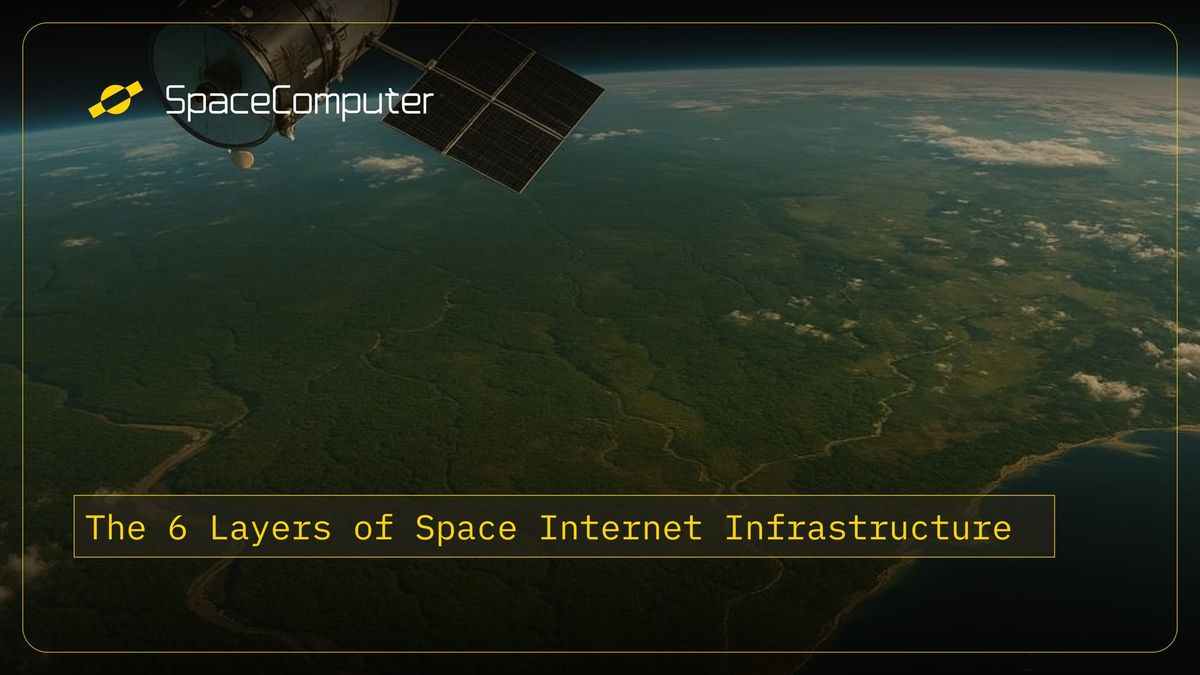
It’s no longer a thing of the future: space internet infrastructure is being developed today - and is already facing high demand. A single ground network provider is handling more than 5,500 satellite contacts a day, orbital data center operators are running production workloads in space, and optical mesh networks are routing traffic between satellites. Earth observation constellations, defense networks, and orbital data centers are all competing for the same downlink windows, compute, and communication spectrums.
In contrast to the new development of space internet infrastructure, humanity has already built successful internet infrastructure on Earth. We predict that as more services move into orbit, in many cases due to resource constraints on Earth, we'll need orbital infrastructure to provide the same extent of internet services from space.
It is important to note that when we refer to ‘space internet’ it’s more than just communications. There is no internet on Earth without compute, security, and interoperability. So in terms of the ‘infrastructure’ that the space internet will need, we see 6 layers of the stack emerge:
- Ground stations
- Communications (between spacecrafts and spacecrafts to ground)
- Computing
- Data
- Analytics and intelligence (includes AI)
- Security
The space industry often describes itself as a value chain: upstream manufacturing and launch, midstream ground systems, downstream services. While this gives excellent insights into who is building what with which capital, it gives you little insight into more specific sectors, like what a functioning space internet needs to operate.
We're mapping the layers of the internet in space, and the infrastructure services that need to be built to support demand, which align with the demand we’ve seen compound on Earth already for decades.
The 6 Layers of the Space Internet Stack
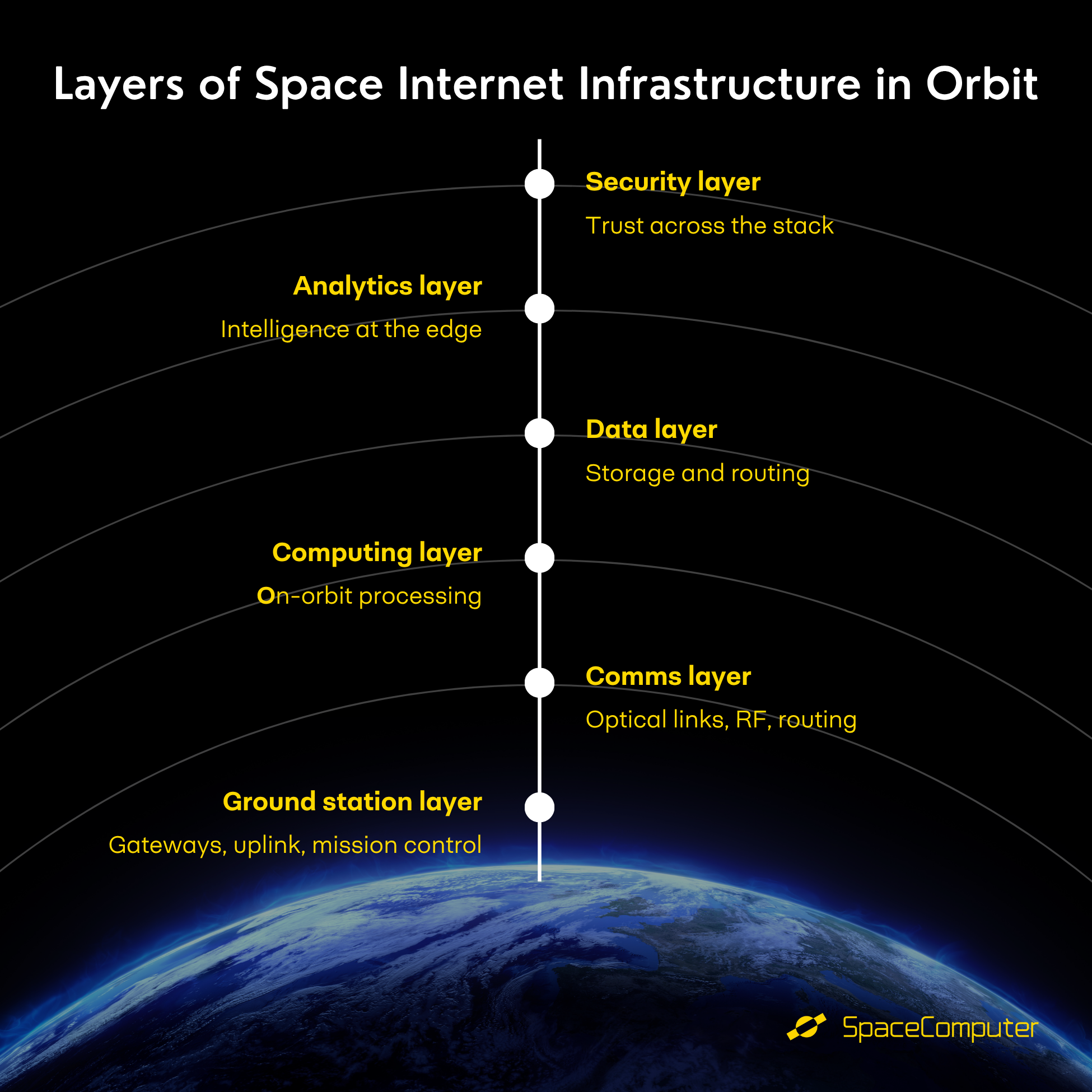
Ground station layer
Gateways, teleports, antennas, and mission control move data between Earth and orbit. This is where the space internet meets the internet. Ground stations increasingly operate as shared networks sold as a service (Ground Stations as a Service aka, GSaaS), the way cloud regions are.
Communications layer
RF and optical links carry data between satellites, between orbital planes, and to the ground. Laser inter-satellite links already form mesh networks that route packets between spacecraft the way terrestrial routers move traffic between cities.
Computing layer
On-orbit processing, and the fastest-moving layer in the stack. GPU-class payloads now operate in orbit, and more compute is moving to space in the next decade.
Data layer
Storage and routing in orbit. Earth observation satellites generate terabytes daily, more than downlink windows can carry. More data is moving to space with compute and rising satellite usage globally, which makes on-orbit storage and intelligent routing an infrastructure problem in its own right.
Analytics layer
Intelligence at the edge, processed via the computing layer. Instead of downlinking a terabyte of imagery, a satellite downlinks the answer extracted from it.
Security layer
Security protects every process in the stack from bad actors, and in orbit it cannot be bolted on after deployment, because nothing can be bolted on after deployment. It has to be designed in: attestation that proves a system runs the code it claims, key management for spacecraft no one will ever visit, randomness that can be verified rather than trusted.
How SpaceComptuer connects each layer
SpaceComputer's goal is to connect each layer of this infrastructure map in a way that provides multi-functionality across spacecraft. We do so through Space Fabric: our infrastructure stack that enables functionality beyond just one purpose or one customer. By allowing more usability out of each launch, then not everyone needs their own satellite for one purpose, and can harness the power of a network more effectively, similar to how power grids, data centers, and even APIs offer connectivity functionality to our Earth internet.
Achieving the same speed and scale as Earth-based networks requires infrastructure that is inherently interoperable. Just as terrestrial systems rely on seamless connections between brand websites, payment channels, user data, and analytics, our goal is to build that same level of interoperability across every layer of the space internet. Here’s what we’re building to achieve this:
Orbitport is your access point to SpaceComputer services, connecting builders to on-orbit services from ground stations.
Our Secure Compute Platform provides satellite-based trusted execution environments (TEEs): workloads run on isolated hardware, with verifiable integrity, anchored in a hardware root of trust built with partners including Infineon and Tropic Square.
In terms of communication, Space Fabric is carrier-neutral by design. Our services run on any comms provider's network, because interoperability with this layer matters more to us than owning it. We currently utilize Iridium, and are open to exploring other providers.
When it comes to data, we’re actively working on finalizing our solution to make data (e.g., sensor data, observation images) verifiable and tamper-proof. With our security services rooted in cryptography, verifying data’s origin and proving it has not been tampered with - is tamper-resistant itself.
Analytics workloads from any provider can run inside our TEEs, so sensitive models and proprietary data can be processed on shared infrastructure safely. This can be applied for AI, pre-processing data before downlinking, military intelligence, and sensitive data that requires high security guarantees.
Security is where our stack runs the deepest: satellite-based TEEs, our key management service (KMS), cosmic true random number generation (cTRNG), and soon post-quantum cryptography. By baseline offering all functions on a secure foundation, computing, communications, data, and analytics layers remain secured for all other applications.
The orchestration layer that binds them
One caveat worth noting is that six layers don’t encompass the internet. They offer the foundational infrastructure, and become one interoperable when they are coordinated: scheduling workloads across spacecraft, managing handoffs between ground and orbit, deciding which piece does what and when. That function is orchestration (could also be considered logistics), and in practice it concentrates alongside the ground station layer, where visibility across the whole system is greatest to those who use it: humans on Earth.
The industry is converging on the same word. KSAT, the world's largest ground network provider, describes the system behind every satellite pass as an orchestration layer coordinating antennas, radios, network routing, mission schedules, and monitoring infrastructure. We expect orchestration to become the most contested ground in the stack, as those who can coordinate between the layers, shape the usability of the stack.
Interoperable software underneath everything
A satellite is the last computer its builders will ever touch. In the traditional model, the capability that launched was the capability the spacecraft carried for life. Software-defined satellites change that. Capability that lives in software can take on new workloads, new protocols, and new missions years after deployment.
Interoperable software is what lets six layers, built by different teams on different stacks that may or may not talk to each other, connect at all. It also creates the stack's central trust problem. When a satellite runs software from multiple parties, its operator needs certainty about what that code can see and do. Trusted execution in orbit answers that. It is why we treat the computing and security layers as inseparable.
How the space internet mirrors Earth's internet
The terrestrial internet operates successfully because of its layered architecture. Because components like cabling, routing, transport protocols, and individual applications all developed independently with stable interfaces connecting them, no single entity owns or built the entire network. This structural interoperability links diverse elements: from brand websites communicating with Google Analytics to laptop AI interfaces pulling data from remote data centers. The space internet can expand twice as fast as the internet on Earth did by assembling the same way. Ground stations parallel physical infrastructure. Comms parallels backbone routing. Computing and data parallel the cloud. Analytics parallels the services built on top. Security runs through everything, in both worlds.
Earth's internet also teaches the strategic lesson: layered infrastructure rewards adaptability. The technology that mattered plugged into every layer as the stack evolved. That is the design principle behind Space Fabric: adaptable, secure compute that plugs into each layer, whichever stack it lives in, built with security and post-launch adaptability in mind.
Beyond six layers
This map describes what we see being built in the next 5 years. That is not to say this layering concept will not change. There’s many components that are yet to emerge as more of the infrastructure in space is built. The power and energy layer may become more prevalent as orbital data centers and ground station operations scale. We may see stratospheric platforms arise between ground and orbit.The applications being built on the software of all six, are emerging across the sector, where the space internet infrastructure turns into products that businesses and consumers alike will use.
The space internet will be built layer by layer, by teams and technology designed to interoperate. That is the internet we are building for.
Space Fabric is SpaceComputer's Secure Compute Platform: satellite-based trusted execution, key management, and verifiable randomness for the space internet.
A great place to learn more: head to our website!
Follow us on X (Twitter) and LinkedIn.
Discover your next read:
 Tara Everding