Threshold Cryptography Explained: Splitting Trust Across Nodes
The traditional model of cryptographic security has one key, one vault, one point of failure. This format is collapsing under the weight of quantum threats, orbital infrastructure expansion, and escalating cyber-physical risks. Enterprise security leaders face a stark reality: adversaries are already harvesting encrypted data today, waiting for quantum computers powerful enough to decrypt it tomorrow. Meanwhile, satellite constellations are multiplying, AI workloads are moving to the edge, and blockchain protocols are processing billions in value. All demanding cryptographic trust models that can survive the compromise of any single node, jurisdiction, or hardware vendor.
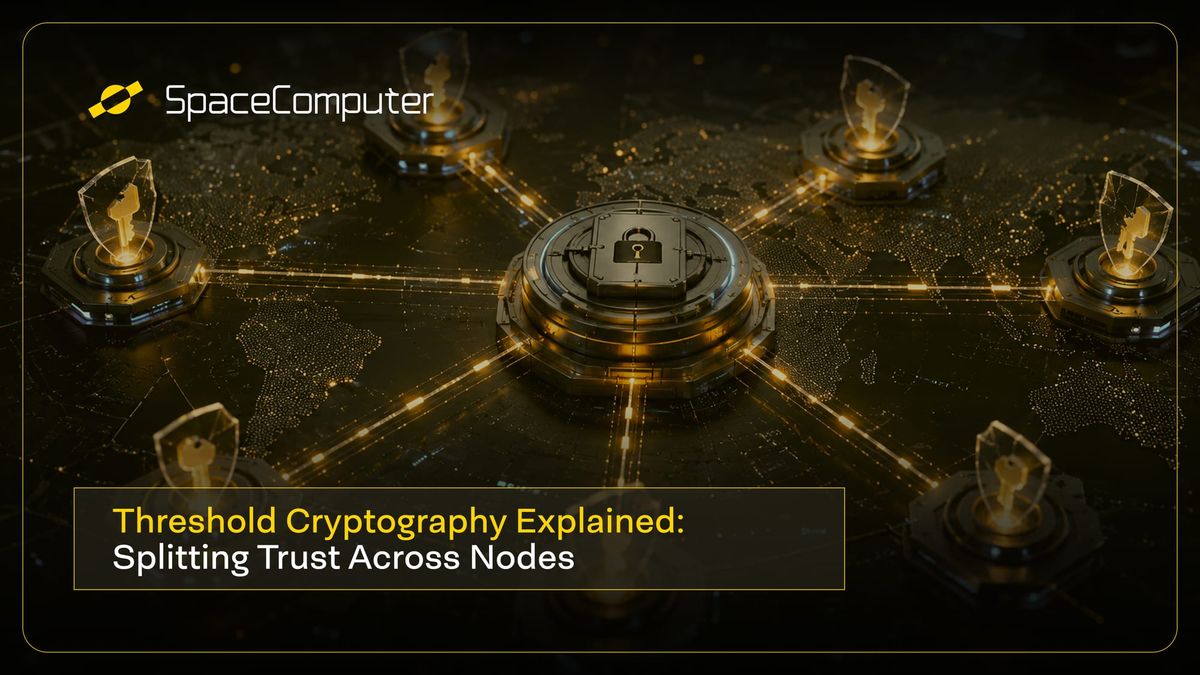
Threshold cryptography offers a fundamentally different approach. Instead of fortifying a single key inside a single vault, it splits cryptographic authority across multiple parties. A secret is divided into n shares, distributed among independent nodes, where a minimum threshold t must cooperate to perform any operation. Compromise one node, and the system remains secure. Lose several nodes, and the system remains operational. This isn't theoretical, as protocols like SKALE and Shutter Network already use threshold encryption to prevent front-running attacks, while satellite operators distribute command keys across constellations to prevent hijacking.
SpaceComputer extends this paradigm beyond Earth. By distributing threshold cryptography across a physically inaccessible satellite constellation in Low Earth Orbit, we eliminate entire classes of vulnerabilities that terrestrial infrastructure, no matter how hardened, cannot escape. Once a satellite is in orbit, no adversary can physically access the hardware. When it de-orbits, every key is destroyed on atmospheric re-entry. This is cryptographic sovereignty in its purest form: trust split across a constellation that operates beyond the jurisdictional reach of any single nation-state.
Key Takeaways
- Threshold cryptography eliminates single points of failure by splitting a secret key into n shares, requiring a minimum threshold t to perform cryptographic operations. N o single compromised node can break system security.
- The (t, n) threshold model provides both security (fewer than t colluding parties cannot reconstruct the secret) and fault tolerance (the system remains operational even if n-t parties are offline or destroyed).
- SpaceComputer distributes threshold cryptography across a satellite constellation in Low Earth Orbit, providing physical inaccessibility that no terrestrial infrastructure can replicate. Once in orbit, no adversary can physically access the hardware.
- Post-quantum readiness and the expansion of decentralized infrastructure (blockchain, satellite constellations, edge AI) make threshold cryptography a strategic imperative, not a future consideration, for enterprise security leaders.
What Is Threshold Cryptography and Why Does It Matter Now?
Threshold cryptography is a cryptographic paradigm where a secret, typically a private key, is split into n shares and distributed among multiple parties. To perform any cryptographic operation (signing a transaction, decrypting data, generating a key), a minimum threshold t of these parties must cooperate. The mathematical foundation ensures that any subset of fewer than t parties even if they collude, cannot perform the operation or gain any information about the underlying secret.
This stands in stark contrast to traditional Public Key Infrastructure (PKI) and Hardware Security Module (HSM) models, where a single entity holds complete signing authority. In those architectures, the compromise of that single key whether through insider threat, physical access, or supply chain attack results in total system failure. Threshold cryptography eliminates the "keys to the kingdom" vulnerability entirely.
The (t, n) model also provides fault tolerance. The system remains operational as long as t participants are reachable, even if n-t parties are offline, compromised, or destroyed. For satellite constellations operating in high-radiation environments, or blockchain validators distributed across hostile jurisdictions, this resilience is non-negotiable.
For organizations with data that must remain confidential for ten or more years (defense secrets, intellectual property, biometric records, satellite telemetry), the transition to quantum-resistant threshold cryptography is a strategic imperative, not a future consideration.
The expansion of decentralized infrastructure amplifies this need:
- Blockchain protocols process billions in value
- Satellite constellations like Starlink doubled their user base to 9 million in 2025, reflecting the broader surge in connected infrastructure as the Number of connected IoT devices reached 21.1 billion, growing 14% year over year.
- AI workloads are moving to edge servers and space-based data centers
Each of these domains requires cryptographic trust models that can survive the compromise of any single node, and threshold cryptography is the only architecture that delivers this guarantee.
Threshold cryptography is the security primitive for Zero Trust Architecture in distributed and orbital environments. It's operational infrastructure, and the organizations that deploy it now will define the security posture of the next decade.
How Threshold Cryptography Works: Core Mechanisms and Operations
The foundation of threshold cryptography is Distributed Key Generation (DKG). In traditional secret sharing, a single "dealer" generates a private key, splits it into shares, and distributes them. This introduces a critical vulnerability: the dealer knows the full key at the moment of creation. Modern threshold schemes eliminate this risk entirely. In DKG, multiple parties collectively generate a public/private key pair through a cryptographic protocol where no single party ever knows the private key.
Each participant generates a random polynomial and shares commitments to the coefficients with the other parties. Through a series of cryptographic exchanges, the participants verify each other's contributions and collectively construct a public key. The private key exists only as distributed shares. Each party holds a piece, but the complete key is never reconstructed. This removes the "trusted dealer" vulnerability and confirms that the setup phase itself is secure.
Threshold Signature Schemes (TSS) build on this foundation. When a cryptographic operation is required, t participants generate "signature shares" using their individual key shares. These shares are then aggregated into a single, standard signature. The critical advantage: the resulting signature is indistinguishable from one produced by a non-threshold system. A Threshold ECDSA signature, for example, can be verified by any standard ECDSA verification algorithm.
Advanced protocols like FROST (Flexible Round-Optimized Schnorr Threshold Signatures) confirm that signature size and verification time remain constant, regardless of the number of participants. A signature from a (3, 5) threshold scheme is identical in size and computational cost to a signature from a (10, 20) scheme, or a traditional single-key signature. This efficiency is critical for blockchain applications where transaction size directly impacts gas fees.
Threshold decryption applies the same principles to confidential computing. A ciphertext can only be decrypted if a quorum of parties cooperates. This is foundational for:
- "Dead man's switch" protocols in defense systems
- Confidential smart contract execution in blockchain
- AI inference where no single node should ever see unencrypted sensitive data
The cryptographic primitive underpinning these operations is Secret Sharing, often based on Shamir's Secret Sharing. A secret is encoded as a polynomial of degree t-1, and each participant receives a point on that polynomial. Any t points can reconstruct the polynomial (and thus the secret), but t-1 points reveal nothing. This mathematical guarantee is what makes threshold cryptography provably secure.
The National Institute of Standards and Technology (NIST) is actively standardizing threshold cryptography through the Multi-Party Threshold Cryptography (MPTC) Project. The NIST IR 8214 series establishes criteria for threshold schemes, with IR 8214B focusing on EdDSA and Schnorr signatures, and IR 8214C representing the "First Call for Multi-Party Threshold Schemes," a formal process to collect and validate reference materials for industry-wide adoption. NIST's goal is to confirm that threshold-produced signatures are "interchangeable" with conventional signatures, maintaining compatibility with existing verification algorithms and infrastructure.
Threshold Cryptography vs. MultiSig and MPC: Understanding the Distinctions
Threshold cryptography is often conflated with Multi-Signature (MultiSig) and Secure Multi-Party Computation (MPC), but these technologies have distinct technical and operational boundaries that architects and developers must understand.
In a MultiSig scheme, each participant holds a complete, independent public/private key pair. To authorize a transaction, each participant submits their individual signature to the blockchain. The protocol verifies that a sufficient number of valid signatures are present (e.g., 3 out of 5). This reveals the number of signers on-chain and increases transaction costs. Each signature adds data to the transaction, increasing gas fees. MultiSig is an application-layer solution, limited to blockchains that natively support it.
Threshold cryptography, by contrast, distributes shares of a single common public key. To sign a transaction, t participants generate signature shares off-chain, which are then aggregated into a single, standard signature. This single signature is submitted to the blockchain as one transaction. To an outside observer, it's indistinguishable from a signature produced by a traditional single-key system. The number of signers is hidden, privacy is preserved, and transaction costs are minimized. Threshold schemes are protocol-layer solutions, applicable to any cryptographic primitive.
MPC (Secure Multi-Party Computation) is the broader field concerned with multiple parties computing a function over private inputs without revealing those inputs to each other. Threshold cryptography is a specific application of MPC principles to cryptographic keys. When combined with homomorphic encryption (which allows computation on encrypted data), threshold MPC enables complex data processing where the data remains encrypted and the power to decrypt it is distributed across multiple nodes.
The distinction matters. For blockchain custody solutions, threshold schemes reduce transaction fees and hide the security structure of the wallet from potential attackers. For satellite command infrastructure, threshold cryptography allows for flexible, dynamic security policies that can adapt to changing threat environments without requiring protocol-level changes.
SpaceComputer's Orbital Threshold Cryptography: Distributing Trust Beyond Earth's Reach
SpaceComputer is building the world's most secure general-purpose distributed compute network, the Orbital Root of Trust, with native support for threshold signing schemes across a satellite constellation in Low Earth Orbit. This isn't an incremental improvement over terrestrial infrastructure. It's a fundamentally different security architecture.
Every terrestrial cryptographic infrastructure: HSMs, cloud KMS providers, on-premise enclaves, shares one fundamental vulnerability: the hardware can be physically reached. The TEE.Fail disclosure demonstrated that attestation keys can be extracted from Intel SGX and AMD SEV using less than $1,000 of equipment. Data center raids, supply chain interdiction, and insider threats are all viable attack vectors. SpaceComputer removes this constraint entirely. Once a satellite is in orbit, no adversary, state-level or otherwise, can physically access the hardware.
SpaceComputer's Orbital Key Management Services (KMS) is designed with a clear architectural path from centralized to distributed threshold cryptography. Initially deployed at the single-node level with hardware-attested Trusted Execution Environments (TEEs), the roadmap explicitly expands to multi-party computation (MPC) protocols across multiple satellites in a hybrid Earth-orbit configuration. All signing keys are generated on-orbit after launch, eliminating pre-launch supply chain attack surfaces entirely.
The security guarantee is absolute: once a satellite reaches end of life and de-orbits, every key and hardware component is destroyed on atmospheric re-entry. This is irreversible secure deletion with no forensic recovery possible.
SpaceTEE (Space-Based Trusted Execution Environments) runs sensitive workloads inside hardware that is physically inaccessible to any adversary, including the infrastructure operator. This eliminates entire classes of side-channel and physical access attacks that terrestrial TEEs (Intel SGX, AMD SEV, ARM TrustZone) are vulnerable to. Confidential AI inference, classified data processing, and cryptographic operations all execute with verifiable software integrity.
SpaceComputer's satellite architecture splits the trust anchor across Secure Elements (SEs) from different vendors, confirming that no single chip supplier holds complete attestation authority. This is a hardware-level implementation of the threshold trust model and no single vendor compromise can undermine the system.
The Cosmic Randomness Beacon (cTRNG) harnesses space radiation to deliver verifiable, tamper-proof randomness from orbit. This directly feeds into secure key creation, nonces, and consensus algorithms. These are foundational elements of threshold cryptography protocols. Unlike terrestrial randomness sources, which can be influenced by electromagnetic interference or hardware backdoors, cosmic radiation is a physical phenomenon that cannot be manipulated.
SpaceComputer's attestation protocol provides cryptographic guarantees that infrastructure is genuinely running in space. Predictable satellite trajectories enable geolocation attestation and Sybil resistance: properties that terrestrial distributed systems cannot authentically replicate. Clients can independently verify that compute is occurring in orbit, without needing to take SpaceComputer's word for it.
This is cryptographic sovereignty: nodes operate beyond the jurisdictional reach of any single nation-state, providing guarantees that ground-based MPC networks cannot replicate. Terrestrial multi-party computation nodes can be subpoenaed, raided, or physically coerced. Orbital nodes cannot.
SpaceComputer integrates post-quantum cryptography (PQC) directly into its orbital infrastructure, with a hybrid migration path from hardware-bound ECC toward post-quantum primitives (such as ML-KEM and other NIST-standardized algorithms) as hardware and standards mature. This makes our threshold cryptography architecture resilient not only against current adversaries but also against the emerging quantum threat, including "Harvest Now, Decrypt Later" attacks targeting long-lived sensitive data.
All services: randomness, confidential compute, a d key management, are accessible through a single API on Orbitport, enabling developers to integrate orbital threshold cryptography capabilities into Web3 applications, enterprise systems, and AI workloads.
Real-World Applications: From MEV Mitigation to On-Orbit Security
Threshold cryptography is operational infrastructure today, deployed across high-stakes environments where single points of failure are unacceptable.
Blockchain and Web3: Preventing MEV Attacks
Protocols like SKALE, Osmosis, and Shutter Network use threshold encryption to prevent Maximal Extractable Value (MEV) attacks. MEV allows validators to front-run or reorder transactions for profit, which is a form of legalized theft that costs users billions annually. Threshold schemes encrypt transactions in the mempool, keeping them shielded from validators until a threshold of nodes collectively decrypts them after consensus. Validators cannot see the contents of a transaction, and thus cannot front-run it or execute "sandwich attacks" where they place their own transactions before and after a victim's transaction to extract value.
The mechanism is elegant: transactions remain encrypted until a quorum of validators has committed to including them in a block. Only after the consensus threshold is met do the nodes collectively decrypt the transactions. This prevents malicious reordering while maintaining the transparency and verifiability that blockchain protocols require.
Satellite Constellations and Space Industry Operations
For satellite constellations and space industry operators, threshold cryptography secures satellite-to-ground and satellite-to-satellite links. Command keys are distributed across ground stations and multiple satellites in the constellation. An adversary must compromise multiple satellites simultaneously to seize control of the network: a feat that requires capabilities vastly more expensive and difficult to acquire than attacking terrestrial infrastructure.
This tamper-proof command infrastructure confirms that even if a single ground station is compromised, the adversary cannot hijack the satellite. The threshold model provides both security (no single compromise is sufficient) and operational resilience (the constellation remains functional even if several nodes are offline or destroyed).
Confidential Computing and AI Workloads
For confidential computing and AI workloads, threshold decryption enables "confidential smart contract execution" and AI inference where data is processed by a cluster of nodes, but no single node ever sees the unencrypted sensitive data. This is critical for:
- Healthcare AI: Processing patient records
- Financial AI: Analyzing transaction data
- Defense AI: Processing classified intelligence
The data remains encrypted throughout the computation, and only the final result is decrypted, and only if a threshold of nodes agrees.
SpaceComputer's Orbitport API platform allows developers to integrate these capabilities directly into their applications. Developer guides demonstrate how to generate secure nonces for Sign In with Ethereum (SIWE) using verifiable cosmic randomness, and how to build tamper-proof randomness into Web3 applications including cryptographic games, lotteries, and secure authentication flows.
Security Challenges and How SpaceComputer Addresses Them
Threshold cryptography distributed across a satellite constellation presents specific engineering and operational challenges. SpaceComputer acknowledges these honestly and is actively building solutions.
Distributed Key Generation (DKG) Phase Vulnerabilities
The Distributed Key Generation (DKG) phase is the most critical vulnerability. If the DKG process is compromised, a malicious participant could influence the entropy of the generated key, undermining the entire system's security. Older models relied on a single "dealer" to split the key, introducing a single point of failure. Modern DKG confirms no single entity ever knows the full key, even at the moment of creation.
SpaceComputer addresses this through the blue paper and verified-empty key slots before launch. All cryptographic material is generated on-orbit in a physically secure environment, eliminating pre-launch key exposure.
Collusion Risks and Hardware Diversity
Collusion risks remain: if t participants conspire, they can reconstruct the full secret key and bypass the security model. SpaceComputer's multi-satellite architecture and hardware vendor diversity mitigate this. The trust anchor is split across Secure Elements from different vendors, confirming that no single entity or chip supplier holds complete attestation authority. An adversary would need to compromise multiple independent hardware supply chains simultaneously, a significantly higher bar than compromising a single vendor or operator.
Communication Constraints in Orbit
Communication constraints in orbit introduce latency and connectivity challenges not present in terrestrial data centers. SpaceComputer focuses on Zero-Knowledge Proofs (ZKP) for succinctness, reducing the communication overhead required for cryptographic verification. Multi-satellite and hybrid Earth-orbit deployment architectures account for orbital communication windows, confirming that threshold operations can complete even when direct line-of-sight to all satellites is not continuously available.
Post-Quantum Readiness
Post-quantum readiness presents a hardware challenge: current secure elements in satellite hardware do not natively support post-quantum cryptographic algorithms. SpaceComputer has designed a hybrid migration path: hardware-bound ECC for current platform security, with a clear roadmap for integrating post-quantum primitives (ML-KEM, NIST-standardized algorithms) as hardware and standards mature. TPMs on our satellites serve as natural integration points for these next-generation primitives.
Addressing Single Point of Failure
The single point of failure challenge is acknowledged directly: a single-node KMS, even in orbit, represents a centralization risk: the antithesis of threshold cryptography's core value proposition. While SpaceComputer's KMS initially targets single-node deployment with TEE hardware attestation, the roadmap explicitly expands to multi-party computation protocols across multiple satellites, distributing key authority across the constellation and eliminating single points of failure through genuine threshold architectures.
Verifiability Without Blind Trust
Verifiability without blind trust is foundational. Clients using any cryptographic infrastructure provider must have confidence that the provider's security claims are true. SpaceComputer's attestation protocol, described as the "https for space compute"that allows clients to independently verify that compute is genuinely occurring in orbit. Predictable orbital trajectories and direct line-of-sight communication create a physically verifiable trust model that terrestrial providers cannot replicate.
TLDR
Threshold cryptography represents a fundamental shift from "security through fortification" (protecting one key in one vault) to "security through distribution" (splitting power across a network). For organizations operating in decentralized, high-risk, or extra-terrestrial environments, it provides the only viable path for fault-tolerant and privacy-preserving cryptographic infrastructure.
SpaceComputer's orbital infrastructure delivers cryptographic sovereignty and physical inaccessibility that no terrestrial provider can replicate. By distributing trust across a satellite constellation in Low Earth Orbit, we eliminate entire classes of vulnerabilities: physical access attacks, jurisdictional coercion, supply chain interdiction that terrestrial infrastructure, no matter how hardened, cannot escape.
The "Harvest Now, Decrypt Later" threat, the post-quantum transition, and the expansion of decentralized infrastructure (blockchain, satellite constellations, edge AI) make threshold cryptography a strategic imperative for enterprise security leaders, blockchain developers, and space industry operators. As NIST standardization progresses through 2026 and the Space Economy expands, threshold cryptography is transitioning from an academic concept to operational infrastructure.
SpaceComputer's Orbital Root of Trust, with native threshold signing schemes, Cosmic Randomness Beacon, and verifiable attestation, is the foundational security layer for the future of secure computing in space. Security architects should begin evaluating threshold cryptography as a mandatory component of their post-quantum and zero-trust security roadmaps. Explore SpaceComputer's Orbitport API platform to integrate orbital threshold cryptography into your infrastructure today.
Frequently Asked Questions
Can Threshold Cryptography Protect Against Quantum Computing Attacks?
Threshold cryptography is a distribution method, not an algorithm. The underlying cryptographic primitive (e.g., ECDSA, RSA) determines quantum resistance. Threshold versions of post-quantum algorithms (e.g., threshold ML-KEM) are being developed and standardized by NIST. SpaceComputer's hybrid migration path uses hardware-bound ECC for current security, with a clear roadmap for integrating post-quantum primitives as standards mature.
How Does NIST's Multi-Party Threshold Cryptography (MPTC) Project Impact Enterprise Adoption?
NIST's IR 8214 series establishes standardized criteria for threshold schemes, confirming interoperability and compatibility with existing verification algorithms. The goal is "interchangeability": a threshold-produced signature should be indistinguishable from a single-key signature, maintaining compatibility with existing infrastructure. As NIST standardization progresses, government and defense agencies will likely mandate threshold protocols for high-security infrastructure.
Why Is the Distributed Key Generation (DKG) Phase So Critical?
If the DKG process is compromised, a malicious participant could influence the entropy of the generated key, undermining the entire system's security. Older models relied on a single "dealer" to split the key, introducing a single point of failure. Modern DKG confirms no single entity ever knows the full key, even at the moment of creation. SpaceComputer generates all keys on-orbit after launch, eliminating pre-launch supply chain attack surfaces.
How Does SpaceComputer's Orbital Infrastructure Provide Advantages Over Terrestrial Threshold Cryptography?
Physical inaccessibility: Once in orbit, no adversary can physically access the hardware, eliminating entire classes of side-channel and physical access attacks that terrestrial TEEs (Intel SGX, AMD SEV) are vulnerable to.
Cryptographic sovereignty: Orbital nodes operate beyond the jurisdictional reach of any single nation-state, providing guarantees that ground-based MPC networks cannot replicate.
Secure deletion: When a satellite de-orbits, every key and hardware component is destroyed on atmospheric re-entry, guaranteeing irreversible secure deletion.
SpaceComputer is the open, credibly neutral infrastructure layer that connects the space economy, providing the hardware and software standard for verifiable compute across operators, jurisdictions, and satellites, with high security guarantees and verifiability.
Visit our website for more information.
Follow us on X (Twitter) and LinkedIn.
Read more about our trust architecture in our research paper Space Fabric here.