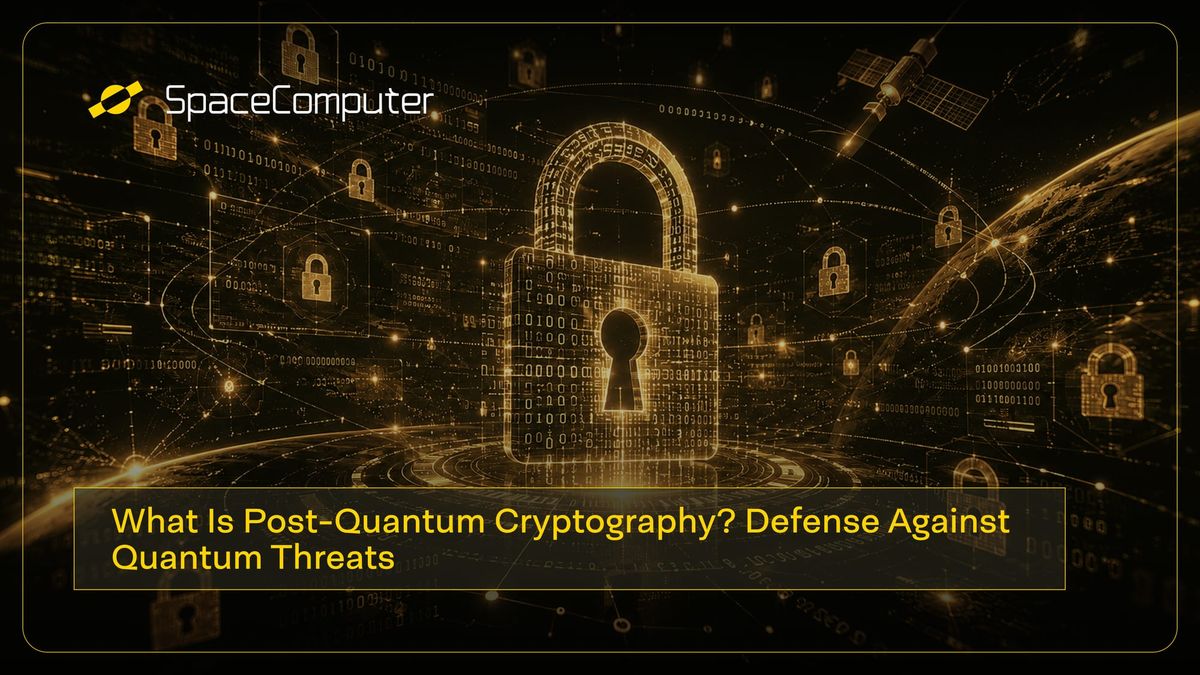
What Is Post-Quantum Cryptography? Defense Against Quantum Threats
Adversaries are harvesting encrypted data today. They cannot read it yet, but they are storing it and waiting for the day there's quantum computers powerful enough to break current encryption standards in hours. This is the "Harvest Now, Decrypt Later" threat, and it is already underway.
Post-quantum cryptography (PQC) is the mathematical defense against this threat. PQC consists of advanced algorithms that run on existing classical computers while resisting attacks from both classical and quantum machines. Quantum cryptography requires specialized hardware to operate. PQC runs on the computers organizations already use.
For enterprise cybersecurity leaders, defense agencies, and space operators, the transition to PQC is an immediate priority. Organizations with data that must stay confidential for ten years or more, including intellectual property, defense secrets, medical records, and satellite telemetry, need to begin now.
In this post, we cover what post-quantum cryptography is, why it matters now, the NIST-standardized algorithms that form the migration roadmap, and how orbital infrastructure changes PQC implementation.
Key Takeaways
- Post-quantum cryptography uses mathematical algorithms on classical hardware to resist quantum computer attacks, while quantum cryptography requires specialized equipment.
- The quantum threat is active today through "Harvest Now, Decrypt Later" attacks, where adversaries store encrypted data for future decryption.
- NIST has standardized PQC algorithms (ML-KEM, ML-DSA, SLH-DSA, and FN-DSA), providing the compliance roadmap for enterprise migration.
- Hybrid cryptography and crypto-agility are essential implementation strategies for the decade-long transition to quantum-resistant security.
- SpaceComputer is working on orbital PQC infrastructure on smallsats (small satellites), providing tamper-proof key management and confidential execution in orbit.
What Is Post-Quantum Cryptography and Why Does It Matter?
Post-quantum cryptography refers to cryptographic algorithms designed to secure data against attacks from both classical and quantum computers. These are mathematical approaches that run on existing hardware, including servers, smartphones, and satellites, without requiring quantum equipment.
Current encryption standards like RSA, Elliptic Curve Cryptography (ECC), and Diffie-Hellman rely on mathematical problems that classical computers cannot solve efficiently. They depend on the difficulty of integer factorization and discrete logarithm problems. Breaking a 2048-bit RSA key would take a classical computer billions of years.
Quantum computers solve these problems on a different timescale. Shor's algorithm, developed in 1994, solves these exact problems exponentially faster on quantum machines. A sufficiently powerful quantum computer, known as a cryptographically relevant quantum computer (CRQC), could break today's public-key infrastructure in hours. Every bank transfer, encrypted message, digital signature, and blockchain transaction protected by RSA or ECC would become vulnerable.
YouTube video of Peter Shor, creator of Shor's algorithm and quantum expert.
"The threat timeline has compressed dramatically. What we once thought was a distant concern is now an active risk requiring immediate mitigation strategies." — National Security Agency, CNSA 2.0 Guidelines
The threat is already active through "Harvest Now, Decrypt Later" attacks. Nation-states and sophisticated adversaries are intercepting and storing encrypted data today, including satellite communications, government secrets, medical records, and intellectual property, with the intention of decrypting it once quantum computers mature. For organizations with long-term data sensitivity requirements, this makes PQC migration an immediate priority.
Post-quantum cryptography and quantum cryptography are distinct approaches:
- PQC uses software-based mathematical algorithms that scale globally and run on standard hardware.
- Quantum cryptography, such as Quantum Key Distribution (QKD), relies on the physical properties of light and requires specialized quantum hardware, fiber optics, and lasers.
Quantum cryptography is theoretically unbreakable, but it is currently limited by distance and high infrastructure costs.
For government defense, space operations, healthcare, cryptographic applications, and enterprise security, post-quantum cryptography is the practical and scalable approach. The transition spans a decade, and that decade has already started.
NIST Standards and the Mathematical Foundations of PQC
The U.S. National Institute of Standards and Technology (NIST) has led a global effort to standardize post-quantum cryptographic algorithms, producing the four standards that form the authoritative roadmap for enterprise migration.
The NIST-Standardized PQC Algorithms
ML-KEM (FIPS 203), based on the CRYSTALS-Kyber family, is a Module-Lattice-Based Key-Encapsulation Mechanism. It is designed to replace RSA and Diffie-Hellman for securing the exchange of encryption keys.
ML-DSA (FIPS 204), based on CRYSTALS-Dilithium, provides lattice-based digital signatures for identity authentication and data integrity in software, firmware, and communications.
SLH-DSA (FIPS 205), based on SPHINCS+, offers a stateless hash-based digital signature standard as a conservative backup for long-term security.
FN-DSA (FIPS 206), known as FALCON, focuses on exceptionally compact key and signature sizes for lattice-based signatures. It is currently in Initial Public Draft, with the final standard expected around 2027. Its core algorithm, parameter sets, and security proofs are well-established and not expected to change. The remaining open questions concern encoding formats and implementation guidance rather than security.
These standards, alongside the NSA's CNSA 2.0 suite, give enterprise cybersecurity leaders, defense agencies, and space operators a formal compliance roadmap.
Mathematical Foundations That Resist Quantum Attacks
The security of these algorithms comes from their mathematical foundations, which remain hard for both classical and quantum computers to solve.
Lattice-based cryptography is the most prominent family. It relies on geometric problems in high-dimensional lattices, such as the Learning With Errors (LWE) problem and the Shortest Vector Problem (SVP). These problems are computationally difficult even for quantum algorithms, which makes lattice-based schemes efficient and secure. They also support Fully Homomorphic Encryption, allowing computation on encrypted data without decryption.
Hash-based cryptography uses one-way hash functions for digital signatures. Its security model is conservative because it depends on the proven reliability of hash functions rather than new algebraic assumptions.
Code-based cryptography relies on the difficulty of decoding random linear codes. The McEliece system has withstood over 40 years of cryptanalysis, though it requires very large public keys, often nearly 1 MB.
Multivariate cryptography involves solving systems of nonlinear polynomial equations, primarily used for fast signature verification.
Mathematical diversity is essential. If a vulnerability is discovered in one family of algorithms, backup options from different mathematical foundations ensure continued security. NIST recently selected HQC (Hamming Quasi-Cyclic), a code-based mechanism, for standardization to provide this diversity.
How SpaceComputer Delivers Orbital Post-Quantum Security
SpaceComputer is the only provider building a dedicated security layer for orbital compute, delivering post-quantum cryptography from space with trust guarantees that terrestrial cloud infrastructure cannot match.
Tamper-Proof Key Management From Orbit
Our Orbital Key Management Services (KMS) are built with post-quantum security at their core. We provide tamper-proof key management from a decentralized network of satellites in Low Earth Orbit. Unlike terrestrial data centers vulnerable to physical intrusion, our orbital infrastructure operates beyond the reach of ground-based threats.
 SpaceComputer | Orbital Root of Trust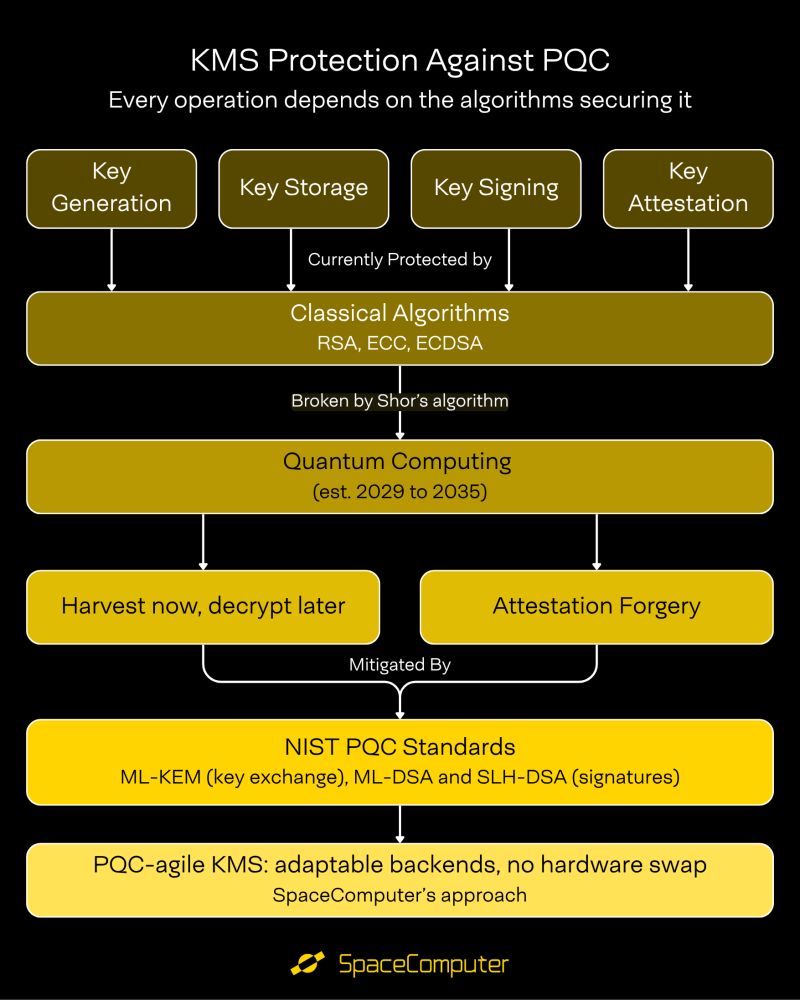
We integrate PQC directly into our space-based infrastructure, offering encryption impervious to quantum attacks for both orbital and terrestrial customers. Our Trusted Execution Environments (TEEs) in space secure sensitive workloads and cryptographic operations against advanced threats, including those posed by quantum computers. Read more about this in our Space Fabric research paper.
Whether you are processing AI models, satellite telemetry, Earth observation data, or blockchain transactions, our orbital TEEs ensure confidentiality and integrity.
Neutralizing the Harvest Threat
Our decentralized satellite network addresses the "Harvest Now, Decrypt Later" threat directly. Space communications can be easily intercepted, which makes them prime targets for harvest attacks. By combining post-quantum cryptography with physical layer security, such as burying signals in noise (negative OSNR), we make transmissions unrecordable and neutralize the harvest threat before decryption becomes possible.
Beyond Terrestrial Limitations
For enterprise cybersecurity leaders and defense agencies planning post-quantum transitions, SpaceComputer extends security services beyond traditional terrestrial cloud providers. Our orbital infrastructure delivers the highest trust guarantees for critical applications, including satellite operations, defense communications, and confidential AI workloads, where security cannot be compromised.
Preparing Organizations for the Quantum Era
The transition to post-quantum cryptography requires strategic planning and phased implementation. We recommend five readiness steps.
1. Inventory Your Cryptographic Assets
Identify every instance where public-key infrastructure is used, including TLS certificates, VPNs, firmware signatures, API authentication, and third-party integrations. Discovery tools are essential for finding hardcoded algorithms in legacy software.
2. Prioritize High-Value, Long-Lived Data
Focus first on information that must remain confidential for ten years or more:
- Intellectual property
- Biometric records
- Defense secrets
- Medical histories
- Satellite telemetry
These assets face the greatest risk from harvest-now attacks.
3. Assess Vendor and Infrastructure Readiness
Ensure that hardware manufacturers (HSMs), cloud providers, and satellite operators have documented PQC migration paths. Quantum readiness is only as strong as the weakest link in your digital infrastructure.
4. Implement Hybrid PQC/Classical Pilots
Hybrid cryptography pairs a classical algorithm (like X25519) with a post-quantum algorithm (like ML-KEM). Data remains secure as long as at least one layer holds. Test these hybrid connections in non-production environments to benchmark performance impacts from larger key sizes.
5. Enable On-Orbit Security for Space and Defense Operations
Extend your cryptographic infrastructure beyond terrestrial reach using tamper-proof, space-hardened PQC modules.
The Importance of Crypto-Agility
Crypto-agility is the architectural principle underlying successful migration. Design systems where cryptographic primitives can be swapped through configuration changes rather than code rewrites. APIs and firmware should reference algorithm identifiers rather than hardcoded implementations. This flexibility is essential for responding to evolving standards and potential future vulnerabilities.
The migration timeline spans a decade. Starting now positions your organization ahead of both the quantum threat and regulatory requirements.
Securing the Future From Orbit
Quantum computers will break today's encryption. This is a mathematical certainty.
Post-quantum cryptography provides the defense, running on classical hardware to resist both current and future quantum machines. NIST's standardized algorithms provide the roadmap. Hybrid implementations and crypto-agile architectures provide the implementation strategy. What remains is infrastructure that matches the scale of the threat.
SpaceComputer delivers the only orbital security layer providing tamper-proof, decentralized post-quantum cryptography from space. Our satellite network extends cryptographic infrastructure beyond terrestrial limitations, offering trust guarantees that ground-based approaches cannot match.
For enterprise cybersecurity leaders, defense agencies, cryptographers, and space operators, the quantum era demands security that operates beyond traditional boundaries. We are building that infrastructure from orbit.
Partner with SpaceComputer to future-proof your cryptographic infrastructure with orbital PQC services that protect your most sensitive data and operations against the quantum threat. Contact us here, or explore our suite of security solutions.
For more details on PQC for satellite operators, check out:
 Tara Jean
Frequently Asked Questions
When Will Quantum Computers Break Current Encryption?
Experts estimate that "Q-Day," the point when quantum computers can break current encryption, could arrive anywhere in a few years. The threat is already active through "Harvest Now, Decrypt Later" attacks, where adversaries intercept and store encrypted data today for future decryption.
How Is Post-Quantum Cryptography Different From Quantum Cryptography?
Post-quantum cryptography uses mathematical algorithms that run on existing classical hardware, including servers, smartphones, and satellites, and it scales globally. Quantum cryptography, such as QKD, requires specialized quantum hardware, lasers, and fiber optics, is limited by distance, and carries high infrastructure costs. PQC is the practical approach for most organizations.
Which Industries Should Prioritize PQC Adoption First?
Government defense, space operations, healthcare, and financial services should prioritize PQC adoption immediately. Any organization with data requiring ten years or more of confidentiality, including intellectual property, biometric records, defense secrets, and satellite telemetry, must act now to protect against harvest-now attacks.
What Are the Main Challenges in Implementing PQC?
The primary challenges include increased key and signature sizes that affect bandwidth and storage, particularly for IoT devices and satellite communications. Organizations also need agile architectures that allow algorithm swapping without extensive updates, and they often require supply chain and vendor network coordination for consistent implementation.
How Does SpaceComputer's Orbital Infrastructure Strengthen PQC Security?
SpaceComputer's future satellite network will provide tamper-proof key management service (KMS) and confidential execution in satellite-based TEEs (SatTEEs), where physical intrusion risks are eliminated. We integrate PQC with verifiable true randomness from space and physical isolation as a security layer, creating an orbital security layer that terrestrial cloud providers cannot replicate.
Can Existing Systems Support Post-Quantum Algorithms?
Yes. Post-quantum cryptography algorithms run on standard classical hardware, including servers, smartphones, and satellites, without requiring equipment replacement. Implementation requires software updates and architectural planning for crypto-agility, which means designing systems where cryptographic primitives can be swapped through configuration changes rather than complete code rewrites.
SpaceComputer is the open, credibly neutral infrastructure layer that connects the space economy, providing the hardware and software standard for verifiable compute across operators, jurisdictions, and satellites, with high security guarantees and verifiability. Visit the SpaceComputer Website.
Follow SpaceComputer on X (Twitter) and LinkedIn.
Discover your next read:
 Tara Jean