Ground Station Cybersecurity: Why Your Satellite's Biggest Risk Is on the Ground
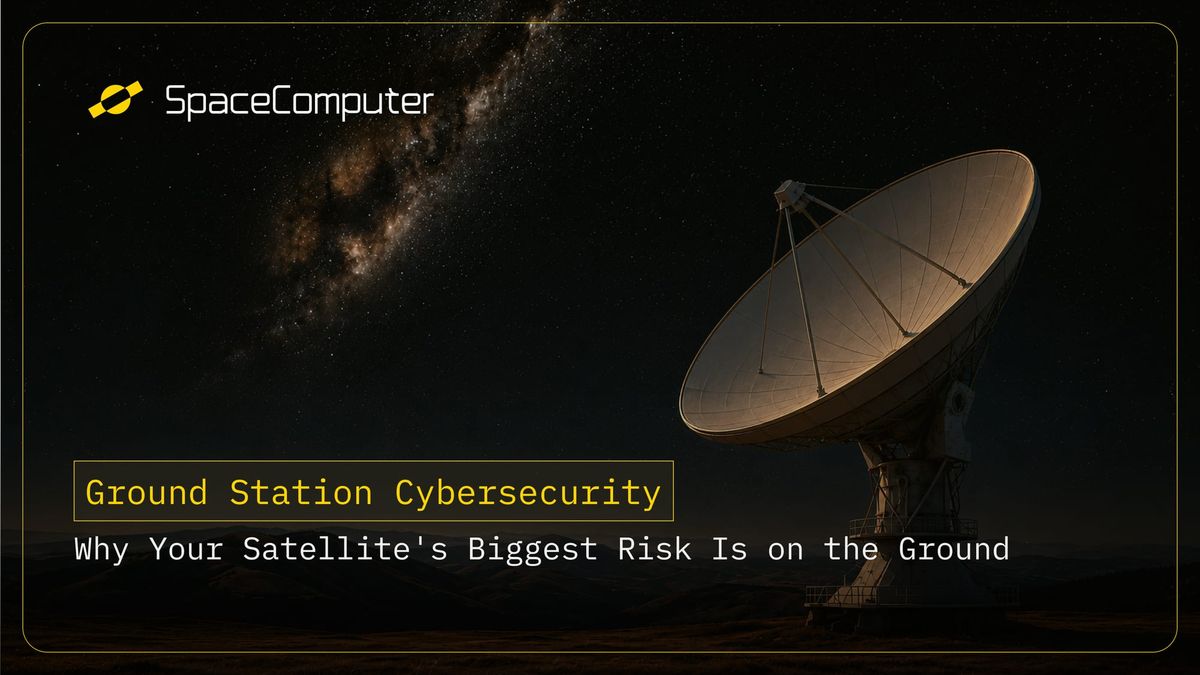
When it comes to satellite security, it’s a lot easier to attack when your target is on the ground rather than in orbit. Ground station cybersecurity, the practice of protecting the antennas, control centers, and software that command satellites and receive their data, is where many incidents begin.
A satellite can be engineered to the highest standard and still be lost through a single weak ground station. For commercial operators, that makes the ground segment one of the most important parts of a security program.
This article covers what ground station cybersecurity is, why ground stations are such an attractive target, case studies of real attacks, and how a different trust model can reduce the risk.
What Is Ground Station Cybersecurity?
Satellite cybersecurity protects three connected parts of every space system:
- The space segment: the satellite and its onboard computers.
- The link: the radio communication between the satellite and the ground.
- The ground segment: the ground stations and control centers that send commands and collect data.
Ground station cybersecurity focuses on the third part. The ground station is the command hub. It sends uplinks of commands for a satellite to carry out, holds the operator credentials and authorization access, and handles downlink of the data the satellite produces.
Because the ground station is the command control center accessible on Earth, its security largely determines the security of the whole system. You can build a flawless satellite and still lose control of it through a poorly secured ground station.
Why Ground Stations Are Targeted
A satellite in orbit is physically out of reach, where a ground station is not. Security researchers studying the New Space era consistently identify the ground segment and the radio links as the primary attack surfaces for space systems.
4 risks at the ground station level:
- Stolen operator credentials and insider access through accounts that are phished, leaked, or misused.
- Malware on ground systems and the software servers that talk to satellites can be compromised like any other computer.
- An attacker who reaches the control path can issue malicious or spoofed commands the satellite treats as legitimate.
- A single compromised ground station can become a systemic risk to an entire satellite constellation or ground station network.
That last point is really critical: a conventional ground network often trusts each station to vouch for what it sends. Compromise one, and the damage can extend beyond a single satellite.
The Business Impact of a Ground Station Breach
For a commercial operator, a ground station compromise is not only a technical problem. The consequences land on the business:
- Service outages when links go down
- Corrupted or untrustworthy data
- Loss of customer trust
- Financial and contractual exposure during downtime, remediation, and hardware replacement.
- Impacting customers in logistics, agriculture, energy, connectivity, and finance, that rely on space-based services.
As the Viasat case showed, a single event on the ground can ripple across multiple industries at once, and full recovery can take weeks.
Real-World Attacks on Ground Infrastructure
Two well-documented cases of attacks on ground infrastructure: one a real attack and one a controlled demonstration.
Viasat KA-SAT (2022)
On the 24th of February, 2022, attackers reached the management network of the Viasat KA-SAT satellite broadband service. According to Viasat's own incident report, they exploited a misconfigured VPN appliance to enter the trusted management segment of the ground network, then issued legitimate management commands that pushed wiper malware, later named AcidRain by SentinelOne, to tens of thousands of customer modems across Europe. The commands overwrote the modems' flash memory and they went offline.

The commercial impact reached 5,800 remotely-monitored wind turbines in Germany, and Viasat shipped thousands of replacement modems to restore service. The attackers never touched the satellite itself.
ESA OPS-SAT Ethical Hack (CYSAT 2023)
In April 2023, at the CYSAT conference in Paris, the European Space Agency invited a Thales cybersecurity team to attempt to take over OPS-SAT, a small demonstration satellite, under controlled conditions. Using standard access rights, the team gained control of the satellite's onboard application environment, then exploited vulnerabilities to introduce their own code.

Thales reported that they could tamper with the images the satellite's camera sent back, including masking selected areas on the ground, and change the spacecraft's orientation. The ESA used the findings to harden the system. The exercise was educational, and it displayed what is possible once an attacker has access to a satellite's command and control layer that a ground station connects to directly.
How to Mitigate Ground Station Cybersecurity Risk
Strong mitigation measures often include encryption, careful identity and access management, zero-trust principles, continuous monitoring, prompt patching, and supply-chain checks. By putting security measures in place, it raises the cost of an attack and belongs at every ground station facility.
These measures are critical but fall to one limitation: trust. By including a trustless security mechanism, you don’t have to rely solely on the contractual security of the ground station provider. You can also rely on the trustless systems in the hardware and software of space-based systems.
At SpaceComputer, we approach the problem from the other direction. Our Space Fabric architecture is designed to be trustless, removing reliance on a single ground station. This concept we refer to as ‘Proof of ET.’
Proof of Execution Triangulation (Proof of ET)
Proof of Execution Triangulation, or Proof of ET, lets a satellite prove it is genuinely in orbit, (giving the satellite proof that it is who it says it is) by collecting endorsements from a quorum of independent ground stations rather than relying on any single one. A single station's endorsement can be spoofed or compromised, but forging the result requires compromising an entire quorum at once, which is far harder when distributed globally around the world. As long as enough honest stations take part and reach consensus on the result, the certificate can be created without any forged data.
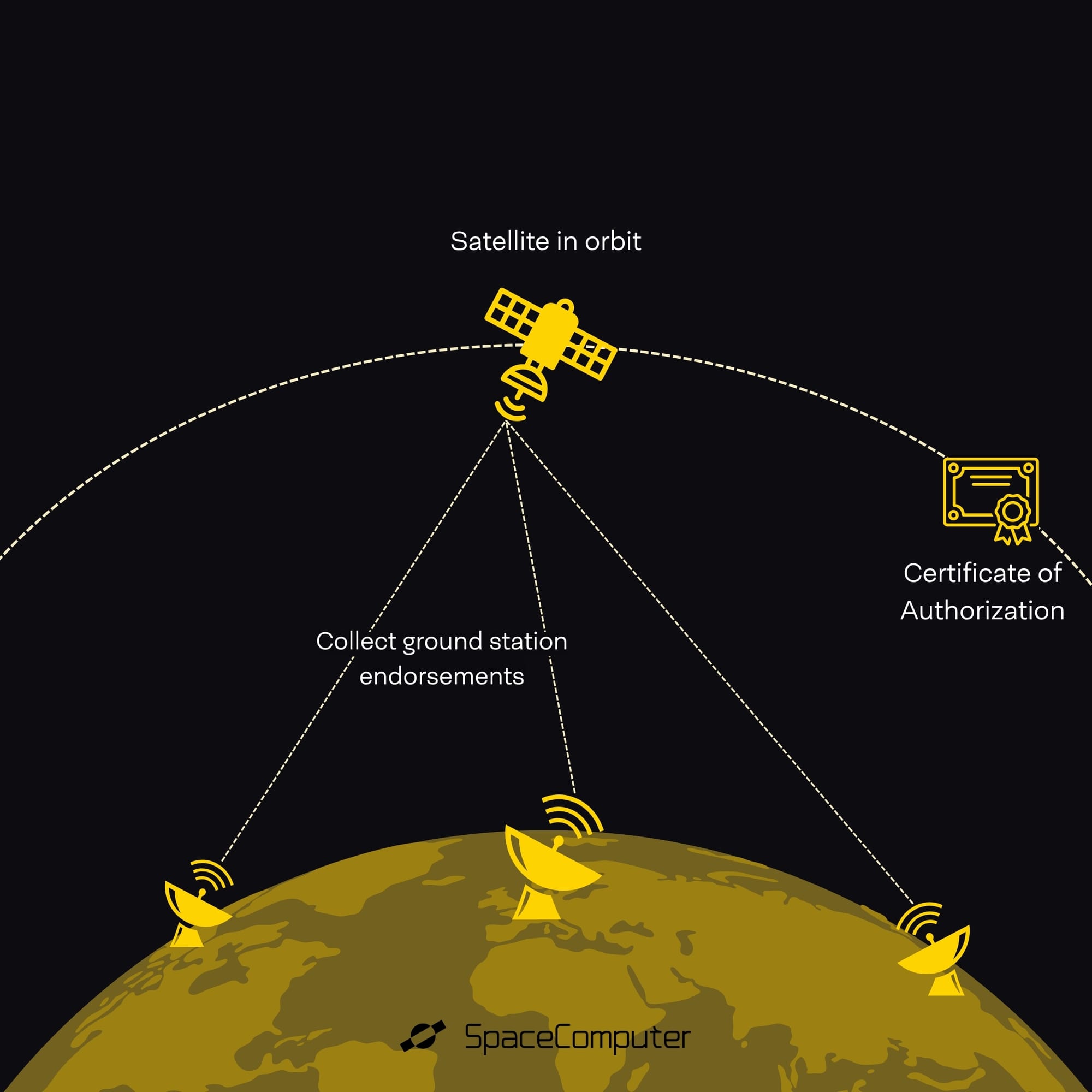
The effect on ground station cybersecurity is direct. One weak or malicious station no longer puts the system at risk, because trust comes from agreement across many stations rather than from any single point.
Strengthening Your Ground Segment
Ground stations will remain the most exposed part of any satellite system, by virtue of physical accessibility. Proof of ET can support filling that gap.
If you're curious to explore how we can support your satellite's cybersecurity and help mitigate ground station risk, reach out to our team at product@spacecomputer.io or contact us.
SpaceComputer is the open, credibly neutral infrastructure layer that connects the space economy, providing the hardware and software standard for verifiable compute across operators, jurisdictions, and satellites, with high security guarantees and verifiability.
Visit our website for more information.
Follow us on X (Twitter) and LinkedIn.
Read more about our trust architecture in our research paper Space Fabric here.
Ready for your next read? Hear from our engineering team how we are securing the connection between Earth and orbital infrastructure:
 Filip Rezabek