What Is Big Tech's Role in Space Exploration?
What Is Big Tech's Role in Space Exploration?
What is big tech's role in space exploration? In short: big tech supplies the infrastructure layer. Google, Amazon, Microsoft, and Nvidia leave the rockets to launch providers and bring connectivity, cloud services, chips, and capital to orbit instead, and that's reshaping what space exploration looks like.
For most of the space age, exploration belonged to government agencies and aerospace contractors. That changed when launch costs dropped and satellites got small enough for commercial companies to fly their own hardware. Now the technology giants that built the internet, the cloud, and the AI boom have entered orbit, and their role looks very different from SpaceX's or Blue Origin's.
Why Are Tech Companies Investing in Space?
Three forces are driving the investment:
Connectivity
Roughly a third of the world still lacks reliable internet access. Satellite constellations in low Earth orbit (LEO) can deliver broadband anywhere on the planet, which is why Amazon's building its own megaconstellation.
Data
Satellites generate enormous volumes of Earth observation, communications, and scientific data. The cloud providers want that data flowing into their platforms, which is why AWS and Azure both built ground station services that pipe satellite downlinks directly into their clouds.
Compute
AI demand is straining terrestrial data centers. The hyperscalers are projected to spend around $400 billion on ground-based data centers in 2026 alone, and orbit offers something Earth can't: near-constant solar power and free radiative cooling. That's pushed several of them to explore putting the data center itself in space.
Which Big Tech Companies Are Involved in Space?
Google announced Project Suncatcher, a research effort to build orbital AI compute clusters. The plan pairs Google's Tensor Processing Units (TPUs) with fleets of solar-powered satellites connected by optical links, detailed in Google's own research, with prototype satellites targeted for launch this year. Google's also been an investor in SpaceX for years.
Amazon operates Amazon Leo (formerly Project Kuiper), a broadband constellation of more than 3,200 planned satellites competing directly with Starlink. On the compute side, AWS partnered with Starcloud to fly AWS Outposts hardware to orbit, extending its cloud rack architecture beyond Earth for the first time.
Microsoft runs Azure Space, which connects satellite operators to its cloud through Azure Orbital ground stations and partnerships across the satellite communications industry.
Nvidia plays a supplier role: its chips are becoming the standard payload for orbital compute. A Starcloud satellite carried the first Nvidia H100 GPU to orbit in late 2025, and follow-on missions are flying Blackwell-class hardware. Nvidia also backs early-stage space companies through its Inception program.
Big Tech vs. Space Companies: What's the Difference?
It's worth separating the hyperscalers from the launch and spacecraft companies they depend on. SpaceX, Blue Origin, Rocket Lab, and Firefly build the vehicles and platforms. Big tech supplies the demand: the chips, the cloud services, and the capital that make orbital infrastructure commercially viable.
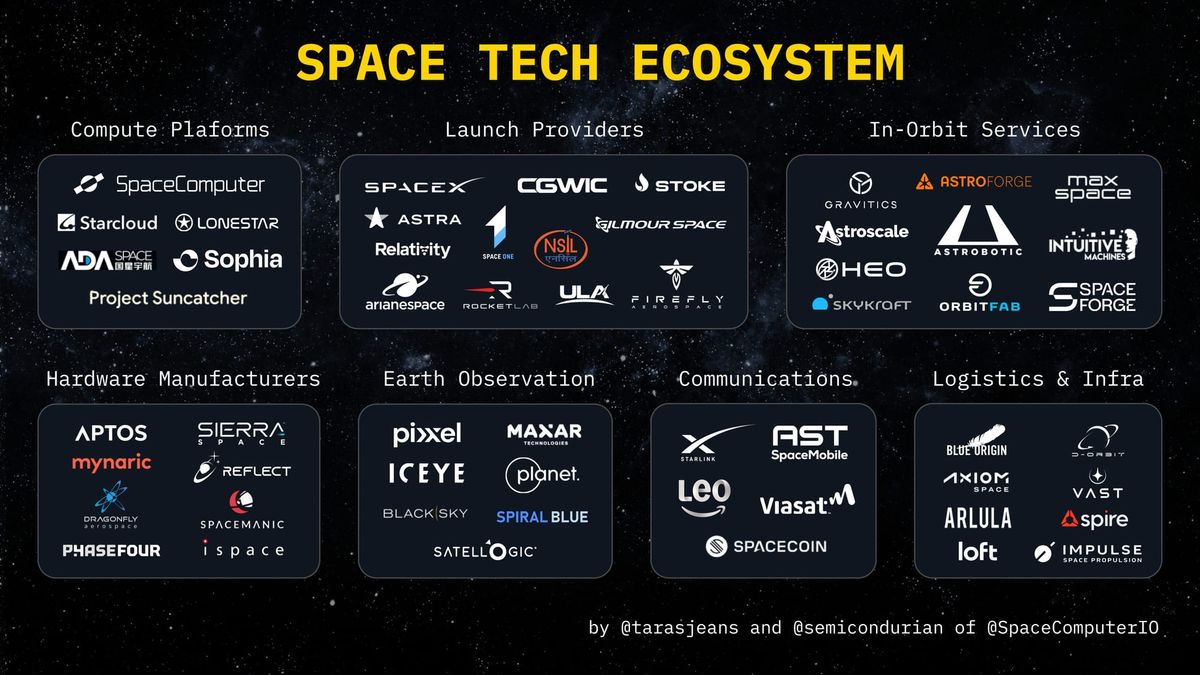
The two groups are converging fast. Google's in talks with SpaceX to launch Suncatcher satellites. Blue Origin, founded by Amazon's Jeff Bezos, filed for its own orbital data processing constellation. The lines between launch provider, satellite operator, and cloud company are blurring into a single orbital economy. We've mapped the full landscape of launch providers, in-orbit services, hardware manufacturers, and compute platforms in our space tech ecosystem breakdown.
So What Is Big Tech's Role in Space Exploration, Really?
It's the shift from missions to infrastructure. Big tech's role in space exploration is building the permanent systems that every future mission will run on: power, connectivity, compute, and the services layered on top of them.
That changes the economics of exploration itself. Cheaper connectivity means better communications for deep space missions. On-orbit compute means satellites can process imagery, run AI models, and make decisions without waiting for a ground pass. And the capital flowing from the technology sector is accelerating everything: the space economy reached $613 billion in 2024 and is projected to grow to $1.8 trillion by 2035.
Where SpaceComputer Fits In
At SpaceComputer, we're building the security layer this new orbital infrastructure needs. As big tech moves compute into space, questions of trust follow it there: who controls the hardware, whether workloads can be tampered with, and how anyone verifies what a satellite actually computed.
Our answer is Space Fabric, a secure compute architecture for satellites built on satellite-based trusted execution environments (SatTEEs). Orbit offers a security property no terrestrial facility can match: physical inaccessibility. A satellite in LEO can't be seized, probed, or physically attacked the way a server in a data center can, which makes it a uniquely strong root of trust for sensitive workloads.
While the hyperscalers focus on scale, raw compute, and connectivity, we focus on making orbital computing secure and verifiable: protected execution, key management, and true random number generation delivered as services from space. So when someone asks what big tech's role in space exploration is, our answer is simple: they're proving that orbit is the next computing platform. We're making sure it's one you can trust.
To see how the whole industry fits together, from launch providers to compute platforms, read our space tech ecosystem overview or visit spacecomputer.io to learn more about secure space internet infrastructure.
Go follow us on LinkedIn and Twitter (X)!
If your team is working on hosted payloads, orbital compute, or sovereign workloads in space, we would like to hear from you. Reach us at product@spacecomputer.io.
Discover your next read:
 Daniel Bar