SpaceComputer Mid-Year Updates 2026: Building the Fabric of the Space Internet
On June 12th 2026, SpaceX completed the largest initial public offering in history, entering the public markets at a valuation approaching $1.8 trillion. This historic IPO alone has lowered the barrier of capital inflows into the space industry significantly. We are about to enter a major space acceleration era!
You may wonder, how will this translates to space companies like us at SpaceComputer?
Well, more of the space economy is going to be built out in the next five to ten years than in the last twenty. The need for foundational infrastructure has never been higher, especially with infinite demand for compute coming from AI growth, the subsequent push for orbital data centers and the desire for better orbital connectivity. We are building the secure infrastructure layer for the space internet to bridge exactly this gap.
As we’ve reached the midpoint of 2026, we've reflected on what needs to be recalibrated and I’ll share our updated outlook for the coming months as we push to build the hardware and software infrastructure layers to power the space internet.
Capital is flowing into every layer of the space internet
- SpaceX's S-1 filing outlines plans to deploy orbital AI compute satellites by 2028.
- Cowboy Space Corporation raised $275 million to build data centers in orbit.
- Northwood Space raised a 100 million dollar Series B and locked a $49.8 million Space Force contract to build high-throughput ground stations that deploy in hours.
- Rocket Lab just announced an $8 billion acquisition of Iridium, merging launch and satellite manufacturing with a global communications network into a single vertically integrated operator.
From our perspective, this adds up to every layer of the space internet being capitalized at the same time.
With launch capacity increasing, more compute moving to orbit, ground links scaling for more data, demand for secure operations, there's a clear need for interoperable and scalable infrastructure, or ‘fabric’ that supports an internet that built for space systems.
This is the layer, Space Fabric that we are building at SpaceComputer. To solve the connectivity problem between the solutions other operators are building out in the rest of the stack. To offer a secure standard for infrastructure that can offer different compute applications, communications, and security services that are accessible and interoperable.
Our Takeaways from European Space Conferences
May was an intense month of conferences for our team. We ran a hardware hackathon at ETHPrague, presented our secure architecture Space Fabric at CySat in Paris and SmallSat Europe in Amsterdam.
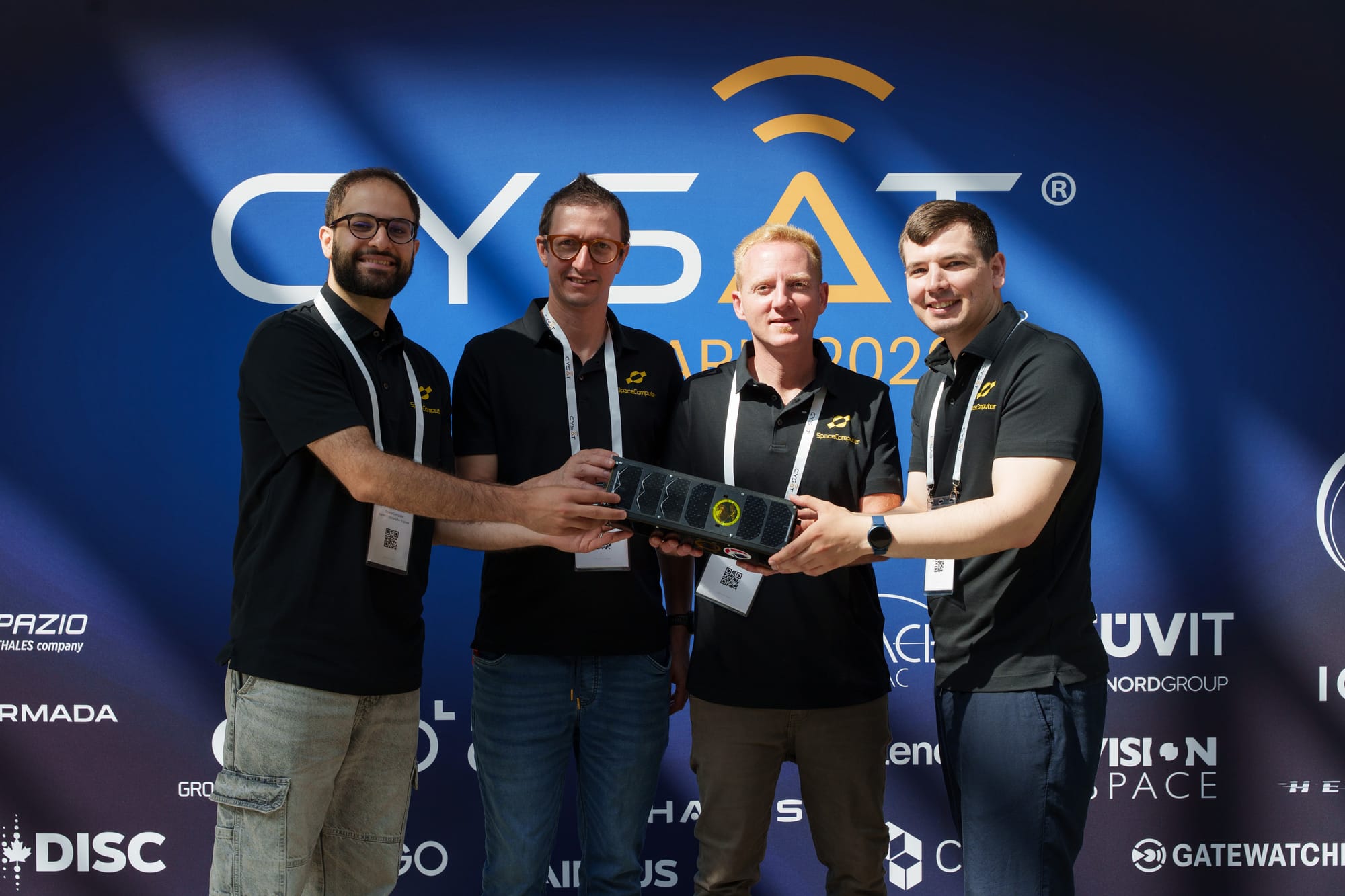
At both space tech conferences in rooms of 300+ participants building in space cybersecurity, our Space Fabric pitch landed immediately.
Dive into Filip's talk at Cysat Europe:
Three things stood out that shaped how we are planning the rest of 2026 and beyond:
1️⃣ The secure compute and communication layer of space is still largely unbuilt and unstandardized. Cybersecurity in orbit is still in early stages, and there is a ‘first to market’ for many companies. We are actively working on this.
2️⃣ Europe’s awareness of its reliance on a small number of large operators (many of them American) is actively causing a push to develop sovereign alternatives. Credibly neutral, open infrastructure aligns well to this goal, and to SpaceComputer’s solutions.
3️⃣ The space industry defaults to proprietary and closed technologies. In the past, this was due to the lack of accessibility to space. Now that launch barriers are shrinking, there is an opportunity to build that open and universally standardized technology.
One thing every conversation reinforced is that the European space sector operates on a different clock than the rest of tech (e.g., software, AI and crypto) where horizons are in terms of months. Many of the missions discussed at CySat are planned for 2030 and beyond.
SpaceComputer team's background in faster moving industries has enabled us to get from idea to deployment faster than common timeframes in the space industry. We iterate quickly to intend to provide high-quality hardware and software buildouts in the near-term for companies ready to scale in the global market.
Across these conferences and customer conversations, the same gap kept surfacing: proper end-to-end confidential compute and communication infrastructure. That gap is what Space Fabric is built to close.
Space Fabric
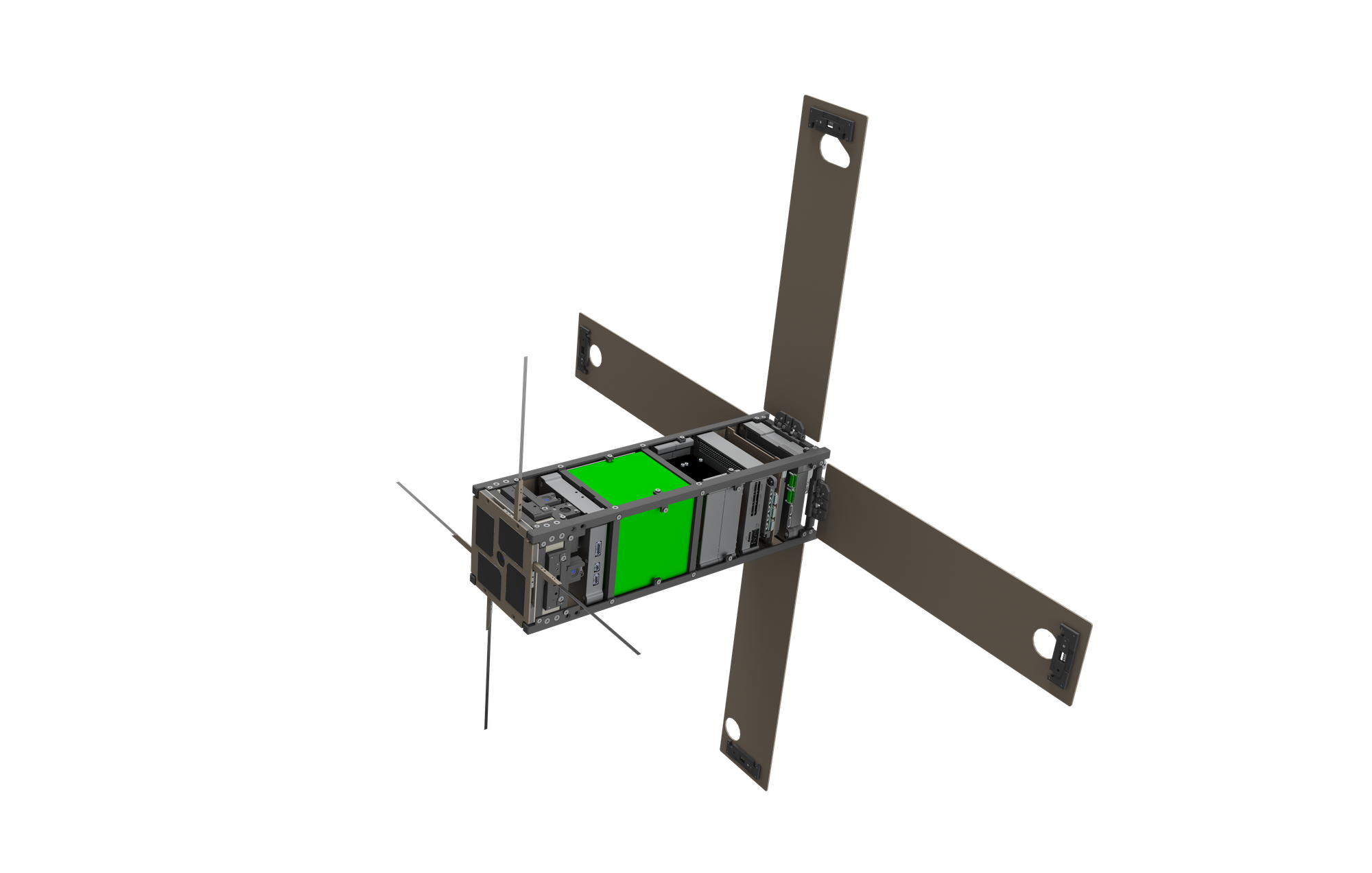
In March this year, we released Space Fabric, the first completely secure compute payload ever built for space, destined for orbit in our three 2027 missions. Space Fabric is our hardware and software architecture that enables workloads to run confidentially aboard spacecrafts, and equips systems on the ground with secure communication to infrastructure in orbit.
Space Fabric uses a specialized satellite-based trusted execution environment (Satellite-based TEE) for confidential computing tasks and encrypted communications to protect against attackers. This design choice is important for secure space internet infrastructure, similarly to how Nvidia GPUs becoming more and more critical to the compute stack over the last 20 years.
If you’re curious about Space Fabric, this is a good primer:
 Tara Everding
If you’d prefer the complete version, read the full research paper here.
Space Fabric will be utilized in every upcoming SpaceComputer mission. While the first version will launch into orbit in Q4 2026, improvements through testing of Space Fabric V1 are already underway.
The architecture gains capability with every mission. It can integrate into future flights as a lightweight payload for one-shot tugs, a security upgrade for existing payloads, or a standalone mission. We are testing these applications in Space Fabric V1 and V2, and will offer adaptable enterprise use cases next year as development is refined.
Our roadmap also extends the platform toward post-quantum-secure communication, designed to harden how space infrastructure exchanges data against the cryptographic risks of the coming decade. We are building that capability because once the satellite is launched, it is inaccessible, and will require updates to security mechanisms that are quantum-resistant when the first quantum computers eventually come online.
IMPORTANT - Refining our product focus: One infrastructure platform.
We began 2026 with two pillars on our roadmap. The first being Secure Compute Platform: confidential compute hardware, a confidential space compute gateway, and secure communication with space infrastructure using current and next-generation cryptography. The second was a Space-Native Decentralized Application Platform, which we referred to as the Space L1.
After months of building and closely reading the market, we have made the decision to deprioritizing the Space L1 and concentrating the company fully on the Secure Compute Platform.
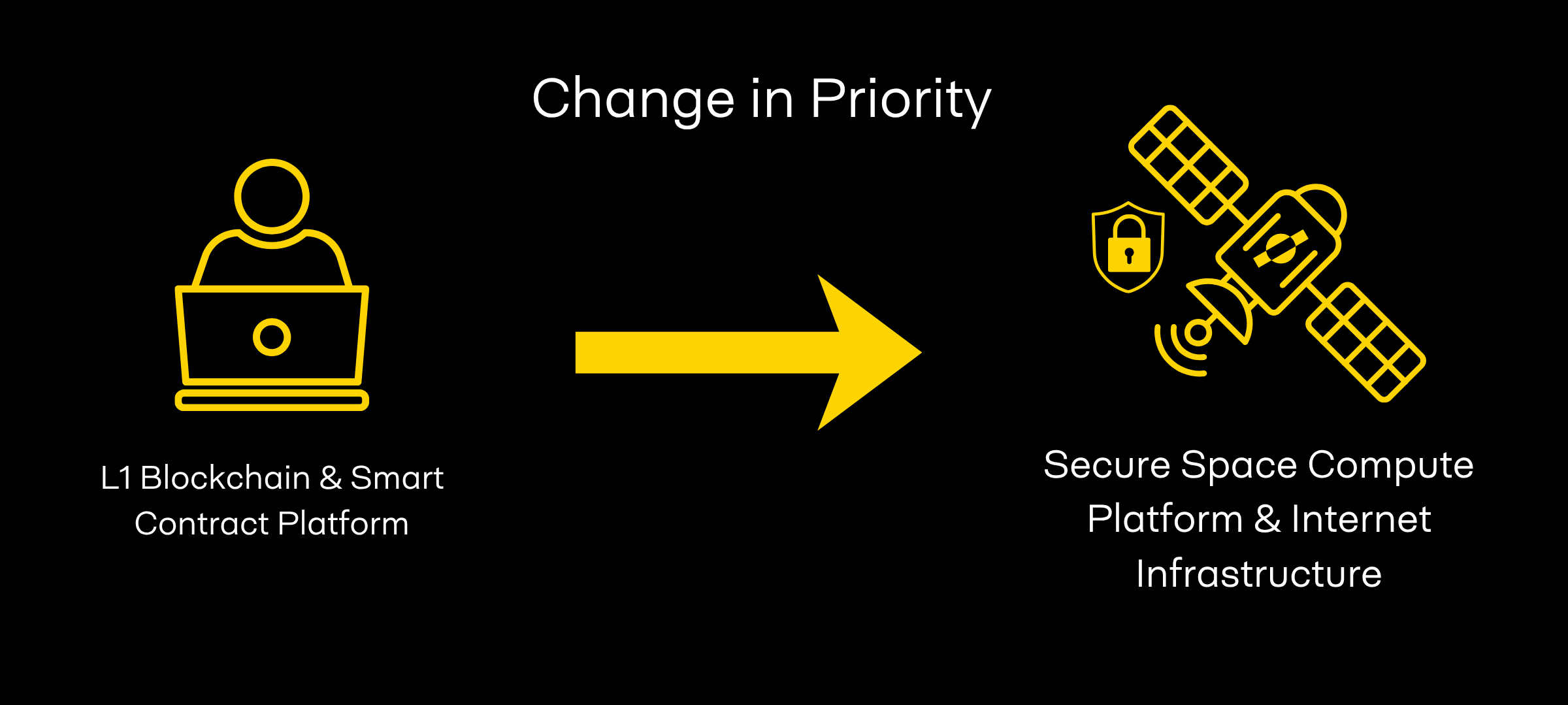
We facilitated this change based on one core principle: "which product solves the problem we came to solve?" That problem is creating an open infrastructure standard that the fabric of the space internet can be built upon. The secure compute layer is the technical foundation everything else depends on, and there is more than enough foundational work to hold our full focus. The conversations we’ve had and identified gaps in the space technology market this year reinforced that secure infrastructure is the clear near-term need, thus we need to put 100% of our efforts into building the best infrastructure layer possible.
This comes with a clear reframe of what SpaceComputer is. Cryptography is a security and enablement technology in our stack. They are how we make compute verifiable, communication private, and trust portable across orbit and ground. Cryptography is the means from which we can offer a credibly neutral secure compute infrastructure. Secure space infrastructure is the foundational layer on top of which the space internet can be built.
Our work is on building that technology and getting it to orbit. We know some teams in our broader market are pursuing growth through token incentives and attention programs. However, we will not be pursuing any airdrops campaigns or token incentives for the time being.
We measure progress in hardware excellence, successful missions, and infrastructure that provides value to prospective partners and clients. In contrast to the signal we want to send, the rest is creating dilutive noise.
Upcoming Partnerships & Missions
One measure of what we are doing is what reaches orbit (and all possible fingers crossed is operationally sound!). We have multiple missions coming in 2026 and 2027.
As you may have seen in our recent publication in Payload, our first announced mission for our Space Fabric architecture is with SpaceManic, our announced launch partner, targeting launch in Q3 2027. Ahead of that, we have an upcoming mission this October, with more details coming soon. A further mission is planned for 2027, further details not yet disclosed.
 View Profile
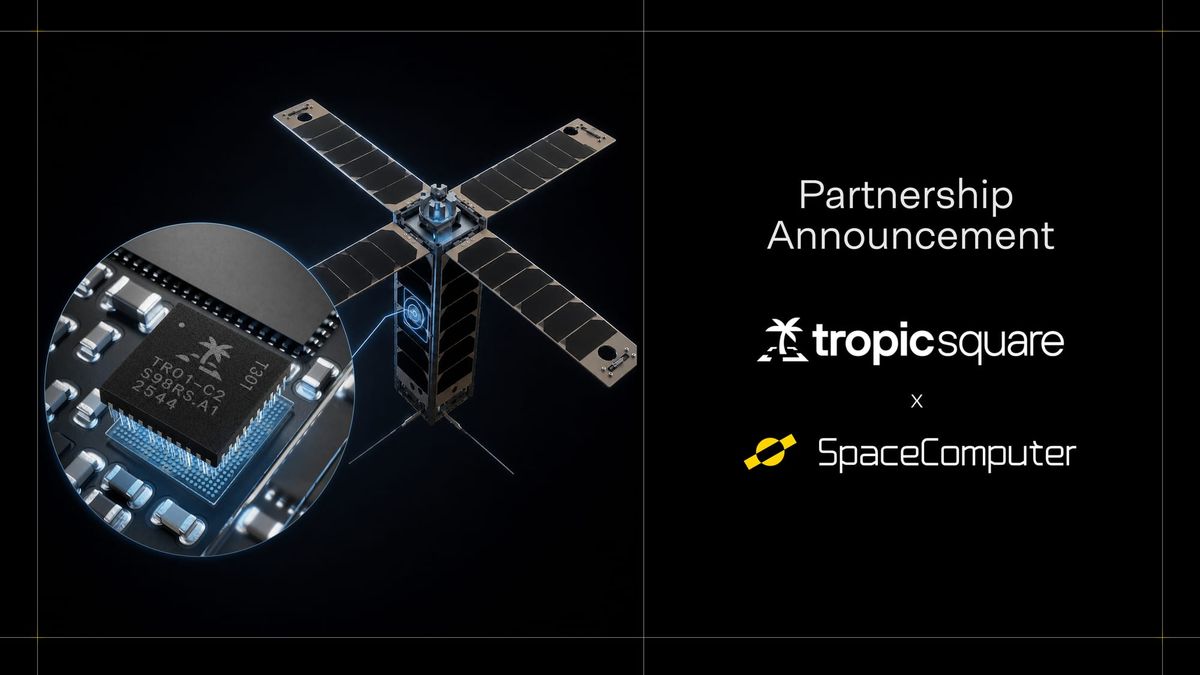
On the hardware front, we are working with two different semiconductor providers: Tropic Square across two upcoming missions, and one upcoming mission is enabled by Infineon, both bringing certified, state-of-the-art hardware security into our payload architecture. More specific details on both partnerships to come! We are part of the NVIDIA Inception program, and are exploring further avenues with their solutions, and more details will be released soon with upgrades to Space Fabric’s architecture.
We’re proud to announce SpaceComputer has partnered with @tropicsquare to integrate TROPIC01 into our hardware design for Space Fabric architecture.
— SpaceComputer (@SpaceComputerIO) July 7, 2026
TROPIC01 is publicly auditable, which makes it a natural fit for an architecture designed around verifiable trust in orbit.
We’ll… pic.twitter.com/WNG4NUKfJE
In Q4, we are heading to conferences and events in the United States to carry these conversations forward and build new partnerships, extending the momentum from our European outreach into the largest space and security market in the world. Our engineering team will continue to push forward on developing Orbitport, our platform for accessing SpaceComputer services, and getting our first deployment of Space Fabric flight-ready for our October mission, in less than 4 months.
If your team is working on secure compute, key management, or preparing for the post-quantum era, we would like to hear from you. Reach us at helloearthlings@spacecomputer.io.
SpaceComputer is the open, credibly neutral infrastructure layer that connects the space economy, providing the hardware and software standard for verifiable compute across operators, jurisdictions, and satellites, with high security guarantees and verifiability.
Follow us on LinkedIn and Twitter (X).
Head to our website for more information.
Discover your next read:
 Filip Rezabek