Layers of the Space Economy: From Earth to Beyond Orbit
The space economy is in launch mode. With the SpaceX IPO behind us, the largest public offering in history, capital is flowing into space at levels the industry has never seen. Novaspace's latest Space Economy Report puts the sector at $626 billion in 2025, heading toward $1 trillion by 2034, with commercial activity now driving roughly 78% of that value. Space stopped being something only governments do and became something companies sell.
That capital is funding an influx of everything: launch providers, ground station buildouts, analytics and AI enablement, in-space logistics, lunar infrastructure, and asteroid prospecting. Over the past few weeks I shared a three-part market map of the companies you should know across all of it. This post brings the full map together, organized the way the economy is actually structured: as layers, starting on the ground and moving out past the Moon. Every company links to its website so you can go straight to the source.
One thing to keep in mind as you continue reading: none of these layers work alone. Each one depends on other layers, which is why we think about space as interconnected infrastructure rather than isolated missions.
On Earth: Ground Services
Every satellite business is partly a ground business. A spacecraft that can't move its data to Earth reliably essentially becomes expensive debris, and with LEO passes creating communication windows as short as five minutes, ground capacity is one of the tightest bottlenecks in the entire stack. That's why ground stations are having a buildout moment, and why the model is shifting from operators building their own dishes to ground-station-as-a-service (GSaaS) networks that any constellation can plug into.
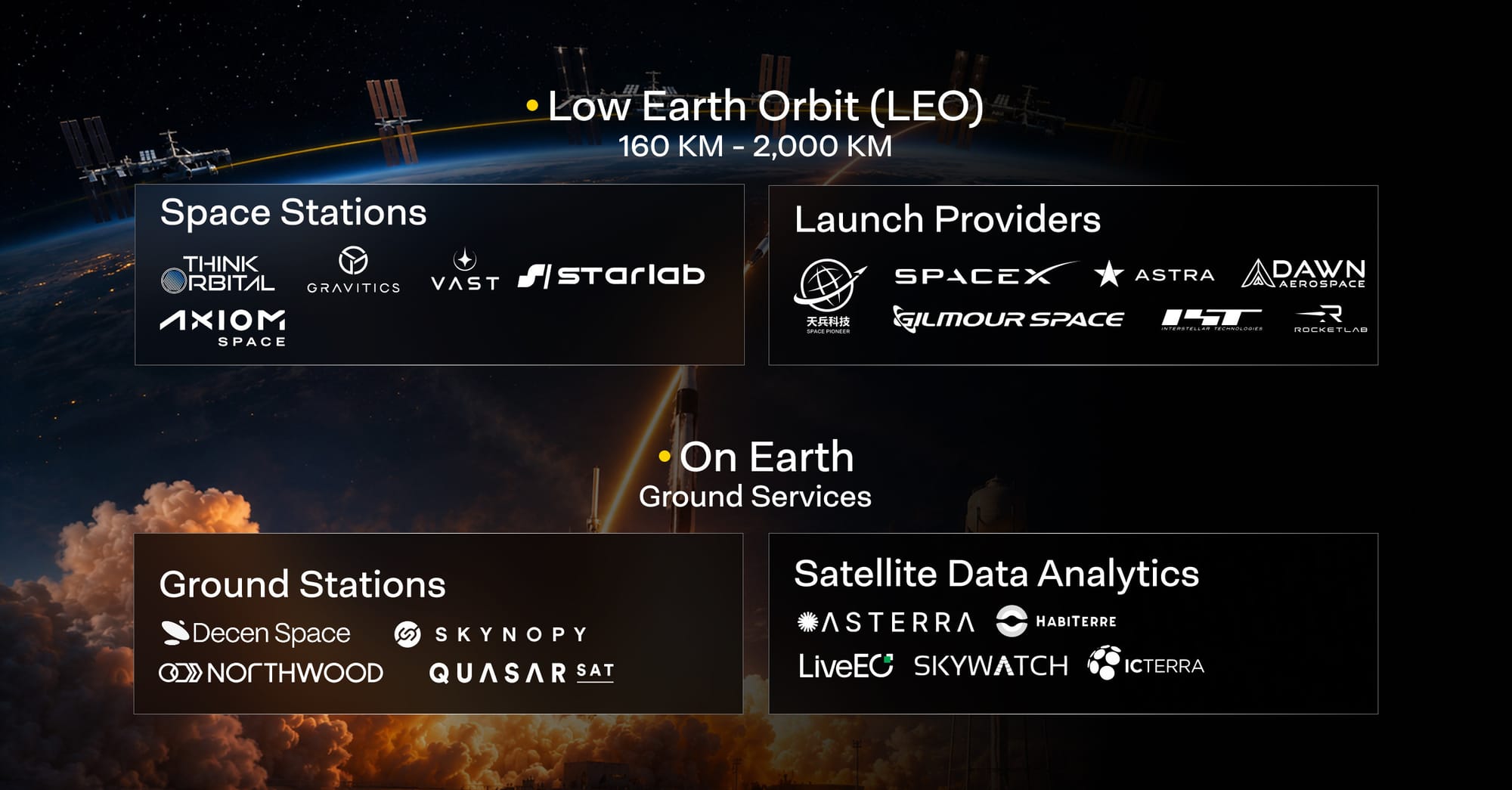
Decen Space, Skynopy, Northwood Space, and Quasar Satellite Technologies are all attacking this from different angles, from decentralized antenna networks to phased arrays that can talk to many satellites at once. We've written before about why ground stations are the first layer of the space internet infrastructure stack, and this category is where that stack touches Earth.
The second ground business is making satellite data useful. ASTERRA finds underground water leaks from radar imagery, LiveEO monitors infrastructure corridors for utilities and railways, Habiterre tracks agricultural and land-use change, SkyWatch aggregates imagery supply via API, and ICterra builds the processing systems underneath. This analytics layer is where most of the space economy's revenue actually gets realized, because it's the part a customer on Earth pays for.
Low Earth Orbit: 160 km to 2,000 km
Standing out in LEO is now harder than getting there. Roughly 13,200 satellites are competing for attention in LEO, against a few hundred spacecraft holding MEO and GEO between them, and about 88% of all active satellites now sit in this one band. The physics advantages everyone came for, low latency and cheap access, are exactly why nobody has them exclusively. Differentiation in LEO has moved from reaching orbit to what you can deliver from it.
Satellites and constellations. Kepler Communications is building an optical data relay network, Iridium runs the veteran voice-and-data constellation, Planet images the entire Earth's landmass daily, Starcloud is putting data centers in orbit, Satellogic and BlackSky deliver high-revisit Earth observation, Rivada Space Networks is building a private orbital network for secure enterprise traffic, Laika analyzes EO data on flight computers, and yours truly at SpaceComputer provides verifiable compute and internet services that rides on spacecrafts across LEO and every one above it.
Space stations. NASA plans to deorbit the ISS around 2030 and become a customer of commercial stations instead of an operator. That deadline created a race: Axiom Space, Vast, Starlab, Gravitics, and ThinkOrbital are all building toward crewed or robotic platforms that need to be operational before the ISS comes down. Whoever closes that gap inherits 25 years of continuous human presence in orbit.
Launch providers. Launch is the on-ramp for every layer above, and it's globalizing fast. SpaceX still dominates cadence, with Rocket Lab close behind with small-and-medium launches. Astra is rebuilding around responsive launch, Dawn Aerospace is flying a runway-launched spaceplane and space transport out of New Zealand, Gilmour Space is standing up sovereign launch from Australia, Interstellar Technologies is doing the same for Japan, and China's commercial wave spans Space Pioneer on launch and AdaSpace, which is already flying the first nodes of an AI computing constellation. More independent on-ramps means more of everything downstream.
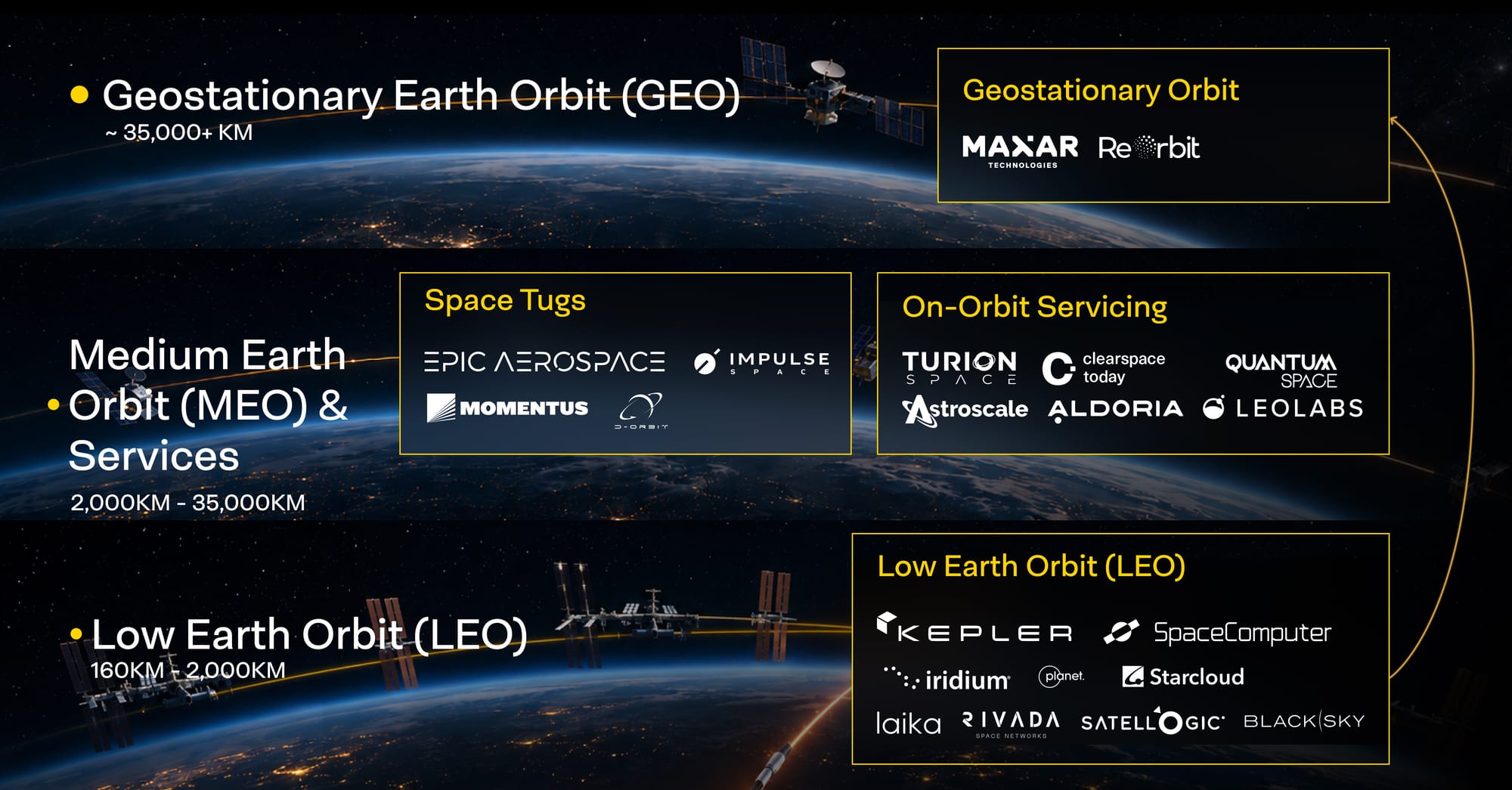
Medium Earth Orbit and In-Space Services: 2,000 km to 35,000 km
MEO is sparse by design. Radiation belts make it hostile territory, so it's historically been home to navigation constellations like GPS and Galileo and not much else. But the region between LEO and GEO is where a new services economy operates, and it exists because of a simple gap: rockets deliver payloads to drop-off orbits, not final destinations, and satellites break, run out of fuel, and become debris.
Space tugs are the delivery trucks of that gap. Epic Aerospace is focused on transfers all the way to GEO, Impulse Space is building high-energy kick vehicles, Momentus offers in-space transport and hosted payloads, and D-Orbit has turned orbital delivery into a repeatable logistics business.
On-orbit servicing keeps the orbital environment usable, which matters more every year as the catalogued object count climbs past 29,000. Astroscale has flown debris-inspection and life-extension missions, ClearSpace is working on active debris removal, Turion Space builds spacecraft for inspection and object retrieval, Quantum Space is developing orbital transfer and servicing vehicles, and Aldoria and LeoLabs supply the tracking data that makes any of it possible. Servicing turns satellites from disposable assets into maintainable infrastructure, and that shift changes the economics of orbital infrastructure.
Geostationary Earth Orbit: 35,000+ km
GEO is an even smaller sector. One spacecraft matching Earth's rotation covers an entire region continuously, no constellation required. The band is being reinvented from two directions at once: incumbents like Vantor (formerly Maxar) modernizing a decades-old industry, and newcomers shrinking the entry price. Astranis builds MicroGEO satellites at a fraction of traditional cost, ReOrbit makes software-defined GEO spacecraft, Kacific and eSAT Global deliver broadband and IoT connectivity to underserved regions, Skyloom is building optical data relay from GEO, and Epic Aerospace and SpaceComputer extend transport and secure compute into the band.
GEO also delivered the security wake-up call of the past year. Researchers at UC San Diego and the University of Maryland pointed an $800 off-the-shelf dish at the sky and found that roughly half of geostationary satellite signals are unencrypted, exposing everything from telecom backhaul to government traffic. It's the clearest evidence yet that the space economy's weakest layer is security of data moving between all these systems. That's the problem we work on every day at SpaceComputer.
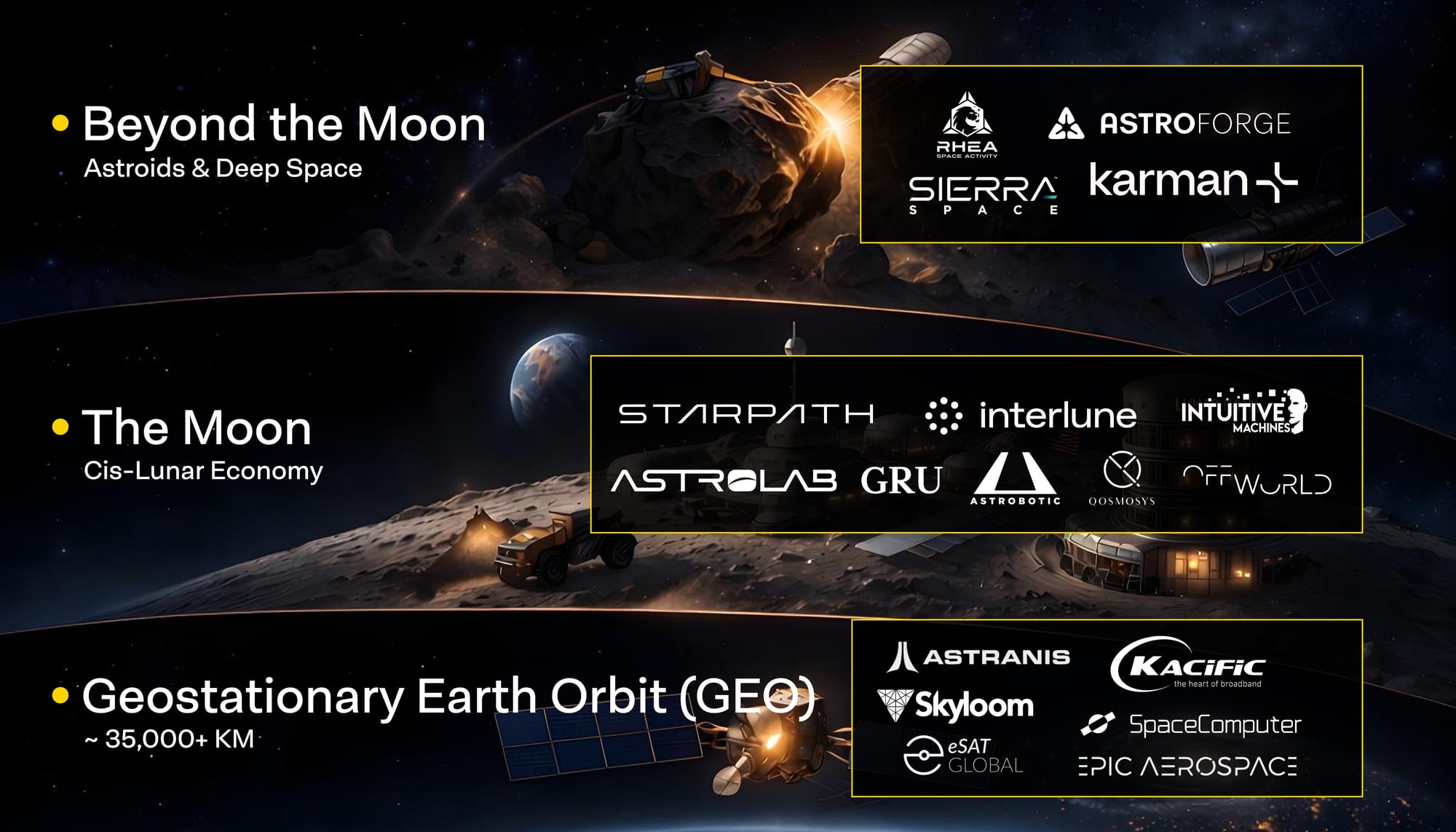
The Moon: The Cis-Lunar Economy
The lunar economy has moved from concept to cargo manifest. Intuitive Machines has already landed on the surface and flies NASA-contracted delivery missions, Astrobotic builds landers and rovers for the same market, Astrolab is developing rovers for transport and surface work, and GRU Space is building a lunar hotel. OffWorld is building industrial robot swarms for mining, Starpath is developing propellant production on the surface, Interlune wants to harvest helium-3 for the quantum computing and fusion markets, and Qosmosys is designing spacecraft for cis-lunar operations.
Here's the part I find the most interesting: only around 2% of space tech startups are focused on the Moon today. The infrastructure needs are enormous, covering habitats, power, navigation, communications, and compute, and the competition is thinner than anywhere else on this map.
Beyond the Moon: Asteroids and Deep Space
The outermost layer is mainly about resources and reach. AstroForge is flying missions toward asteroid mining for platinum-group metals, Karman+ is targeting water-rich asteroids to produce propellant in space, Rhea Space Activity develops deep space navigation and intelligence tools, and Sierra Space builds spaceplanes and expandable habitats that stretch from LEO toward deep space missions. Nobody here has a proven business model yet, but that's exactly what the early launch market looked like fifteen years ago. More buildout is coming in the next few decades.
The Layers Only Work Together
The biggest lesson from compiling this map is that new space companies are announced and funded every week. It's a fantastic time to be building in space.
The second lesson is that the layers are inseparable. A satellite in LEO depends on a launch provider to get up, a ground station to talk to Earth, an analytics platform to make its data worth something, and increasingly on tugs and servicing vehicles to stay operational. Wherever you operate, your data moves through every layer of this map, and much of that territory is still unsecured. At SpaceComputer we're building the trust layer for all of it: verifiable, tamper-resistant compute, integrated before launch, for whichever band your mission calls home.
This isn't an exhaustive list. If I missed a company that belongs on the map, let me know, and tell me which part of the space economy you'd like mapped next.
Ad Astra.
This article is brought to you by Daniel Bar, Co-Founder and CEO of SpaceComputer, we're building the secure compute layer for the space internet. Follow Daniel on X (Twitter) and LinkedIn.
If your team is working on hosted payloads, orbital compute, or sovereign workloads in space, we would like to hear from you. Reach us at product@spacecomputer.io.
Visit our website for more information.
Check out SpaceComputer on X (Twitter) and LinkedIn.
Read more about our trust architecture in our research paper Space Fabric here.