What Is Orbital Compute? A Guide to Space-Based Data Centers
Welcome to orbital compute 101.
Terrestrial data centers are hitting a wall. Power grids strain under AI's insatiable appetite for electricity, water supplies and land usage.
The solution we see isn't going to be building bigger facilities on Earth, but moving compute infrastructure into Earth's orbit.
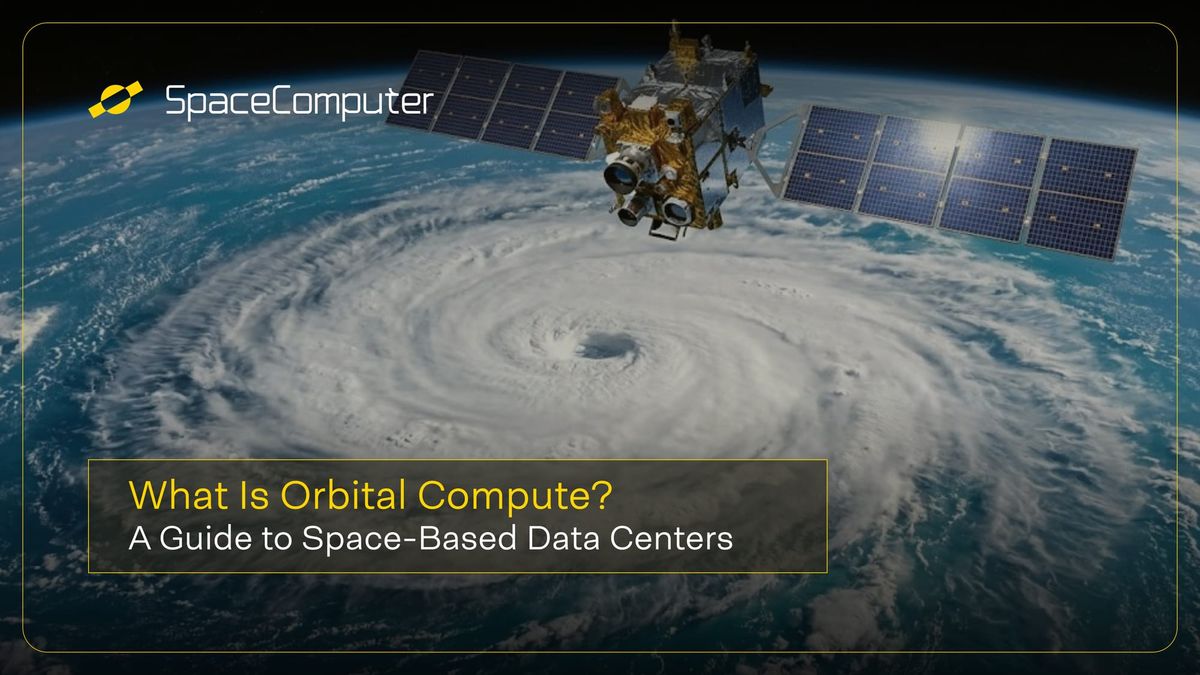
Orbital compute deploys processing power, storage, and networking hardware aboard satellites in Low Earth Orbit (LEO). This isn't a futuristic concept anymore. Companies are launching operational systems right now, using space's advantages: unlimited solar energy, passive radiative cooling, and physical inaccessibility that creates security guarantees impossible to achieve on the ground.
SpaceComputer is building the security layer that makes this transition possible. Our Orbital Root of Trust provides post-quantum cryptography, confidential computing, and tamper-proof key management from orbit. This article explains how orbital data centers work, why they're becoming essential infrastructure, and what workloads are moving to space today.
Key Takeaways
- Orbital compute uses space's physical environment for superior energy economics and security
- Physical inaccessibility of satellites creates an "Orbital Root of Trust" impossible to replicate on Earth
- Current use cases focus on sovereign data storage, AI inference, and post-quantum cryptography
- SpaceComputer provides the security layer enabling enterprise adoption of orbital infrastructure
- The market is transitioning from demonstration to operational deployment between 2026-2030
How Orbital Data Centers Work: Architecture and Core Components
An orbital data center (ODC) is fundamentally different from its terrestrial counterpart. You can't plug into a municipal power grid or connect to city water for cooling. Every system must be self-sustaining in the vacuum of space.
The architecture consists of four critical layers working in concert.
Radiation-Tolerant Compute Layer
High-energy particles bombard satellites constantly. Standard server chips would fail within hours. ODCs use radiation-hardened processors alongside commercial hardware like NVIDIA A100 GPUs and AWS Snowcone devices, protected by specialized shielding. Companies like Ramon.Space have developed storage platforms specifically designed to withstand this harsh environment.
Thermal Management Systems
Heat dissipation in space requires a complete rethinking of cooling. Without air or water, ODCs use massive radiators to disperse heat directly into deep space via infrared radiation. These radiators can span hundreds of square meters for high-compute workloads. Managing thermal cycles as satellites move between sunlight and Earth's shadow remains one of the most complex engineering challenges.
"The vacuum of space doesn't conduct heat away like air does on Earth. We're essentially building giant refrigerators that radiate heat into the coldness of space itself." — Thermal Engineering Lead, Axiom Space
Energy Generation and Storage
Solar arrays provide power, generating approximately six times more energy than equivalent terrestrial panels due to unfiltered sunlight and no atmospheric interference — a significant advantage over terrestrial generation capacity detailed in FERC & EIA Report data on renewable energy sources. Large-scale nodes may feature arrays spanning kilometers. High-capacity batteries maintain operations during eclipse periods when Earth blocks the sun.
Networking and Communication
Traditional radio frequencies can't handle the throughput required for cloud operations. ODCs use Optical Inter-Satellite Links (OISLs) instead. These laser-based connections currently achieve speeds from 2.5 Gbps to 100 Gbps, with next-generation systems targeting 400 Gbps, as explored in research on IEA Electricity Information Statistics. datasets covering network supply infrastructure trends. This creates an "orbital mesh" where satellites communicate directly, forming a distributed network above Earth.
SpaceComputer's Space Fabric hardware architecture is purpose-built for these constraints. Our dual secure element design from independent vendors means no single supplier controls the complete attestation chain, while the system scales alongside maturing orbital compute capacities across the industry.
Why Move Compute to Space? The Strategic Drivers
The migration to orbital compute isn't driven by novelty. It's driven by necessity.
Terrestrial Resource Constraints
U.S. data center spending increased 70% between 2023 and 2024, reflecting the broader surge in technology infrastructure investment documented in National trends in prescription spending studies that track sector-wide expenditure growth patterns. Energy consumption could triple by 2028, potentially consuming 12% of national electricity, as tracked by National Health Care Spending analyses of resource utilization trends across sectors. Large facilities face increasing opposition from communities concerned about water usage for cooling and massive land requirements. These aren't temporary bottlenecks. They're structural limits.
Superior Economics After Launch
Once an ODC is deployed, operational expenditure drops dramatically. Solar power and radiative cooling are essentially free. Research from Frontier Group projects orbital compute energy costs will be cheaper than terrestrial equivalents by 2030. The 97% OpEx reduction potential comes from eliminating ongoing utility costs that plague Earth-based facilities.
Physical Inaccessibility as a Security Primitive
Every secure computing system on Earth shares one constraint: the hardware can be physically reached. Given enough time and access, terrestrial Trusted Execution Environments (TEEs), Hardware Security Modules (HSMs), and secure enclaves can be compromised. The TEE.Fail disclosure demonstrated that attestation key extraction from Intel SGX and AMD SEV enclaves is achievable with under $1,000 of equipment.
SpaceComputer removes this constraint entirely. Satellites in LEO are physically unreachable, making sustained physical attacks impossible by design, not by policy. Our Orbital Root of Trust is designed to remain resilient even if all of Earth's data centers go dark.
The "Harvest Now, Decrypt Later" Threat
Adversaries are actively harvesting encrypted data today, storing it until quantum computers become powerful enough to break current encryption. For organizations with data that must remain confidential for ten or more years—intellectual property, biometric records, defense secrets, satellite telemetry—post-quantum cryptography migration is not a future concern. It's an immediate operational priority.
SpaceComputer is the only provider integrating post-quantum cryptography directly into space-based infrastructure from day one. Our hybrid migration path combines hardware-bound ECC for legacy compatibility with PQC primitives for forward security, so organizations don't need to wait for a new generation of satellites to begin their quantum-readiness transition.
Primary Use Cases: What Workloads Are Moving to Orbit Today
Orbital compute is operational now, not theoretical. Specific workloads are already moving to space.
In-Orbit Edge Processing
Satellites traditionally collect raw data and downlink it to Earth for processing. This creates massive latency and bandwidth costs. With orbital compute, satellites send data to a nearby ODC node via optical link. The ODC runs AI and machine learning models to filter, compress, or analyze the data in real-time. Only high-value insights are transmitted back to Earth.
For Earth Observation satellites, this means detecting specific features—ships, fires, infrastructure changes—in orbit and sending only the relevant metadata. Defense and environmental monitoring applications gain immediate decision-making capability without waiting for ground-based processing.
Sovereign Data Storage and "Star Vaults"
Storage is a killer application because it requires relatively low power (approximately 15% of a typical data center's consumption) and generates minimal heat. Companies like Lonestar Data Holdings are deploying "Star Vaults" in polar orbits and on the lunar surface.
Under international space law, a satellite remains under the jurisdiction of its registering nation. For governments and defense agencies, storing sensitive data in orbit means the information is physically unreachable by terrestrial adversaries and immune to local geopolitical instability or foreign "lawful intercept" demands. This creates true digital sovereignty.
AI Inference and Confidential Computing
AI inference is ready for orbit today. Training massive Large Language Models requires interconnect speeds (terabits per second) that currently exceed space hardware capabilities, but executing trained models works now.
SpaceComputer's SpaceTEE enables end-to-end confidential AI inference. AI model architectures and weights remain encrypted in storage and memory. They're decrypted only inside the SpaceTEE enclave during computation. Even an attacker with full control of the satellite's main operating system would see only ciphertext, never the model or its outputs.
Each workload runs in its own enclave with its own keys, providing strong multi-tenant isolation even on shared GPU or CPU hardware. One customer cannot access another's code, prompts, or outputs. This confidentiality model is purpose-built for defense, finance, intelligence, and other sectors that cannot tolerate data leakage.
The Orbital Compute Ecosystem: Key Players and Market Trajectory
The sector is transitioning from demonstration to operational utility. Several major initiatives are underway.
SpaceComputer is building the dedicated security layer with post-quantum cryptography for space computing integrated directly into space-based infrastructure from day one. Our Orbitport API provides unified access to orbital security services: confidential compute, key management, and verifiable randomness. We're positioned as the trust layer enabling enterprise adoption of orbital infrastructure.
Axiom Space successfully launched the first commercial cloud device (AWS Snowcone) and the Data Center Unit-1 (AxDCU-1). They're building a scalable network from kilowatts to megawatts of processing power, integrated with the Kepler Communications optical relay network.
SpaceX filed for a constellation of up to 1 million satellites to support an orbital data center, with a stated goal of achieving 100 gigawatts of AI compute capacity. Their valuation trajectory (from approximately $400B to $800B in a single year) signals that the broader space sector is becoming a critical layer of the modern internet and AI compute stack.
Starcloud is building a distributed constellation of 88,000 small inference nodes, aiming to deploy 20 gigawatts of compute. They recently launched the first NVIDIA A100 and H100 chips into orbit.
Planet and Google are collaborating on early-stage experiments to fly NVIDIA GPUs on the Pelican and Owl satellite constellations, aimed at risk reduction for hyperscale cloud providers.
Market Timeline
The deployment follows a phased approach:
- 2025-2027 (Operational Demo): Success of small inference nodes and "sovereign vaults" for secure storage. Testing of quantum-secure links and edge processing for Earth Observation satellites.
- 2027-2029 (Scaling Micro-Data Centers): Implementation of 2.5 Gbps+ optical meshes and more sophisticated AI processing. Deployment of first commercial ODC nodes with high-speed cross-links.
- 2030 and Beyond (Mega-Infrastructure): Expansion of orbital cloud capacity from kilowatts to megawatts. Emergence of revenue-generating space data centers. Potential for larger-scale AI training as launch costs fall and communications technology matures.
The sector is where the internet was in the 1970s: expensive and exclusive, but foundational decisions made now will define the architecture of what follows.
Technical and Economic Challenges Facing Orbital Compute
Significant hurdles remain before orbital compute achieves parity with terrestrial cloud providers, as analyzed in detail by research on Orbital Data Centers: Constraints, resilience, and break-even economics, which examines AI-driven deployment barriers in space environments.
Communication Bottlenecks
Modern AI training clusters on Earth require interconnect speeds of approximately 7.2 terabits per second. Current optical satellite links, while fast, are one to two orders of magnitude slower. This gap limits general-purpose public cloud computing in space. Specialized edge processing and sovereign storage use cases work now, but massive AI training remains bandwidth-constrained.
Elasticity vs. Fixed Hardware
Terrestrial clouds can scale resources up or down almost instantly. In space, hardware is fixed by what was launched. Scaling requires expensive resupply or additional launches. True cloud elasticity is difficult to reproduce in orbit.
Thermal Management and Latency
Managing heat, distributing power, minimizing latency, and synchronizing state across satellites with sporadic connectivity requires purpose-built approaches. SpaceComputer is developing proprietary HotStuff Protocol implementations and Space Fabric hardware specifically designed to reduce latency in orbital environments. Our previous analysis in "Cooling for Orbital Compute: A Landscape Analysis" detailed the engineering challenges of passive radiative cooling at scale.
Pre-Launch Supply Chain Security
Space Fabric's strongest security guarantees apply post-launch. The hardware integration window before launch, when physical access is possible, represents a real operational risk. SpaceComputer addresses this through pre-registered device identifiers and verified-empty key slots at the time of integration, combined with strict operational controls during the pre-launch window. All cryptographic keys are generated on-orbit after launch, never before.
Post-Quantum Readiness of Secure Elements
Current secure elements don't natively support post-quantum cryptographic primitives. SpaceComputer has designed a hybrid migration path: hardware-bound ECC for platform identity and current compatibility, with PQC integration planned as standardized algorithms (including NIST-selected ML-KEM and HQC) become available in hardware. This gives enterprise and agency customers a clear compliance path without waiting for a second generation of satellites.
Multi-Tenant Security
As orbital platforms grow and serve multiple customers simultaneously, workload isolation becomes critical. SpaceComputer's SpaceTEE provides hardware-level separation between tenants. Each workload runs in its own enclave with its own keys. One customer cannot access another's code, prompts, or outputs, even when they share the same physical satellite hardware. This isolation persists across shared GPU or CPU resources.
Final Thoughts
The convergence of declining launch costs, superior space physics, and escalating terrestrial constraints makes orbital compute inevitable, not speculative. Solar energy delivers six times the output of terrestrial arrays. Passive radiative cooling eliminates ongoing utility costs. Physical inaccessibility creates security guarantees impossible to achieve on Earth.
Security architecture must be designed into orbital infrastructure from the earliest stages. Retrofitting trust is not an option. Enterprise security leaders cannot approve moving critical workloads off-planet without confidential computing guarantees.
SpaceComputer's Orbital Root of Trust provides the answer. Our SpaceTEE delivers hardware-isolated secure enclaves beyond the reach of any ground-based adversary. Our Orbital Key Management Services integrate post-quantum cryptography from day one. Our Orbitport API makes space computing accessible with modern cloud usability.
The orbital compute economy is forming now. The decisions made today will define the architecture of tomorrow's digital infrastructure.
Explore SpaceComputer's security offerings at spacecomputer.io. Access the Space Fabric technical paper at arXiv:2603.23745. Connect via Orbitport to begin your post-quantum transition.
Frequently Asked Questions
What Makes Orbital Compute More Secure Than Terrestrial Data Centers?
Physical inaccessibility eliminates entire classes of side-channel and physical access attacks. The TEE.Fail disclosure showed terrestrial TEE compromise with under $1,000 of equipment. SpaceComputer's satellites are physically unreachable, making sustained physical attacks impossible by design, not policy. Terrestrial systems operate under the constraint that given enough time and access, hardware can be compromised. Orbital systems remove that constraint entirely.
Can Orbital Data Centers Handle Real-Time AI Workloads?
AI inference is ready today; training is bandwidth-limited currently. SpaceComputer's SpaceTEE supports confidential AI inference with COTS hardware like NVIDIA A100s. Model architectures and weights remain encrypted; they're only decrypted inside the enclave during computation. Even an attacker with full satellite OS control would see only ciphertext. Real-time edge processing for Earth Observation and defense applications is operational now.
How Does SpaceComputer Address Post-Quantum Cryptography?
SpaceComputer is the only provider integrating PQC directly into space-based infrastructure from day one. Our hybrid migration path combines hardware-bound ECC for legacy compatibility with PQC primitives for forward security. All signing keys are generated on-orbit after launch, eliminating pre-launch supply chain attack surfaces. Keys and hardware are permanently destroyed upon satellite atmospheric re-entry at end of life. This gives enterprise customers a clear compliance path without waiting for second-generation satellites.
What Are the Current Cost and Accessibility Barriers?
There's currently a gap between technical possibility and commercial viability at scale. SpaceComputer focuses on high-security use cases where the "inaccessibility premium" justifies current costs: key management, sovereign data processing, confidential AI inference. Orbitport is our unified API that abstracts complexity and delivers orbital services with modern cloud usability. Declining launch costs and maturing infrastructure will expand accessibility through 2030.
How Does Multi-Tenant Security Work on Shared Satellite Hardware?
SpaceTEE provides hardware-level separation between tenants. Each workload runs in its own enclave with its own keys. One customer cannot access another's code, prompts, or outputs. This isolation persists even when multiple customers share the same physical satellite hardware (GPU or CPU). The security guarantees don't depend on software policies; they're enforced by hardware architecture.
What Happens If a Satellite Fails or Is Compromised?
SpaceComputer's distributed architecture across multiple satellites in LEO provides redundancy. Cryptographic operations use threshold signing schemes across nodes. If a satellite is compromised or fails, the network continues operating without single points of failure. Space Fabric's dual secure element architecture from independent vendors means no single supplier holds the complete attestation chain. End-of-life satellites undergo atmospheric re-entry, permanently destroying all keys and hardware.
This article is brought to you by SpaceComputer, we're building the secure compute layer for the space internet.
If your team is working on hosted payloads, orbital compute, or sovereign workloads in space, we would like to hear from you. Reach us at product@spacecomputer.io.
Visit our website for more information.
Follow us on X (Twitter) and LinkedIn.
Read more about our trust architecture in our research paper Space Fabric here.
Ready for the next level of orbital compute? Read about cooling mechanisms for orbital data centers:
 Tara Everding