SpaceComputer at Silicon Valley Space Week Recap: Orbital Compute, Security, and Verifiable Data

From October 27th to 29th, our team set up our booth at the Computer History Museum in Mountain View, California, for Silicon Valley Space Week, hosted by Sat News. Over three days, our co-founders and team held many conversations with startups and established companies in the global space sector, about why space needs a scalable interoperability layer of compute and cybersecurity infrastructure that makes the space systems of today (and the future) more usable.

We brought that case to the floor on a panel, with live demos of our hardware, our Key Management Service (KMS), and Spacebooth demo providing a walkthrough of what we're taking to orbit, and how we plan to provide these processing and security capabilities to leaders in the industry.
This blog brings together our team's accomplishments, insights, and takeaways from the conference, and how it's shaping the future of the space tech sector and how we are bringing that future to reality.
The SpaceComputer team has touched down in Silicon Valley, with our booth setup and ready for #SVSW.
— SpaceComputer (@SpaceComputerIO) October 27, 2026
See you tomorrow! 🚀 pic.twitter.com/oHuXLkPfyB
Security to unlock scale in orbital compute

On the first day of the conference, our co-founder and CTO Filip Rezabek joined Jason Aspiotis, Rob DeMillo, Dr. Slava Turyshev, and Joseph Yaffe on the panel "Orbital Data Centers: Investable Infrastructure or Thermodynamic Bet?." The panel tested the engineering and economics of computing in orbit, and Filip focused on who can safely use that compute once it's flying.
"Security is what unlocks scale in orbital compute. Today one party usually owns the satellite and the payload and uses it for one purpose, and when that purpose is done there's a lot of compute sitting unused."@rezabfil on the #SVSW Orbital Data Centers:Investable… pic.twitter.com/NNyN343Mgt
— SpaceComputer (@SpaceComputerIO) October 28, 2026
"Security is what unlocks scale in orbital compute. Today one party usually owns the satellite and the payload and uses it for one purpose, and when that purpose is done there's a lot of compute sitting unused."
~ Quote from Filip during the panel
→ Follow Filip on LinkedIn.
This under-utilized computational capacity stems from the single-purpose silos around which most spacecraft are traditionally designed. Secure multi-tenancy enables multiple payloads to execute workloads on a spacecraft while ensuring their respective code and data remain fully isolated and protected. However, operators must incorporate this capability into the system architecture prior to launch to successfully extend that capacity to additional tenants.
Subscribe and watch Filip's best moments on the panel on our YouTube👇
Watch the best moments of Filip on the panel on our YouTube. Don't forget to Subscribe!
From ground to orbit: security guarantees at every step of the stack
Satellite cybersecurity was a priority topic of conversation at our booth, usually around the same area: data and commands pass through ground stations, network providers, gateways, processing nodes, and sometimes different spacecraft before they reach a customer, and a gap at any of those steps puts sensitive data and processing at risk. For companies with high security guarantees, sensitive intellectual property (IP), or proprietary data, that risk rules out any infrastructure they can't protect and check at every step.
An encrypted communication covers only part of that problem, as it protects data in transit. The customer still needs confidence in the computing environment. A company using another operator's satellite also needs to know how a result was produced, where the processing happened, and that its data stayed confidential throughout. Filip and Pedro's recent blog covering the end-to-end threat model maps where those attacks can happen across a space system.
The Spacebooth: what verifiable Earth observation data looks like in 2027
While Earth observation data drives critical decisions across commercial, environmental, and national security sectors, users are currently forced to rely on contractual promises alone for its origin and integrity.
To offer a hands-on demonstration of data verifiability, Pedro designed Spacebooth. Attendees took a photo using a mock satellite, followed its lifecycle on a tablet, and attempted to alter the image; seeing the immediate change in its cryptographic fingerprint and modifications before printing their verified souvenir.

That fingerprint shows an image wasn't altered after capture, and it's a demonstration of one application for our missions in 2027. Once these capabilities reach orbit, a customer will be able to verify that data stayed encrypted along the entire stack, which satellite or spacecraft captured it, and exactly when it was taken.
The Spacebooth demonstrated how verifiability and security for consumers provides them with evidence they can trust, and shows providers along the stack can show exactly what they handled without directly accessing it, which builds a trust path from end to end. The key takeaway from the demo: attestation supplies the evidence, and verifiability lets relevant parties check it, and both are critical for end-to-end security.
Daniel, Filip, and Pedro took visitors through the full architecture on Wednesday in "Can You Prove It Came from Space?" They showcased our mission control services running in trusted execution environments (TEEs), through Orbitport's ground-to-orbit path, to attested execution on Space Fabric and data signed at the source in orbit.
→ Follow Daniel and Pedro on Linkedin.

Integration partners can add secure hardware alongside almost any payload

Our booth demonstrations ran on the actual Space Fabric hardware. Developing hardware and software integration partners was a critical focus for us at the show, because secure compute reaches orbit through the operators, manufacturers, and ground providers already building missions.
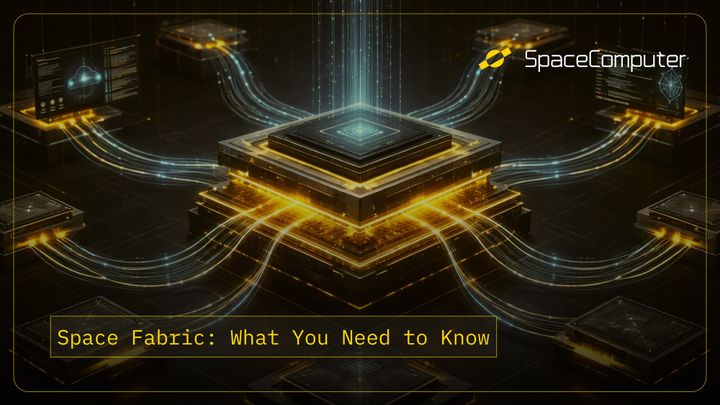
Space Fabric lets partners integrate secure software, protocols, cybersecurity services, and hardware (TPM, TEE, HSM, secure elements) alongside essentially any payload, while adding processing power. That gives sovereign satellites protected compute, and onboard a satellite bus, it supports multi-tenancy computing for several customers on one spacecraft.
Depending on the architecture, the integration can be a complete payload on its own, or a processing component of an existing operating system. Space Fabric can be integrated before launch, providing the next generation of secure satellite systems with the ability to host sensitive workloads with clear trust boundaries.
KMS gives AI agents guardrails for using cryptographic keys
Our Key Management Service was the other live demo at the booth, and it's the part of the stack anyone can test today. AI inference and agentic applications need to sign, encrypt, and reach sensitive data on their own, which makes handing them raw keys a real risk. KMS lets teams set measures, guardrails, and hierarchies for how agents use keys: an application requests a signature, and the service checks whether that request is allowed before carrying it out.
We'll provide this for agents through an MCP server in the coming weeks, first available locally, with more updates to follow.

The public beta runs on Earth and is experimental, and its architecture is built to be compatible with and deployable on our upcoming orbital payloads. Explore our KMS solution and roadmap, then create an account to start testing.
Our first demonstration mission takes this stack toward orbit in early 2027
We left Mountain View with KMS, hardware, and software integration conversations to follow up on, and our next stop for 2026 is Web Summit in Lisbon this month. Check out Filip's talk at Web Summit here.
The bigger mission milestones are coming in early 2027, when our first demonstration mission starts moving this stack from a booth in Mountain View to orbit, and the fingerprint visitors tested on a printed photo moves a step closer to data captured in space. We can't wait to share more with you of what’s coming next.

Follow along on X and LinkedIn as we get closer to launch.
SpaceComputer is building sovereign compute and secure communications infrastructure for the Space Internet.
Space is evolving from isolated missions into shared infrastructure. We're bringing technologies established in terrestrial computing, confidential execution, hardware-rooted security, cryptographic attestation, and key management, into space. Our goal is to make orbital compute and communications accessible as secure, interoperable services, without requiring every customer to build and operate their own satellite infrastructure.
Visit our website for more information.