

What is a Key Management Service?
In 2025, developers pushed 28.65 million new hardcoded secrets to public GitHub repositories, a 33.9% jump from the year before, while leaked credentials for AI services rose 81%.
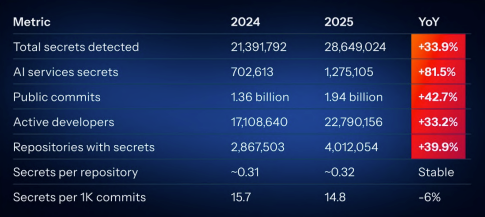
Each of those secrets is a password, token, or key sitting where anyone who reads the code can copy it, and keeping keys out of places like that is exactly what a key management service is built to do.
What Is a Key Management Service?
A key management service (KMS) is a system that generates, stores, and controls access to the cryptographic keys used to encrypt, decrypt, and sign data. Applications ask the KMS to perform those operations, and the keys themselves stay inside the service.
Most teams first meet a key management service through their cloud provider, such as AWS KMS. The principle holds wherever a KMS runs: keys live in one protected place, and every use of them goes through rules you define. The keys a KMS manages range from symmetric keys that encrypt databases to the private signing keys that prove who produced a piece of software or a transaction.
For reference, these are the 'key' differences between secret keys and signing keys:
| Feature | Secret Key | Signing Key |
|---|---|---|
| Primary Purpose | General encryption, decryption, or symmetric authentication. | Proving data origin, authenticity, and preventing tampering (integrity). |
| Symmetric vs. Asymmetric | Always symmetric (the same key is shared for both operations). | Can be symmetric (shared secret) or asymmetric (private key for signing, public key for verifying). |
| Visibility of Counterpart | No counterpart; the same secret does all the work. | Often paired with a public verification key distributed to the public or clients. |
| Use Case Example | Database passwords, API credentials, or encrypting data at rest. | Signing JSON Web Tokens (JWTs), SSL certificates, or Git commits. |
A Key Management Service Handles Every Stage of a Key's Life
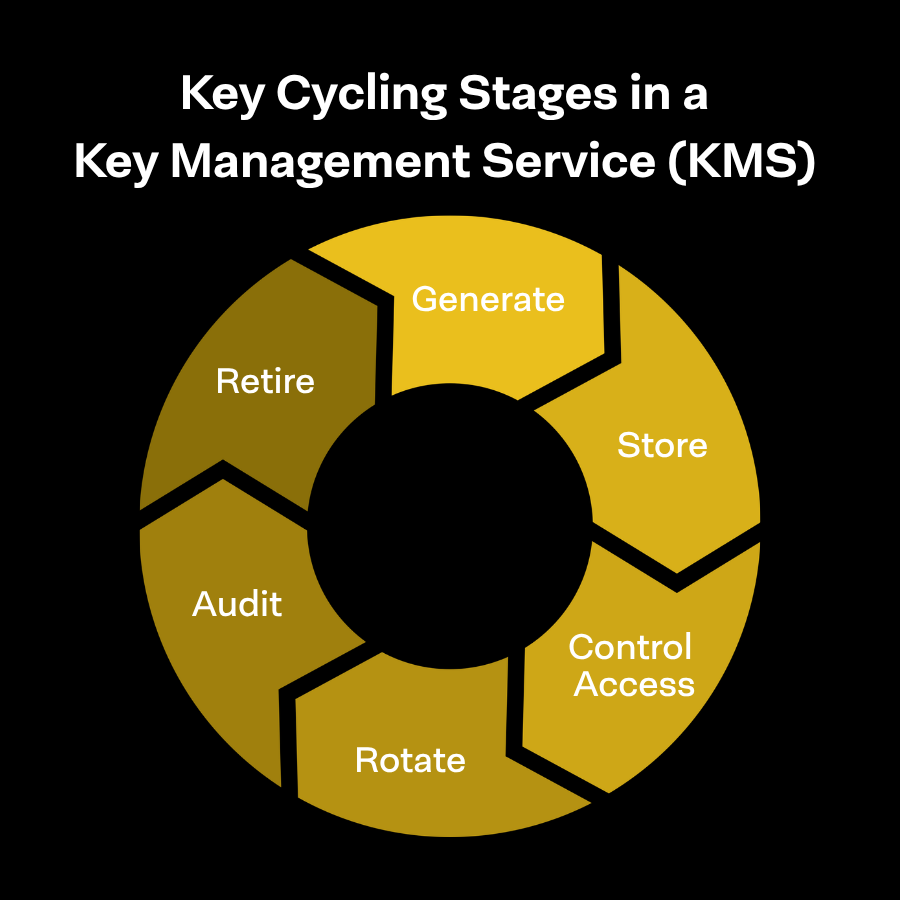
Every cryptographic key goes through a lifecycle, and a KMS automates each stage so none of them depend on someone remembering to do it:
- Generate: the KMS creates keys from strong randomness inside the service, so nobody has to make a key on a laptop and move it somewhere safe afterward.
- Store: keys are kept in protected hardware or encrypted storage, usually in a hierarchy where higher-level keys protect the ones below them.
- Control access: policies decide which people, applications, and services can use each key, and for which operations.
- Rotate: keys are replaced on a schedule, which limits how much data any single key protects and how long a stolen key stays useful.
- Audit: every use of every key is logged, giving security teams a record of who did what and when.
- Retire: keys that are no longer needed are disabled and destroyed.
Retirement is the stage teams skip most often. GitGuardian's same report found that 64% of valid secrets leaked in 2022 could still be used in 2026, which is what happens when nobody owns the end of a key's life.
A Key Management Service Lets Applications Use Keys Without Holding Them
The defining feature of a KMS is that applications send it requests instead of reading the key. To encrypt a customer record, an application sends the data to the KMS, the KMS encrypts it inside its protected boundary, and the application gets the encrypted result back. Signing works the same way: the application sends a message or transaction and receives a signature it can publish.
Because the key never leaves the service, an attacker who compromises an application server can only make requests while they're inside, and access policies limit those requests while the audit log records them. They don't walk away with a copy of the key that works indefinitely.
Most KMS designs also use a key hierarchy. Data is encrypted with data keys, data keys are encrypted with key-encryption keys, and the chain ends at a root key that stays in the most protected layer. Revoking a key high in that chain cuts off access to everything beneath it, and rotating one means re-wrapping the data keys it protects rather than re-encrypting every file.
For signing keys, where a key is generated matters as much as where it's stored, which we cover in What Is a Signing Key?
Common Uses for a Key Management Service
Encrypting databases and cloud storage: a KMS holds the keys that protect customer records, backups, and files, so a stolen disk or database dump is unreadable without access to the KMS.
Signing software and transactions: publishers sign software updates so devices only install genuine releases, and web3 teams sign blockchain transactions without keeping a wallet's private key on an application server.
Giving AI agents credentials without the plaintext: agents that call APIs and services need credentials, and a KMS can grant them scoped, time-limited access, which contains the damage if an agent is compromised or misbehaves.
Proving how keys are handled: access policies and audit logs give security reviews and compliance audits a clear record of every key and every use.
Why Key Management Matters More in 2026
Two shifts are putting key management at the top of security roadmaps. The first is the growth of non-human identities: every AI agent, CI/CD pipeline, and integration needs its own credentials, and the AI-service leak numbers above show how quickly those spread without a central system managing them.
The second is the move to post-quantum cryptography. NIST published its first post-quantum cryptography standards in 2024, and adopting them means finding every quantum-vulnerable key, generating replacements, and rotating the old keys out. Organizations using a KMS can make that change in one place, while those without one have to hunt keys down across every application. We break this down in Post-Quantum Migration Is a Key Management Problem.
SpaceComputer's Key Management Service Public Beta Is Live
Soon, SpaceComputer is launching a public beta Key Management Service. Developers can store, retrieve, list, and delete secrets through our API, alongside encryption (transit) operations and Ethereum signing. Keys are non-exportable by design, so applications use them without ever receiving them.
For teams building with AI agents, an orchestrator agent can hand worker agents time-limited, wrapped secrets within a single account, so workers complete their tasks without ever holding the plaintext credential.
The beta is the first stage of a roadmap that moves from hardware-attested infrastructure on Earth to threshold cryptography across multiple parties, and eventually to keys generated in orbit. Cofounder and CTO of SpaceComputer Filip Rezabek lays out that roadmap in Secure Key Management Services Beyond the Cloud.
Create an account at accounts.spacecomputer.io to start building.
Frequently Asked Questions
Is a key management service the same as Windows KMS activation?
No. Microsoft uses "KMS" for a Windows volume licensing service that activates Windows across an organization's machines, and it's unrelated to cryptographic key management.
Does a key management service store my data?
Usually not. Your data stays in your own database or storage, and the KMS stores the keys, encrypting or decrypting data (or the data keys protecting it) when an authorized application asks.
Do I need a KMS if my cloud provider already offers one?
A cloud provider's KMS works well for data that lives inside that cloud. Teams working across multiple clouds, signing on-chain transactions, or running agents across services often want key management that isn't tied to a single provider.
What's the difference between a KMS and an HSM?
A hardware security module (HSM) is a physical device built so keys never leave it in plaintext, while a KMS is the service layer that manages keys and their policies, often with HSMs underneath. We cover HSMs alongside other security hardware in our post on the hardware behind SpaceComputer satellites.
SpaceComputer is the open, credibly neutral infrastructure layer that connects the space economy, providing the hardware and software standard for verifiable compute across operators, jurisdictions, and satellites, with high security guarantees and verifiability.
Visit our website to learn more about our Key Management Service.
Follow us on X (Twitter) and LinkedIn.