SpaceComputer and Aptos Orbital Technical Integration: A D-Orbit Rideshare Mission to Demonstrate Shared Confidential Compute in 2027

We’re announcing our third 2027 mission, a partnership with California-based Aptos Orbital to bring secure, verifiable compute to a shared satellite. It’ll be the second of our three missions to fly in 2027, and our first focused on low Earth orbit (LEO). Space Fabric, our security-first hardware and operating system for satellite computing, will be connected with Aptos Orbital’s cEDGE communication box and flying alongside other payloads on a D-Orbit rideshare spacecraft. The mission is a step toward securing multi-tenant edge compute on satellite constellations.
Isolated missions to shared infrastructure
In space, you cannot assume every part of the system will remain secure for the lifetime of the mission. A neighbouring payload may be compromised, a host OS may be exploited, or the software stack may change over time.
Today, operators still rely heavily on reputation, contractual agreements, and physical integration to establish trust between payloads, platforms, and end customers.
Space Fabric creates cryptographic trust boundaries around individual workloads, and it’s designed to be verifiable and tamper-resistant, so customers don’t have to assume trust in the operator, vendor, other payload, or SpaceComputer itself. It combines trusted execution environments (TEEs), isolated areas of a computer where code and data stay protected from the rest of the system, with workload isolation, a secure runtime, and remote attestation. Operators can isolate sensitive code and data, verify what software is running, measure the state of the system against expected software and Software Bill of Materials (SBOM) information, and provide provenance for where and how data was processed.
On this mission, we will start by demonstrating confidential compute, workload verification, and secure software lifecycle in orbit, communicating through Iridium and S-band links, with cryptographic attestation showing users the environment their workloads are running in. As the mission matures, we will open these services to other operators aboard the spacecraft, moving from our own workloads to shared confidential compute.
These capabilities support applications such as an AI company protecting its model weights on a shared satellite while proving where inference ran, or an Earth observation customer checking that its data hasn’t been tampered with before acting on it.
The Technical Integration
We designed Space Fabric’s hardware and OS to integrate with third-party space infrastructure before launch. On this mission, Space Fabric runs on our own compute hardware, while cEDGE serves as a communications proxy into the Iridium constellation.
This setup lays the groundwork for routing workloads from other cEDGE-connected satellites to Space Fabric, a capability we aim to validate during on-orbit operations. On the ground, we will interact with the cEDGE Gateway, the cloud service operated by Aptos for command & control.
As a result, our communications will have near-continuous connectivity beyond traditional ground station passes, giving us far more time in each orbit to operate and test Space Fabric, with the goal of multi-constellation deployments in the future.

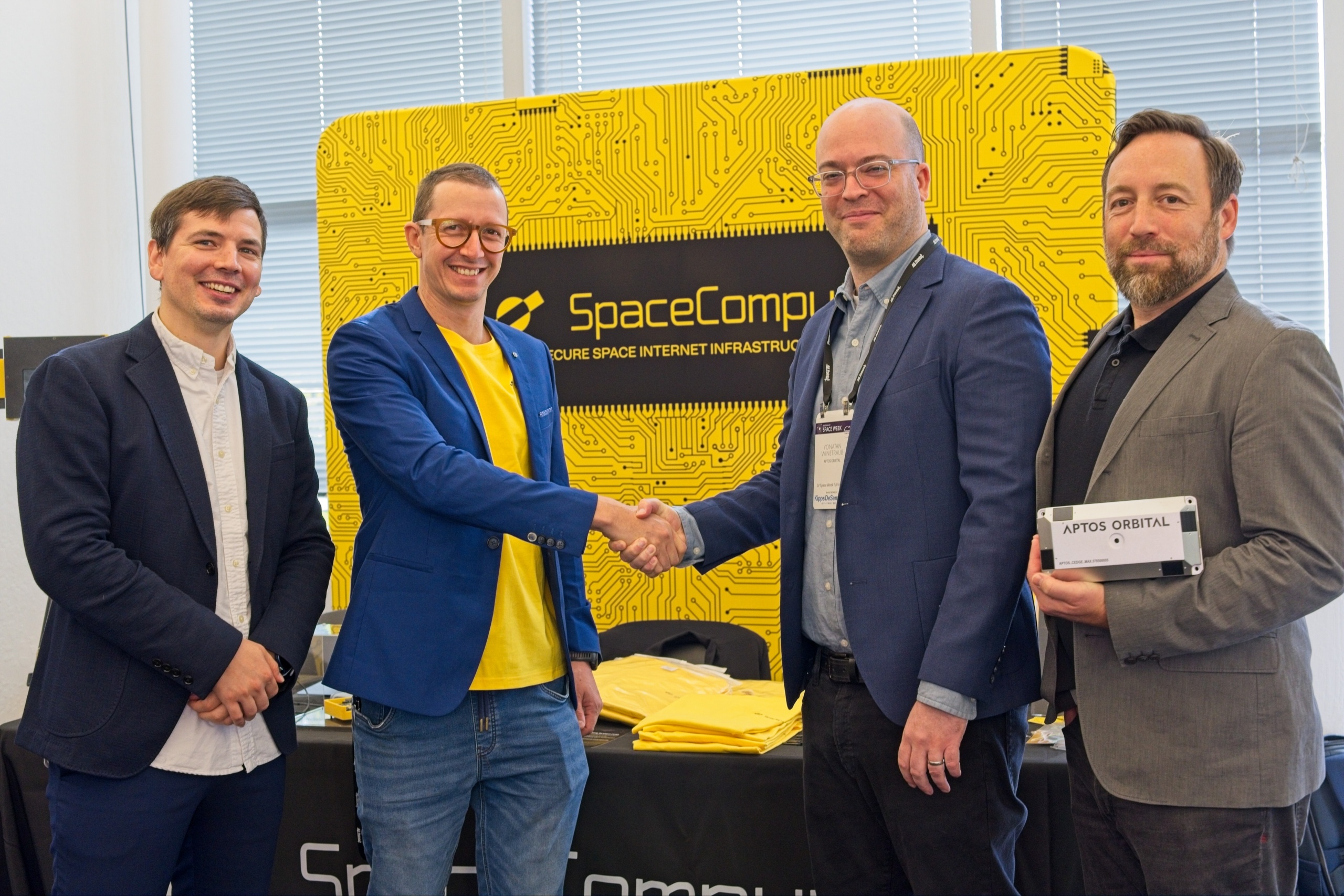
"Scaling the digital space infrastructure includes solutions that enable strong data provenance visibility, secure communication and secure compute. The Space Fabric hardware brings security that can lead to an increase in utility of every satellite,"
said Daniel Bar, Co-Founder and CEO of SpaceComputer.
“Aptos is excited to partner with SpaceComputer on the mission to operate secure hardware that enables 3rd parties to share resources as it’s done on terrestrial cloud. Aptos Orbital has been pioneering in-space comms and edge compute and we’re excited to partner with SpaceComputer to take a step and toward orbital data centers,”
said Yonatan Winetraub, Founder of Aptos Orbital.
This mission gives us flight experience integrating with partner spacecraft systems as orbital infrastructure scales. The same architecture can support shared satellite buses, sovereign satellites, and future orbital data centers, bringing confidential compute and satellite cybersecurity services to more spacecraft.
Read the exclusive press release on this mission by Payload here:
 Douglas Gorman
Space is evolving from isolated missions into shared infrastructure that will form the space internet. But unlocking this transition requires solving three fundamental challenges: scalability, interoperability, and verifiable trust.
SpaceComputer is building sovereign compute, confidential execution, and cryptographic security into space. Our goal is to make orbital compute and communications accessible as secure, interoperable services, without requiring every customer to build and operate their own satellite infrastructure.
Learn more about Space Fabric at spacecomputer.io/spacefabric.
Try KMS, now in public beta on Earth, at accounts.spacecomputer.io.
Follow us on X (Twitter) and LinkedIn.