SpaceComputer featured in a Google Cloud case study on Orbitport, our secure space-to-ground gateway

Google Cloud has published a customer case study on how we built Orbitport, our secure gateway to orbital services, on Google Cloud Confidential VMs and Google Kubernetes Engine (GKE). The case study follows a few months of building and testing the system in real deployments as part of the Google Cloud Startup Program, and it shows confidential computing for satellites at work: operators and developers can verify the gateway they route commands through instead of taking whoever runs it at their word.
The gateway is where space-to-ground trust breaks down
Talking to a satellite has long meant working through fragmented, proprietary ground station interfaces. Orbitport unifies that access into one gateway between applications on Earth and infrastructure in orbit, which places it at the most sensitive point in the chain: translating terrestrial protocols such as TLS into space protocols such as CSP requires the data to sit exposed in memory at the gateway, so whoever operates that proxy becomes a highly privileged party.
A compromised command could permanently de-orbit a multi-million-dollar satellite, which gives operators good reason to hesitate before routing traffic through a third party they can't inspect. We designed Orbitport to replace organizational assurances with independent, mathematical verification, so a client can check the gateway itself before trusting it with a single command.
Why Orbitport runs on Google Cloud's Intel TDX Confidential VMs
We evaluated the confidential computing environments of the major cloud providers and chose Google Cloud because its Intel TDX implementation came closest to a native, bare-metal deployment while still running at cloud scale. Intel TDX creates an isolated trust domain inside the VM and encrypts its memory in hardware, so the data Orbitport translates stays protected from the host it runs on.
Google Cloud's Platform Provider ID (PPID) host provenance lets a client run a remote hardware attestation check before sending sensitive data, confirming that Orbitport runs on genuine Intel TDX hardware and that the physical host is part of Google Cloud, which turns our trust assumptions into something every user can verify for themselves.
"Google Cloud Intel TDX implementation is as close as possible to native deployments. Features like host provenance prove Orbitport runs on genuine TDX hardware inside Google Cloud, giving our clients complete confidence in our verifiable infrastructure."
Filip Rezabek, Co-founder and CTO, SpaceComputer
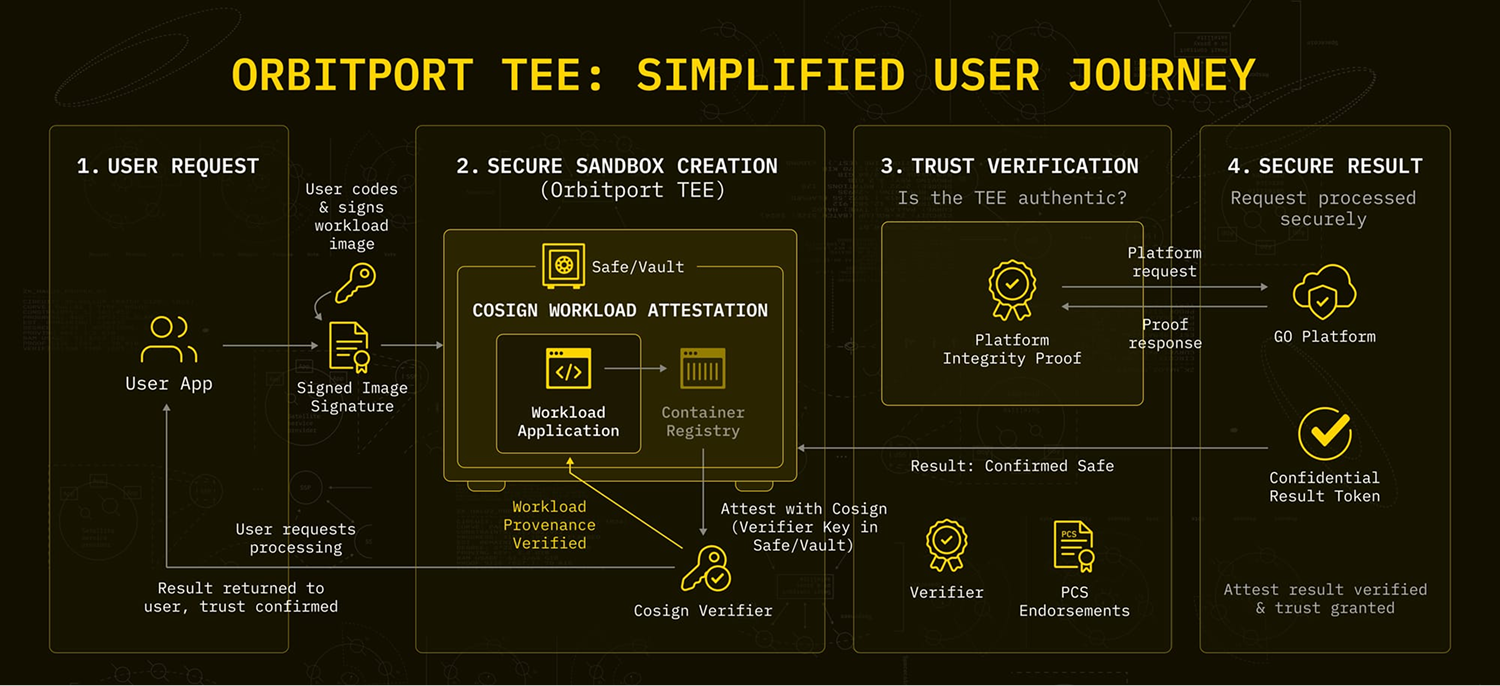
[Graphic placeholder: the Orbitport user journey in four steps, from the client's attestation check to command delivery during an orbital pass. Caption: How a client verifies Orbitport before sending data.]
How GKE keeps Orbitport online for every orbital pass
A satellite is only reachable for roughly 15 to 20 minutes per pass, and in that window Orbitport has to connect to the ground station, authenticate services, route commands and translate protocols without error, because a failed gateway can mean waiting hours for the next window. We use GKE to orchestrate the platform and manage our hardened Confidential VMs, and this setup maintains 100% gateway uptime during orbital passes.
Once a client's attestation check passes, GKE scales capacity for high-throughput traffic without adding cryptographic overhead to every byte. Managed GKE and Identity and Access Management (IAM) controls removed manual infrastructure debugging from our lean engineering team, and abstracting satellite integration into simple APIs cut bespoke integration timelines from weeks to a single weekend.
"Google Cloud lets a lean team consume mature infrastructure (Confidential VMs, GKE, IAM, and KMS) rather than rebuilding it. That gives us immense leverage to focus on space security architecture rather than managing underlying servers."
Filip Rezabek, Co-founder and CTO, SpaceComputer
Orbitport's next step is post-quantum TLS with hybrid ML-KEM + ECC
Next on the Orbitport roadmap is post-quantum protection for its TLS connections, using hybrid ML-KEM + ECC built on NIST-standardized cryptography. The hybrid approach keeps the gateway cryptographically agile and guards against "harvest now, decrypt later" attacks, where an adversary records encrypted traffic today to decrypt it once quantum computers can break classical key exchange.
Read the full case study and explore the Orbitport architecture
The Google Cloud case study goes deeper into the gateway's design, including the four-stage Orbitport user journey. To see how Orbitport works under the hood, read the Orbitport architecture docs, and for where the gateway fits in the bigger picture, see our breakdown of the six layers of space internet infrastructure.
Space is evolving from isolated missions into shared infrastructure that will form the space internet. But unlocking this transition requires solving three fundamental challenges: scalability, interoperability, and verifiable trust.
SpaceComputer is building sovereign compute, confidential execution, and cryptographic security into space. Our goal is to make orbital compute and communications accessible as secure, interoperable services, without requiring every customer to build and operate their own satellite infrastructure.
Learn more about Orbitport at spacecomputer.io/solutions.
Follow us on X (Twitter) and LinkedIn.